MU-Penguins 2010 Team Description
David Jahshan
Department of Electrical and Electronic Engineering, The University Of Melbourne
Abstract Since MU-Penguin's last appearance at Robocup in 2005, the robots have undergone a major redesign. The robot's diameter has been increased by 10cm and the laptops have been replaced with an nano ITX motherboard. These modifications have increased the stability of the robots. Further the software has been redesigned from the ground up. Webcams have been replaced with high performance 60Hz 720 by 576 CCD cameras utilising real time FPGA based image processing algorithms. The 360 degree rotatable arm has been improved with finer control for more accurate positioning to assist in intercepting balls.
1 Introduction
MU-Penguin's primary aim is to develop robust robotic platforms to be used in more fundamental control and distributed computing research.
2 Hardware
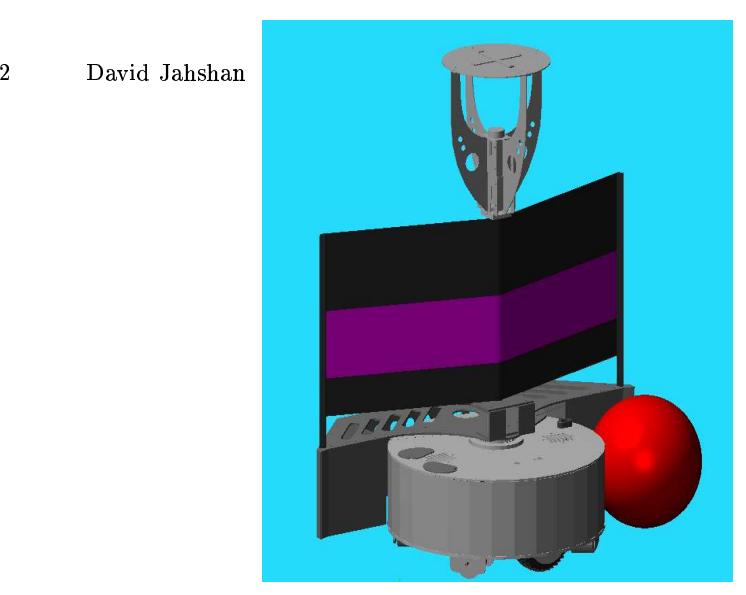
The robots consist of a custom made chassis, a ball handling device and an electrical payload.
2.1 Chassis
From the bottom up, under the robot is an 8Ah 14.8V 15C Lithium polymer battery. A 5mm sheet aluminium 40cm diameter base plate has four omnidirectional castors mounted equally spaced around the edge. There are a number of PCBs mounted to the base plate. On the underside there are 8 line sensors. On the top side the main board houses the motor control electronics and the Cyclone III FPGA vision processor. Next to the base board is the main processor, a VIA EPIA-NX1500G nano ITX motherboard. On the opposite side of the base plate is an 802.11a bridge. Two 10mm aluminium uprights also attached to the base plate support the motors, pulley system and the drive wheels. A 3mm sheet aluminium 40cm diameter top plate is then used to sandwich a 3mm foam coated tube of High Density Polyethylene to form the outer shell. From the top plate an 20mm extruded aluminium tube is mounted vertically as a centre pivot
' ( 7 2 KL & .9 ,& 4 # '8 ' $ ,+ # 4 " # +1 ! *" $ (' #%
w q k p v k ut ¦§ y k w wm p pk s ur k l s t ¨ ut l p q y s s k t p k s w u q q mq k ut w sr t x q © w w wk uk p s k s q © y k w
ª ± ª º · ® wt s t x s pk k q t s t p pk wt s p t u uk vr ¼ k uk ws pt w ¼j i ¦ § xm u ur s k l p s k i p l k q t s t p wt s pt u uk p y k q t s t p wt s p t u uk p p k wt m o uk s t sq k u g q w pt w t s t u uk p ¦ § y o s w u k wt k p s s w k
½ ¸ · º ³ ± º · ® ¾ ¿ ª · ® ¯ ± k q o pt wk t p j t psq k s t x © k o k w s k t j y s s w k s t s k q t s k pv t p t p
 º ¸ · º ³ ± ¯ ª º · ® w t s t x us k p r w ut k j à ¦¥ § i Ä ¥ À Ä vr ĥ w q k p ¦Ä § m k s t w o sm p k q l k tÅ
Çb È`} | a ~
o pt l p q s s t t k s l k u u ¦ § y w s ¨ pm kq t o p t wk y w
~ È~ a ~ _ e ~ Ë
- = A [ A 7 " # Ì9 4 / L A Í ,% " A Î > Í ' + " * ,Y " $ ,' & 7 $1 ' (' # " 4' + + # N ' 8 ' $ 9 4 ,& . " : ,4 ,'& K Ï " 4 - 6% & ,K- ,# + $ ,'& " * 4 & 4' # A L # ' + - ,& . 4 ' ( N ' 8 ' +9 ! O < < < V ' # *- [ 9 ! R: / L AJ$ '& / 0 AÏ " *+1 / \ AÐ # " $ Y 4 +1% " # A
- O A 7 ,Ñ \ "& + " # Y Î 0 1 2 & ,Ò L 1 , *' 4' ! 15 A ,. ,$ " * L # 4 4 Ó + % 8 # = / =Ô Ô Õ Ö
- ; A J0 : × X O JL ; < K) > 9 $ '% ' $ ,3 (9 * *5 ,& $ . # " $ X K8 # ,- . % ' $ ' # # ,3 # / 1 $ $! ÎØ ØQ Q Q A4 $ A+ '% Ø 4 $ ' & * ,& Ø8 ' ' Ñ 4 Ø! - ( Ø- ' + 4 Ø =< Ù ; O A! - (
- Õ A > $% * >0 7 ) \ > =O Ù % ,+ # ' +' & $ # ' * * # / Q Q Q A" $% * A+'% Ø " $% *Ø " + # ' 8 " $ Ø- ' + OÕ W Z A! (
- P A > *$ # " [ 5 + *' & R R R U L \ > ( "% , *5 / Q Q Q A" *$ # " A+ '% Ø! # ' 9 + $ 4 Ø- 3 ,+ 4 Ø +5 + *' & ; Ø+5 ; K
- W A " , [: K> Z <[ Í 1 $ $! ÎØ ØQ Q Q A? " , A+'% Ø)× Ø[ "% # " J' *9 $ ,' & 4 ØL # ' -9 + $ 4 ØL " . 4 Ø[ : K > Z <[ Í A" 4!Ò