NuBot Team Description Paper 2011
Huimin Lu, Zhiwen Zeng, Xiabin Dong, Dan Xiong, Shuai Tang, Wentao Yu, Hui Zhang, Xun Li, Zhiqiang Zheng
College of Mechatronics Engineering and Automation, National University of Defense Technology, China, 410073
http://nubot.nudt.edu.cn · http://www.nubot.com.cn
Abstract This paper presents the developments of our middle-size league robot team "NuBot" for RoboCup 2011. The robot platform, active ball handing system, and robot's distributed motion control system are introduced in hardware; ball velocity estimation algorithm, camera parameter auto-adjusting algorithm, arbitrary ball recognition based on omnidirectional vision, and trajectory tracking based on model predictive control are proposed in software algorithms.
Introduction
The middle-size league competition of RoboCup which obtains more and more attention provides a standard test-bed where many technologies of robotics and artificial intelligence can be examined and integrated.
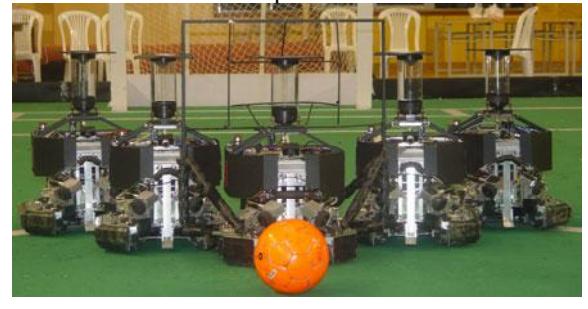
NuBot (Fig. 1) is the RoboCup Middle Size League team of National University of Defense Technology. This team was founded in 2004. Since 2006 we have continuously participated in five World RoboCup competitions and entered into the top 8 from 2007 to 2009, and the top 6 in RoboCup 2010 Singapore. We have also participated in RoboCup China Open and won the 1st-place from 2006 to 2008, the 3rd-place in 2009 and the 2nd-place in 2010. Now our research focuses are on multi-robot cooperation, robust robot vision, robot control, etc.
This paper describes the recent developments of NuBot for RoboCup 2011.
The Robot Platform and Active Ball Handling System
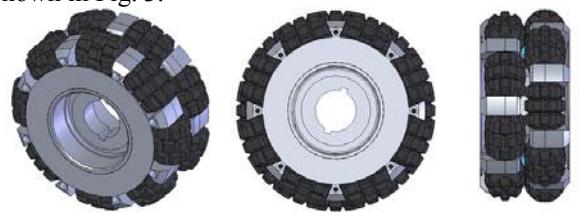
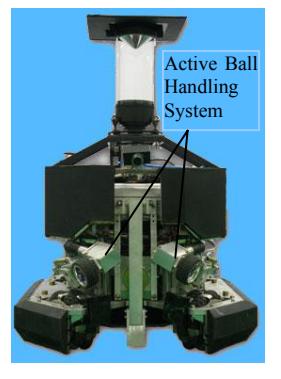
After RoboCup 2009 Graz, we have developed a totally new robot platform, as shown in Fig. 1 and Fig. 3. The motion ability especially the acceleration can be improved greatly comparing to our former robots. We also design a new omnidirectional wheel, as shown in Fig. 2. This wheel can provide more friction than our former wheels. More details can be found in our mechanical and electrical description materials.
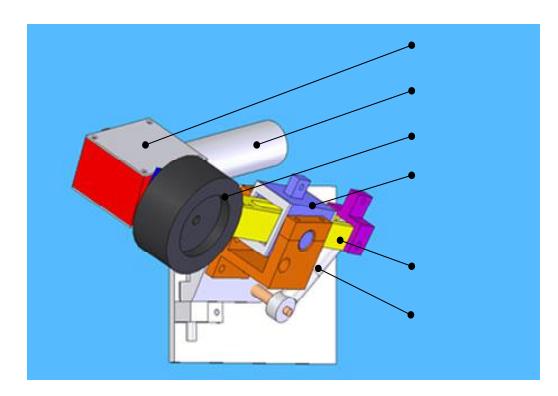
The active ball handling system, which is designed for dribbling the ball, is made up of the active ball handling mechanism and its control system. The ball handling mechanism is shown in Fig. 3.
The main parts of our active ball handling mechanism are wheels (one at each side), DC motors, axis, spring and the parts using to limit the rotation angle of the axis. When the robot is dribbling, the spring keeps pressure between the wheels and the ball, and the wheels driven by the DC motors provide frictions to make the wheels keep in touch with the ball. The control architecture includes two levels. On the lower level, the velocity of the wheels is controlled by DSP. On the higher level, the PC decides when the active ball handling system works. In comparison with the passive ball handing mechanism used before, the active ball handling mechanism has three advantages: firstly, it introduces the opportunity to drive the ball not only forward, but also at any direction, which makes path planning easier. Secondly, the robot could stop the ball at any place, which is useful when the robot is dribbling near the corner and sideline. Thirdly, the robot is capable to grab the ball from the opponent robot with the mechanism. We will further our research on the following issues: ameliorating the mechanism, improving its reliability, enhancing the adaptability to the dynamic environment, and optimizing path planning based on the active ball handing system.
The Robot's Distributed Motion Control System
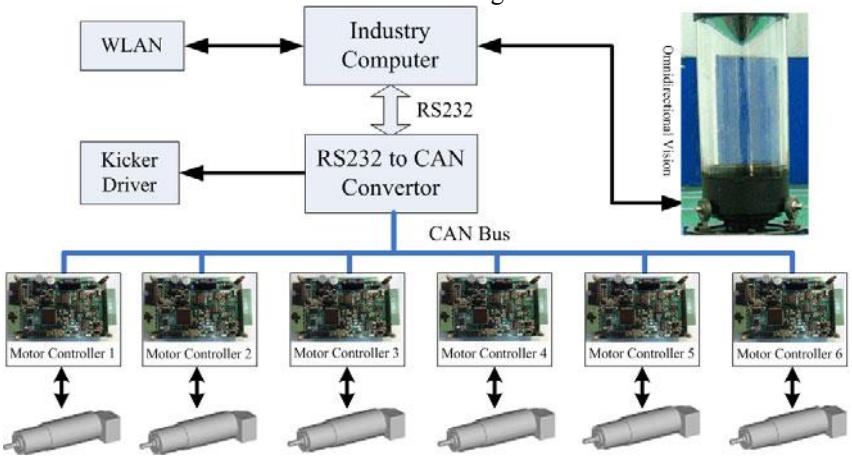
The electrical circuits system of our robots can be divided into three modules: the DC motor control module, the shooting module and the module of RS232 to CAN convertor, as shown in Fig.4. In comparison with our former system [1], the biggest change is that motion control turns to be distributed, which means that each motor has an independent controller. The module of RS232 to CAN convertor and the DC motor control module are mainly built upon TMS320F2808 DSP. TMS320F2808 DSP is the core IC of these two modules, which takes charge of the realization of motion control algorithms, data processing, PWM signal producing, AD input receiving, communication with each other and PC, and so on. The motor control module is designed in the form of H-bridge including four MOSFET and a special driver IC. Two close loops, namely the speed loop and the current loop, are used in the motor control module, so it can control a DC motor independently. The shooting module, also named as kicker driver, is mainly composed of a relay and an IGBT FGA25N120ANTD. The module of RS232 to CAN convertor is mainly composed of a TMS320F2808 DSP and some communication interface IC. It is responsible for communicating between the industry PC and the motor control module and the shooting module.
Ball Velocity Estimation Algorithm
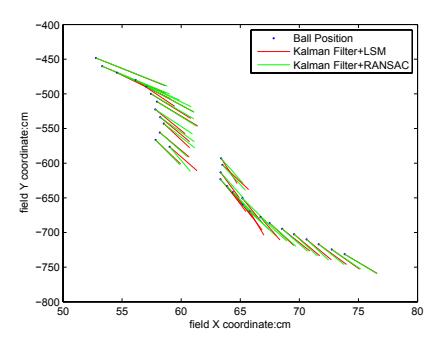
We develop a novel method to estimate the velocity of the ball. The method is based on Kalman filter and RANSAC algorithm. Firstly we restore several cycles of the ball position and use Kalman filter to smooth these positions. Then we calculate all the possible velocities between every two cycles. After that we randomly choose several possible velocities and calculate the average velocity as a possible velocity model. We build hundreds of models and finally apply RANSAC algorithm to calculate the best velocity model as the final ball velocity. RANSAC algorithm can effectively eliminate the outliers, so when the ball positions are not accurate enough, the velocity can still be estimated accurately by our algorithm and the variation of the velocity can also be detected quickly. The results of ball velocity estimation by Least Squares Method (LSM) [2] and our algorithm are shown in Fig. 5.
Camera Parameters Auto-Adjusting Algorithm
The final goal of RoboCup is that robot soccer team defeats human champion, so robots will have to be able to play competition in highly dynamic lighting conditions even in outdoor environment sooner or later. So designing robust vision system to recognize color-coded objects is still a research focus in RoboCup community. Besides adaptive color segmentation methods, color online learning algorithms, and object recognition methods independent on color information, several researchers also have tried to improve the robustness of vision sensors by adjusting camera parameters in the image acquisition [3, 4, 5, 6] to make the acquired image describe the environment as consistently as possible.
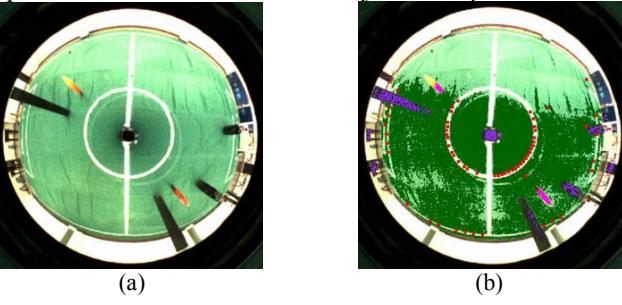
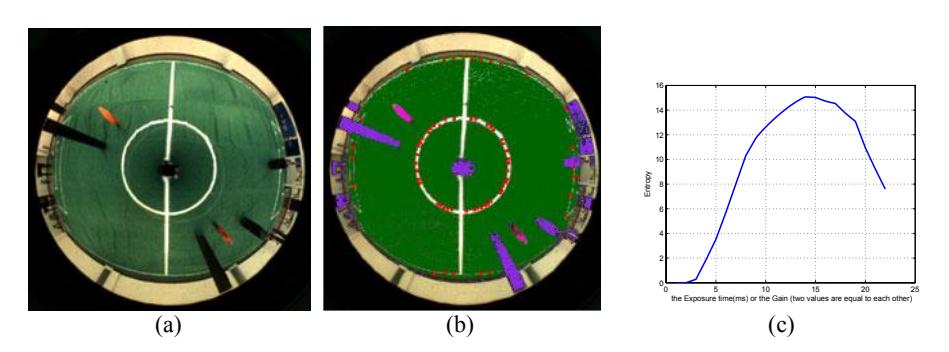
We develop a novel camera parameters auto-adjusting method based on image entropy [7][8]. Firstly we present the definition of image entropy, and use image entropy as the optimizing goal for the optimization problem of camera parameters after verifying that image entropy can indicate whether camera parameters are properly set by experiments. Then a searching path is defined in the parameter space to search the maximal image entropy, and the camera parameters corresponding to the maximal image entropy are the best ones for robot vision in the current environment and the current lighting condition. This method makes robot vision system adaptive to different lighting condition. The algorithm was tested using our omnidirectional vision system [8][9] in indoor MSL environment and outdoor RoboCup-like environment, and the results show that our algorithm is effective and color constancy to some extent can be achieved. The results of an experiment in indoor environment are shown in Fig. 6 and Fig. 7. When the lighting condition changed and camera parameters had not been optimized, the acquired image and the processing result are shown in Fig. 6. It is obvious that the image is over-exposed and the processing result is unacceptable for robot vision. After the parameters had been optimized, the image is well-exposed and the processing result is also good, as shown in Fig. 7. Our algorithm can also be applied in perspective vision and extended to adjust more parameters like iris etc [10].
Arbitrary Ball Recognition Based on Omnidirectional Vision
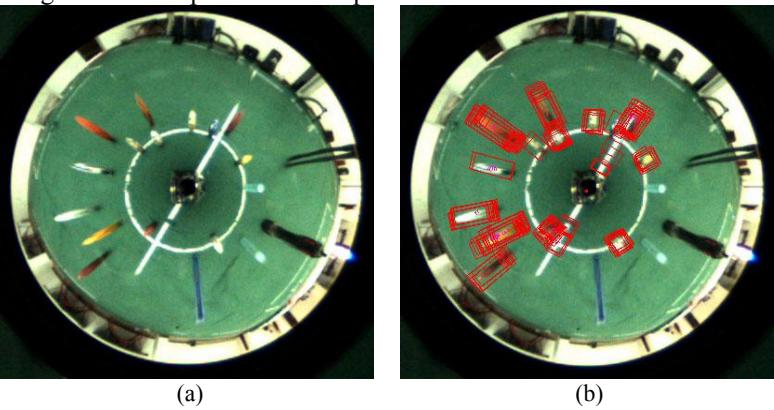
Recognizing arbitrary standard FIFA ball is a significant ability for RoboCup Middle Size League soccer robots to play game without the constraint of current color-coded environment. An arbitrary FIFA ball recognition algorithm based on our omnidirectional vision [8][9] and AdaBoost algorithm [11] is developed. The recognition algorithm includes two phases: the off-line training phase and the on-line recognition phase. In the off-line training phase, dozens of panoramic images which contain different kinds of arbitrary balls are acquired by our omnidirectional vision system. Then sub-images including the ball or not are extracted from the panoramic images, and used as the positive samples or negative samples of the training set. Then the Haar-like feature vectors are calculated from each sub-image of the training set, and are combined as a feature matrix. Finally, a classifier is generated with the feature matrix as the input of the AdaBoost learning algorithm. In the on-line recognition phase, a series of rectangle windows are defined along the radial direction of the panoramic image. According to the imaging characteristic of our omnidirectional vision, the lengths of the rectangle windows vary along the radial direction of the panoramic image. Then the whole panoramic image is searched by these rectangle windows along both the rotary and radial direction. Finally, the learned classifier is applied to classify these rectangle windows, which means the classifier judges whether the window contains a ball or not. The experimental results show that arbitrary FIFA balls can be recognized effectively with our algorithm. A typical panoramic image and the ball recognizing result is shown in Fig. 8. With this algorithm, NuBot team won the 3rd place in the technical challenge of RoboCup 2010, and the champion in the technical challenge of RoboCup 2010 ChinaOpen.
Application of MPC for Trajectory Tracking
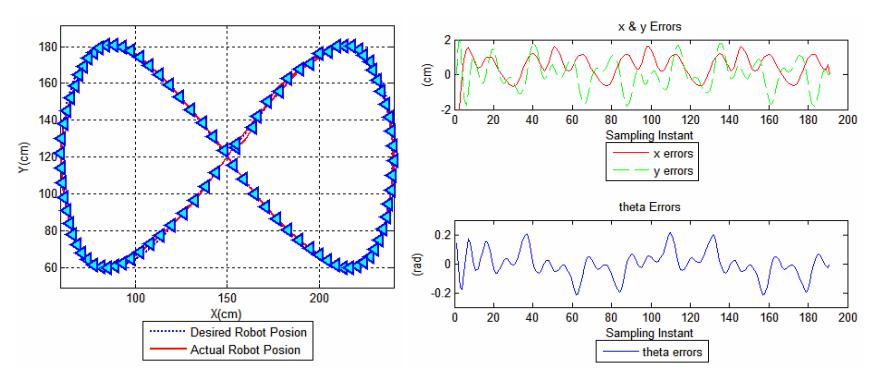
In our recent research, we use Model Predictive Control (MPC) which can easily take constraints into account and utilize the future information to get current control inputs [12], to solve the path following and trajectory tracking problem for our robots. First, the linear full dynamic error model has been developed for the system description, which is based on the kinematics model of the robot, and then MPC is employed to design the control law to satisfy the kinematics constraints and dynamics constraints. In order to reduce the computation cost of MPC for the on-line application, the Laguerre Networks is used in designing the MPC control law [13]. The simulation results show the robot can track the path/trajectory with higher speed, quick dynamic response and low tracking errors with our algorithm, as shown in Fig. 9, so the motion ability and the obstacle avoiding ability of our robot can be improved.
Current Research Focuses
Our current main research focuses are listed as follows:
Robust robot vision: Soccer robots will have to be able to play games in outdoor environments and get rid of the color-coded environment sooner or later. We will go on developing our robot vision system to make the robot work well in the environment with highly dynamic lighting conditions and even in totally new field without any off-line calibration. We are also doing further research on arbitrary FIFA ball recognition with our omnidirectional vision system. We are also interested in recognizing and distinguishing the robots belonging to different teams and other generic objects by using the advanced pattern recognition techniques.
Multi-robot cooperation: Multi-robot cooperation holds an important place in distributed AI and robotics field. We have designed a good multi-robot cooperation mechanism and also realized several two-robot cooperative behaviors [14]. Now we have to do deeper research to develop our robot's cooperation ability by involving more robots and more complex cooperative behaviors in this mechanism.
Multi-robot cooperative perception: As the MSL environment becoming more and more complex and the field larger and larger, for the field of view of every robot is limited, the occlusion of important objects such as the ball is very common in the highly dynamic game, and the inconsistent world model of every robot brought by perception noises will also affect team's strategy. So we are interested in building a global, accurate and consistent world model of multi-robot team by cooperative perception such as cooperative object localization and robot's cooperative localization.
Conclusion
This paper describes the current developments of the NuBot team as follows: robot platform, active ball handling system, and robot's distributed motion control system in robot hardware; ball velocity estimation algorithm, camera parameters autoadjusting algorithm, arbitrary ball recognition based on omnidirectional vision and application of MPC for trajectory tracking in robot software. Our current research focuses are also presented finally.
Acknowledgement
We would like to thank Dan Hai, Xiangke Wang, Junhao Xiao, Shaowu Yang, Shengcai Lu, Peng Dong, Dengke Zhu, Yong Li, Ying Qu, Lin Liu, Fei Liu, Xiucai Ji, Yupeng Liu and Wei Liu for their cooperation to establish and develop our RoboCup MSL soccer robot team-NuBot.
References
- Zhang, H., Lu, H., Ji, X., et al.: NuBot Team Description Paper 2007. In: RoboCup 2007 Atlanta, CD-ROM (2007).
- Lauer, M., Lange, S., and Riedmiller, M.: Modeling moving objects in a dynamically changing robot application. KI 2005: Advances in Artificial Intelligence, pp. 291-303 (2005).
- Grillo, E., Matteucci, M., and Sorrenti, D.G.: Getting the most from your color camera in a color-coded world. RoboCup 2004: Robot Soccer World Cup VIII, pp. 221-235 (2005).
- Takahashi, Y., Nowak, W., and Wisspeintner, T.: Adaptive Recognition of Color-Coded Objects in Indoor and Outdoor Environments. RoboCup 2007: Robot Soccer World Cup XI, pp. 65-76 (2008).
- Lunenburg, J.J.M., Ven, G.V.D.: Tech United Team Description. In: RoboCup 2008 Suzhou, CD-ROM (2008).
- Neves, A.J.R., Cunha, B., et al.: Aotonomous configuration of parameters in robotic digital cameras. In: the 4th Iberian Conf. on Pattern Recognition and Image Analysis, ibPRIA 2009 (2009).
- Lu, H., Zhang, H., et al.: A Novel Camera Parameters Auto-Adjusting Method Based on Image Entropy. RoboCup 2009: Robot Soccer World Cup XIII, pp. 192-203 (2010).
- Lu, H., Yang, S., Zhang, H., et al.: A robust omnidirectional vision sensor for soccer robots. Mechatronics, 2010, doi: 10.1016/j.mechatronics.2010.06.007.
- Lu, H., Zhang, H., et al.: Arbitrary Ball Recognition Based on Omni-directional Vision for Soccer Robots. RoboCup 2008: Robot Soccer World Cup XII, pp. 133-144 (2009).
- Lu, H., Zhang, H., et al.: Camera Parameters Auto-Adjusting Technique for Robust Robot Vision. In: Proceedings of the 2010 IEEE International Conference on Robotics and Automation, pp. 1518-1523 (2010).
- Freund, Y., Schapire, R.E.: A Short Introduction to Boosting. Journal of Japanese Society for Artificial Intelligence 14, 771-780 (1999).
- Li, X., Zell, A.: Nonlinear Model Predictive Control of an Omnidirectional Mobile Robot. In: Proceedings of the 10th International Conference on Intelligent Autonomous Systems (IAS 2008) (2008).
- Wang, L.: Model Predictive Control System Design and Implementation Using Matlab. Springer, 2009.
- Wang, X., Zhang, H., Lu, H., et al.: A New Triple-Based Multi-robot System Architecture and Application in Soccer Robots. ICIRA 2010, Part II, LNAI 6425, pp. 105-115 (2010).