Water Team Description 2016
Xueyan Wang, Yong Zhao, Song Chen, Xiaoming Liu, Wanjie Zhang, Xinxin xu, Ye Lu, Ye Tian
Beijing Information Science&Technology University, No.12, East Qinghexiaoying Rd., 100192, China
Abstract The paper mainly introduces the robot hardware and the software system of Water Team.The introductions mainly include hardware of robot,Vision System, Self-positioning System, the Robot Path Planning and multi cooperation the architecture of dribble system, Experience of winning.
1 Introduction
RoboCup is an international scientific initiative with the goal to advance the state of the art of intelligent robots.When established in 1997, the original mission was to field a team of robots capable of winning against the human soccer World Cup champions by 2050.
In the Middle size league, two teams ofup to 6 robots play soccer on an 18 × 12meter indoor field.Each robot is equipped with sensors and an on-board computer to analyze the current game situation and successfully play soccer.
Water Team is a Middle Size Robot Team of Beijing Information Science & Technology University. This team was foundedin 2003.Water has participated in the China Open from 2006 to 2011. It won 2nd-place prizes from 2008 and 2009, and won the 1st-place in 2010.Water also participated in the RoboCup from 2009 to 2012, which got 1st in 2010 and 2011. Water's major research focuses:Robot Vision, Software Architecture Frame of Component, Path Planning, Positioning, Forms ofCommunication and Control Models.
2 Hardware Structure
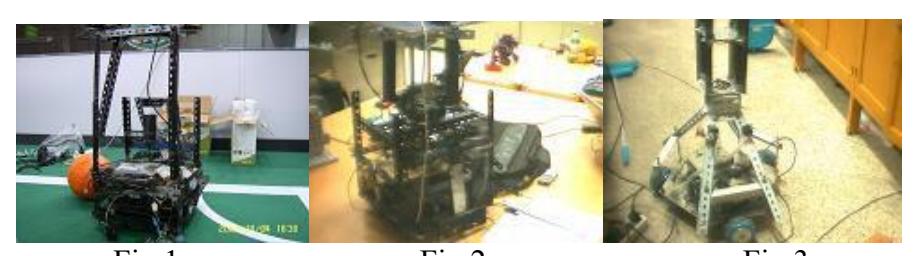
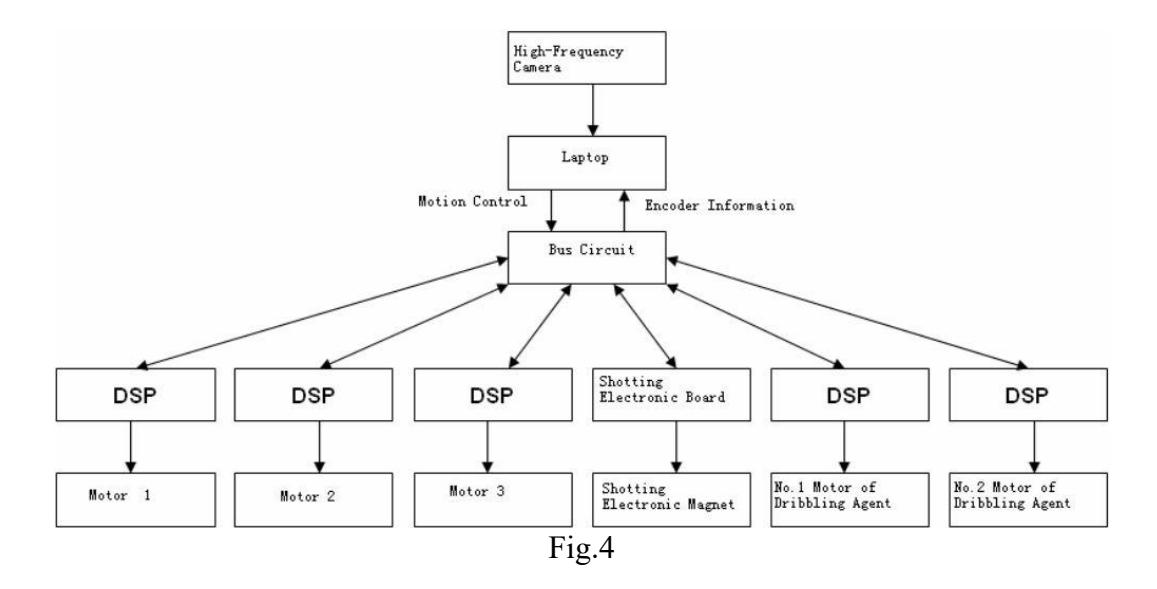
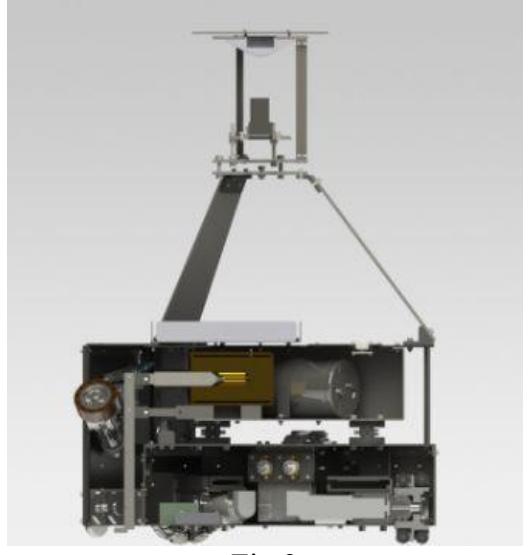
The original robot was made manually in 2004.The first two wheels robot was made manually by the team in 2006.Then in 2007 we made a large-scale transformation to it, and advanced the visual parts and motor driver parts ofthe robot.So the effect of the image and the speed of robot were upgraded.(Fig.1 and 2)In 2008, our first Omni-directional three wheels robot was finished which was also made manually.(Fig.3)This robot was more flexible.In 2009, our robot was advanced and new robotwas born.In 2010, We use advanced vision system and electronic system.(Fig.4) In 2012, We advanced our software system.
2.1 Motion
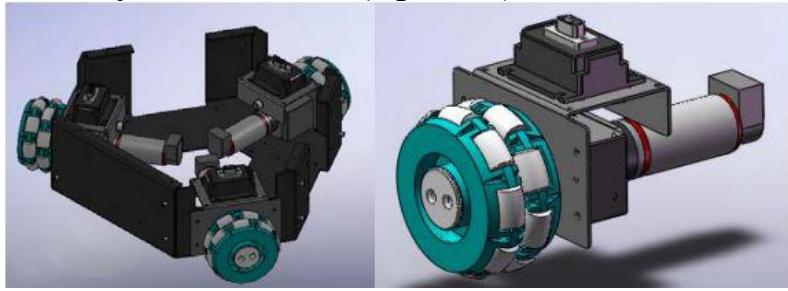
When we made the robot, we put an Omni-directional wheel, a 160w DC electric machinery and a pro-Motion BDMC3606SH Servo Driver together to make a Machinery Servo Driver.And placed them on the venly Equilateral triangle robot machine chassis.The angle of the adjacent otor axis is 120 degrees.So the connection between the Machinery ervo Driver is simpler and easier to replace, remove or fix.(Fig.6 and 7)
2.2 Control circuit
Our control circuit could make unified controlling for all functions ofthe robot.The onboard computer could communicate with it through USB.Using this interface, we could control the 5 axes servo motor of our robot and collected the current of every motor, encoder position and the cultivate volume from dribbling sensor.
2.3 Kicker system
Through several experiment, we found the best ratio of both ends ofthe lever which could change the electricity into mechanical energy in maximum extent.Now, the maximum height of our flying ball was about 2.4 meter and the maximum height of vacated distance was 12 meter(it was the maximum distance in test, but we just made it reach to 8 meter before 2011).In the discharge circuit, we designed a time control structure and accuracy even could reach to millisecond level.The time controlstructure could set the energy of kicking exactly which decided scoring the goals from dead space in anywhere of half-court.The system worked very stable and had good repeatability.If we used the same energy to make air free jets more than one time, the placement point of the ball would be in area of radius of10 meter.The kicking calibration system was designed by traditional simple motion model.After the correction, used correction curve from the experiment data, the scoring goals accuracy was improved.
2.4 The architecture of dribble system
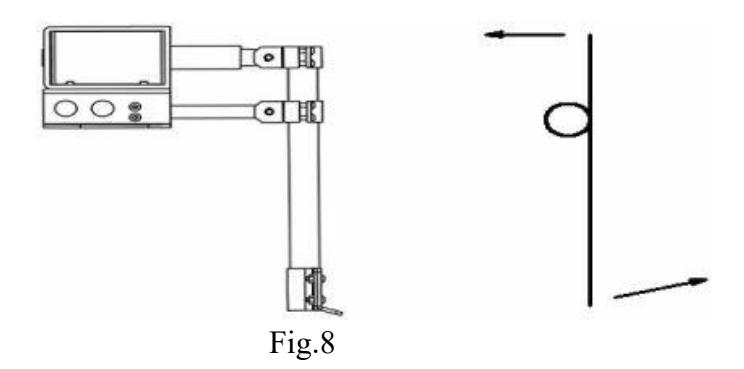
We did a lot of work in dribbling when the robot attacked.We had done many system research before there were dribble motor. We designed a new kind of dribble equipment in 2010. It could endure physical impact from any direction by accident during the competition and actively grab. We installed on dribble equipment so that we got great superiority in this kind of middle size competition which needed many grabbing and fighting.
2.5 Camera
The minimum requirement for cameras is 640*480 resolutions and 45 fps. Therefore we select the point Gray's ffmy camera, which can reach 60 fps.the color dynamic range was higher than 90db, so we had a bettersuitability for light.
2.6 Omni
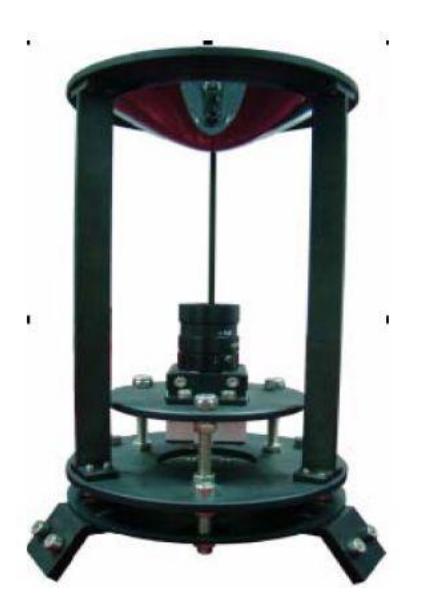
The visual range of omni line and the ball we made was much more than 9m. It made it possible that if there was no shelter materials in the ring, our robot would overlook the court nearly about more than 90%.This character greatly helped our robot to judge the trace and predict the position of ball.
3 Software System
Software system overview and architecture for robot control and coordination.
3.1 Path-Planning
Our path-planning not only could provide best walking route, but also made the robot generate his own action initiatively.The robot would produce movement direction, speed and corner speed based on his own direction in polar coordinates and other model which formed his own movement.This feature had several advantages.It combined the tactic part and controlling part together cleverly and generated unified way to solve the movement action.Such as in defense, the coach sent an easy command to assign the robot to one place and he would generate his own movement pattern.It provided an easy, effective and flexible way for motion.
Due to this feature, we also could set up any of tactics flexibility.Our robot would do technical adjustments for different team, strategy and formation.We often did some special adjustment in the second half just for the problem in the first half.
3.2 Vision
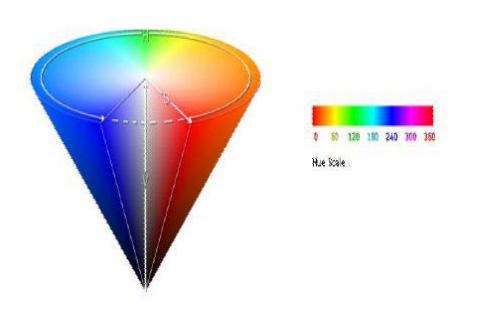
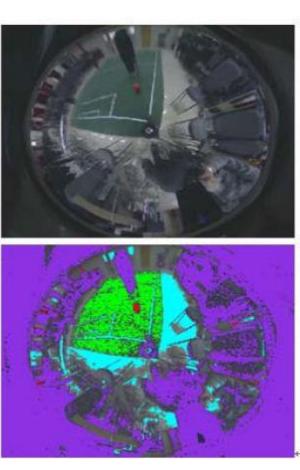
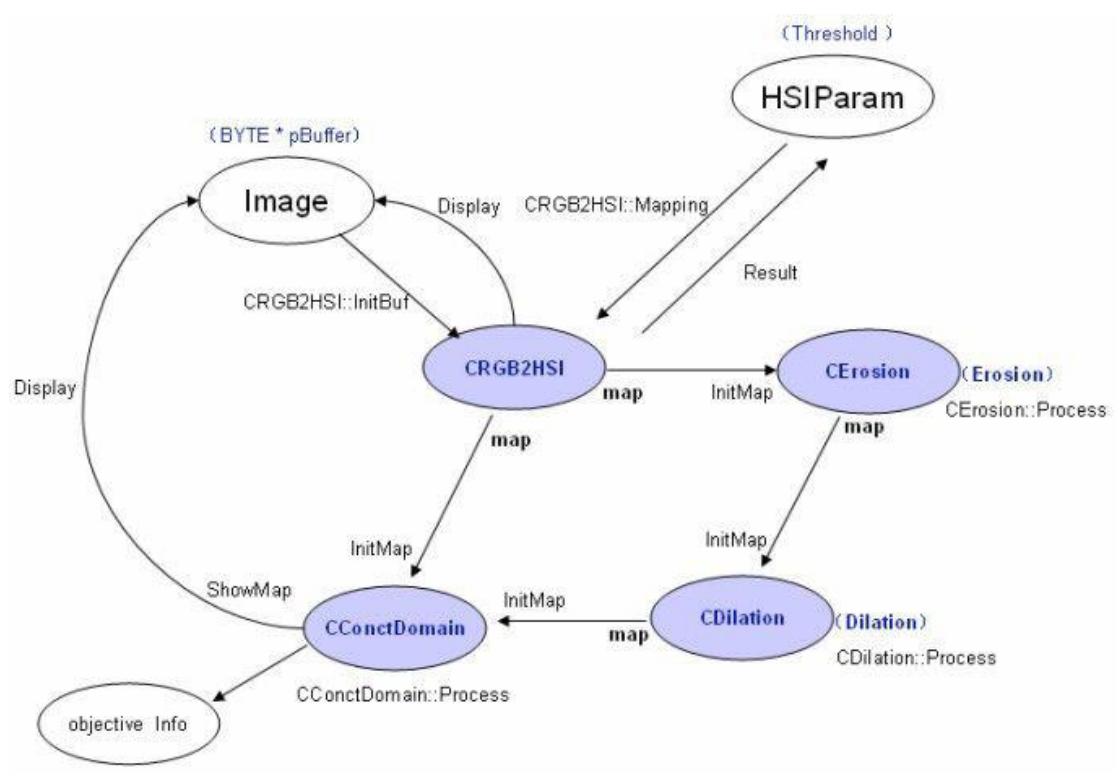
In the part of robot vision, we use HSV to describe the frame.With the distribution pixels ofH, it judges the color of objects.The computer give the result of the binary.The football is red, the field is green, the field line is lightblue and the obstacles are purple.(Fig.10, Fig.11)The flow chart of vision system in software:(Fig.11)
3.2 Self positioning
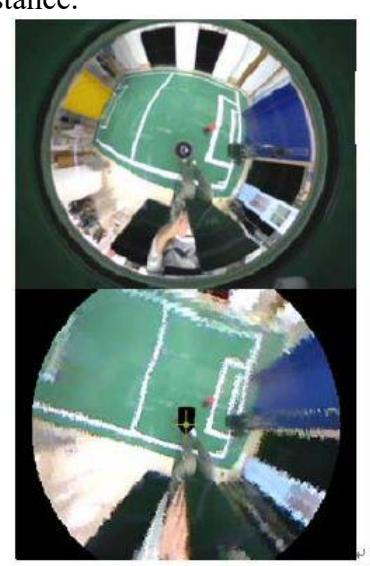
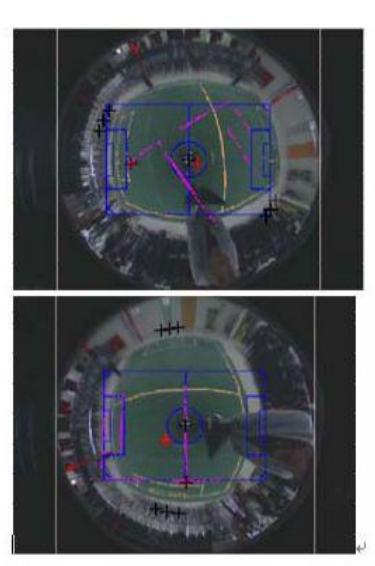
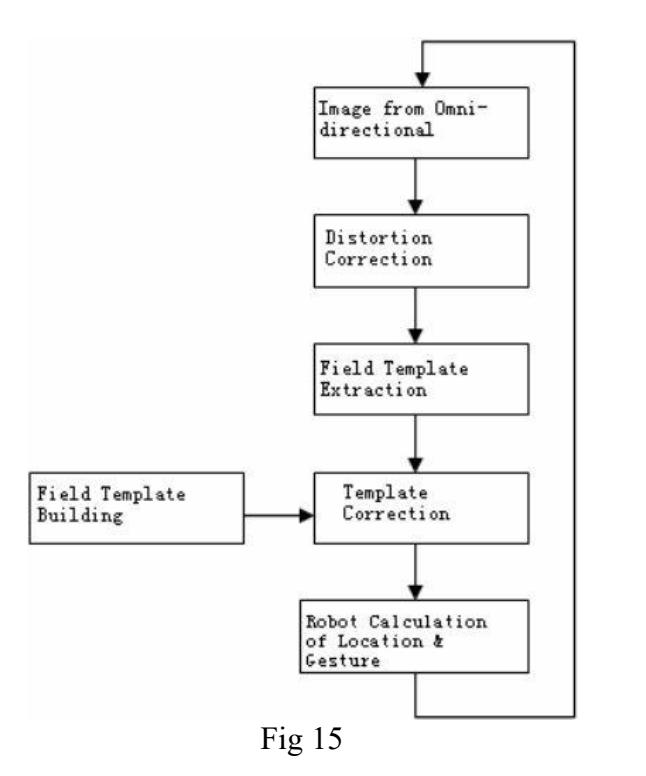
Our robot self-locates by the white lines ofthe field relative to the position and angel of the robot.We will make correction to the omni-image first and recovery the shape of field line.(Fig.13)The picture is Omni-image before correction and after correction.Through the white line in the image and template of field line, we get the locationrelative to the field line.From Fig 14, the color of template field line is blue.Thewhite field line was expressed by pink matrix.The software will match the pink matrixwith the blue lines until they get together.We calculate absolute coordinate in the fieldwith the turning of matrix angel and distance.

3.3 Multi-Cooperation
We use global planning and self decision to make robot cooperation.The Coach programming will analysis the match and give the direction from the referee-box.(Fig.16)
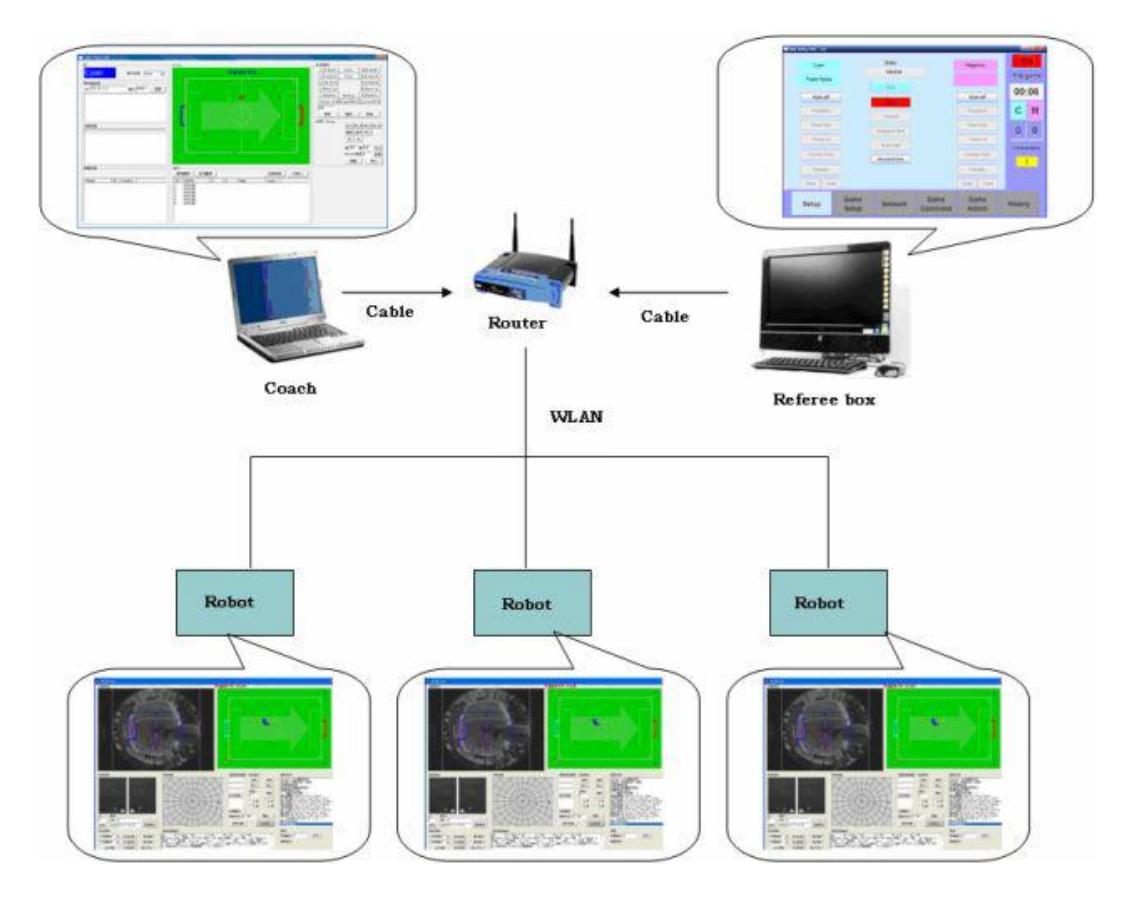
4 Experience of winning
The Water Team kept at least 8 members to do researching and training since she was created in 2006.The 8 members was just like 8 teachers which could be an important key for our team.In this way, we could transfer our experience astotally as possible for training new members and developing our team.
The core of Water Team included six members.Everyone could not only lead one team to participate in the competition, but also had his orher own special skill in one area.As the six members could build the entirety perfectly, every time we would make all-around consideration to optimize the performance of our robot to the peak for upgrade.During the competition, there were four members ofthe core at least to join in so as to solve any problem at first time.
We did re-model several times for our mature technique in order to optimize the robot as quickly as possible based on the feature of court and the state of the robots, such as locating. For most of us working now, generally, we did 2V2 without goalkeeper test according to the rule and condition before competition.In this way, we could comprehend our advantage and disadvantage in defense and attack much more which provided foundation for everyone to rewrite theirprograms.After the test, we shared our experience together that helped us analyze the statics of opponents and do adjustment in competition fleetly.
The competition not only gave us a wonderful result but also made us learn from it.During every competition, we observed and compared the robots from our opponents and learned from them which gave theexample for us to improve ours.The competition was just the spring source of our experience.
5 Summary
This paper introduced the hardware and software of Water Team and described the current research direction:robot vision, software structure, path-planning and position.Every research field was needed to be improved.
To get better achievement for our team, we had been doing farther research in very field of this.
First, we studied the locating of our robot for object in space with omni or even new fits such as kinect which would enhance its ability that the robot could distinguish not only the football but also other things.
Second, We had done more research about our tactics such as long passing which could enrich the coordination of tactics and break dull states now.
Third.We optimized the programs of distinguishing and tracing for normal objects and researched on locating through vision.
Fourth.Optimized the parameters through neural network.
Fifth, We bettered the strategy formation and strengthen the ability of path-planning in multi-cooperation.
References
- Dou Zhenzhong.The Application Design and Examples ofPIC.Beijing.Beijing University of eronautics and Astronautics Press
- http//www.Robocup.org.
- Li Shi, Xu Xuming, Ye Zhen, Zhang Zengqi.The International Robot Football match and Related Technology.Robot.000, (9):420-426.
- Predicting away Robot Control Latency Sven Behnke2, Anna Egorova1, Alexander Gloye1, Ra′ul Rojas1, and Mark Simon1,2004
- RoboCup Middle Size Robot League Rules and Regulations for 2013