ROBIT 2017 Team Description Paper
Yu Liang, Feng Han, Jie Xu, Yichuan Yang, Ji Qi, Yulin Wang, Liming Gao, Bowei Zhang, Ke Jin, Jiahao Wu, Zheng Guan, Lixing Liu, Zizhen Yan, Chen Ma, Ziqian Zhao, Zicheng Wang, Xianchao Sun, Xiong Xiao, Jinkui Wang, Bowen Liu, Jiefei Shi, Sijie Shuai, Zhida Wu, Bin Liu, Anqi Hu, Yihao Li, Zechao Xue, Yongcan Shi, Dong Zhang, Guangyu Liu, Yi Wu, Xin Wan, Zeyu Chen, Yueshi Qiu, Yicheng Jin, BinBin Li, Yunfan Li, Kaiyu Chen, Jian Xu, Guangzhao Lu, Zhengmin Yu, Weitao Lin, Jian Zhang, Jiashuo Li, Rui Luo, Penghao Ye, Hongao Li
School of Software, Beijing Institute of Technology, P.R.China, 100081
Abstract The ROBIT(former name BITAC) is the Beijing Institute of Technology's Middle Size League RoboCup team. We will present our brief background and the initial results in the opening section. The following sections demonstrate the hardware structure and software architecture of the ROBIT. Our current research activities focus on multi-robot joint observation, computer vision and local collaboration in dynamic real time domains.
1. Introduction
The BIT MSLR team (ROBIT, former name BITAC) has started its work in May 2011 at Undergraduate Innovation Center and Incubator of Software, Beijing Institute of technology. Our Team is composed of undergraduates from different departments which involve the school of software, the school of optoelectronics, the school of mechanical & vehicles and the school of information & electronics. Our project contains some relevant domains of robot research, which cover the robot hardware manufacturing, automatic control of robot, computer vision, multi-agent collaboration, etc. Additionally, we regard RoboCup MSL as an opportunity to make a self-enhancement in artificial intelligence.
Last year, we achieved the 4th place at the Robocup China Open in Hefei. It's our 4th participation in Robocup Middle Size League. Currently, we, ROBIT team members, keep working on our robot research, holding on the belief, so-called the spirit of boiler room, that after making persistent efforts unremittingly to robot research, we may make our contribution to the dream that robotic soccer players may someday defeat a human champion team.
2. Hardware Structure
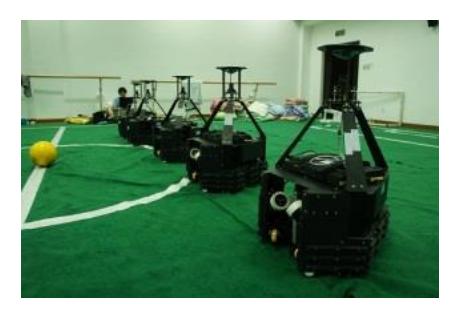
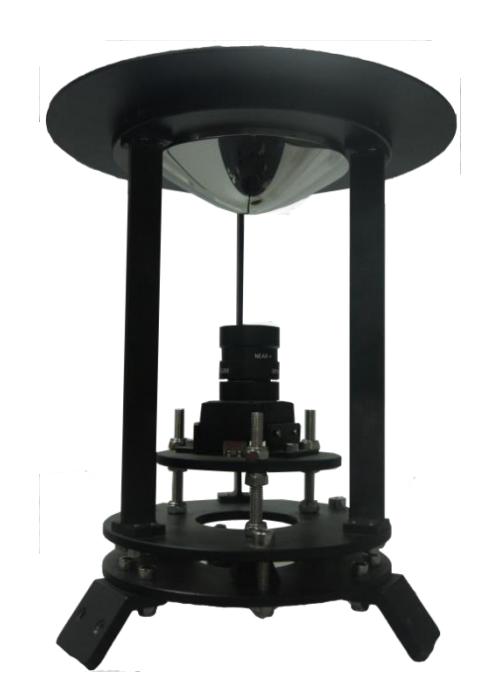
Our first generation of robot platform is designed as a 3-wheels omni-directional robot equipped with ball kicker mechanism, ball holder mechanism and vision system, which is shown in figure.2. The components list is shown in Table.1.
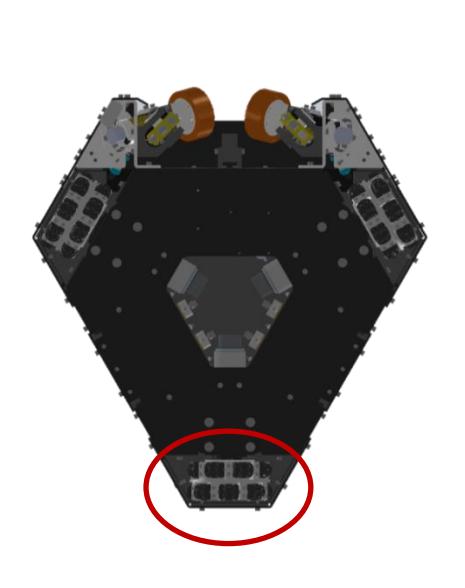
Table 1 Generation I Components list
| component | description | param | Fig |
|---|---|---|---|
| Platform | omnidirectional | 3 wheels | 3 |
| Motion | Maxon RE40 | 150W | / |
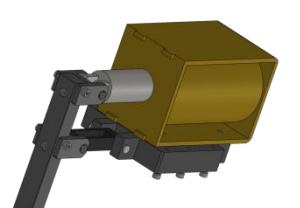
| Holder | faulhaber2342 | 9,000 rpm | 4 |
| Kicker | electromagnetic jet device |
stroke 200mm shot speed 6m/s |
5 |
| Vision | omnidirectional | visual range 5m | 7 |
| Handler | digital servo | / | |
| battery | Lithium iron | 12V, 6.9Ah (*2) | / |
2. Hardware Structure (continued)
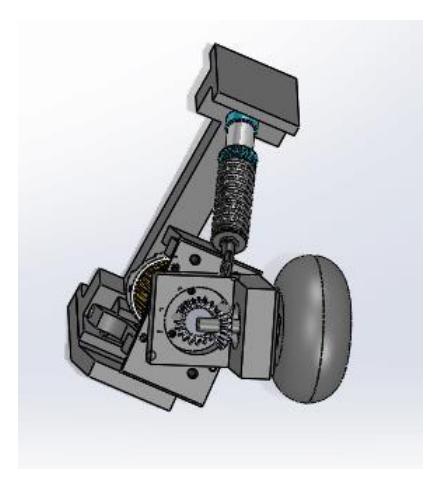
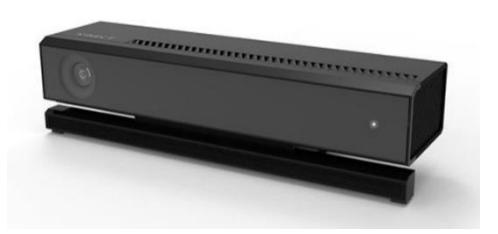
Recently, we are developing our second generation of robot platform, which is shown in figure 6. With the growing concern on passing the ball rather than single agent attack ability, we designed a new ball kicker and holder mechanism which allows us to switch from shooting mode to passing mode. We also discussed the solution of 3D vision and made attempt to use the Kinect sensor. The components list is shown in Table.2.
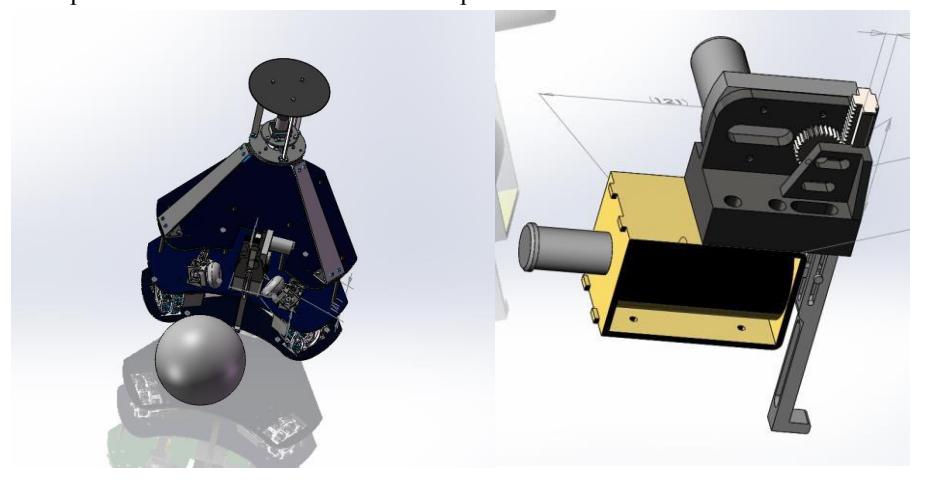
Table 2 Generation II Components
| component | description | param | Fig | |
|---|---|---|---|---|
| Platform | omnidirectional | 3 wheels | / | |
| Motion | Maxon RE40 | 150W | / | |
| Holder | Maxon RE30 | 9,000 rpm | 8 | |
| Kicker | electromagnetic jet | stroke 200mm | 7 | |
| device | shot speed 6m/s | |||
| Vision | omnidirectional | visual range 5m | / | |
| Handler | digital servo | / | ||
| battery | Lithium iron | 12V, 6.9Ah (*2) | / | |
| Kinect | Kinect for windows |
Depth sensing | 9 | |
| V2 | 5-4.5 meters | |||
| 1080p color camera |
3. Software Architecture
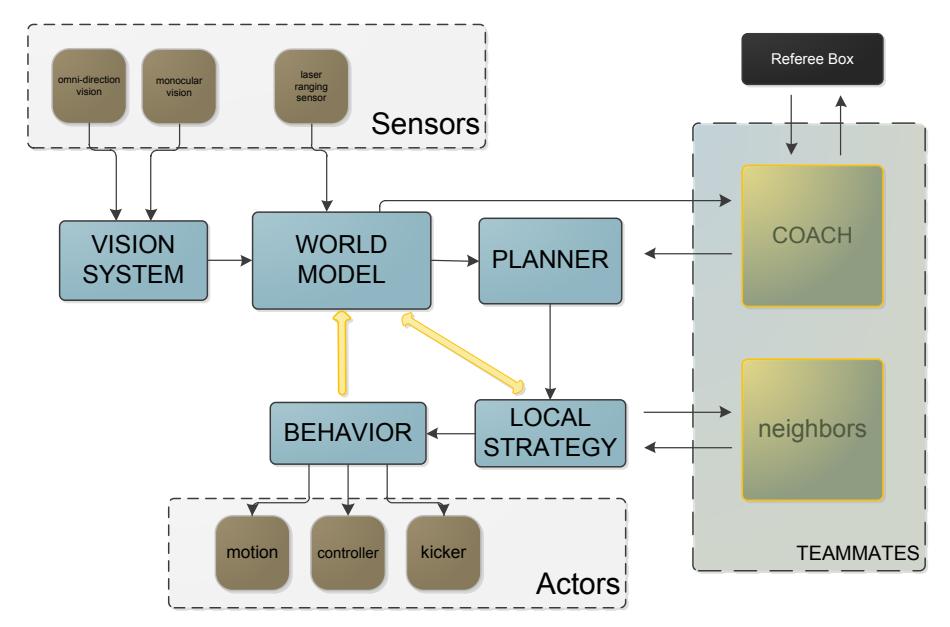
The ROBIT's software system mainly consists five sub-systems. An overview of the system modules is given in Figure.10.
3.1. Vision
Vision is one of the major research regions of the ROBIT, for environment information collection and calculation is a significant pre-step of decision process. We face to the challenge that keeping the balance between information entropy and efficiency in such dynamic real time system. The following processes were proven to be practicable in dealing with dynamic real time. Recently we are making an attempt on combining Kinect sensor with our existing vision system and have achieved phase result.
3.1.1. image preprocessing
Pre-processing filters are used to reduce image noises and to enhance the connectivity of standard color regions.
3.1.2. color classification
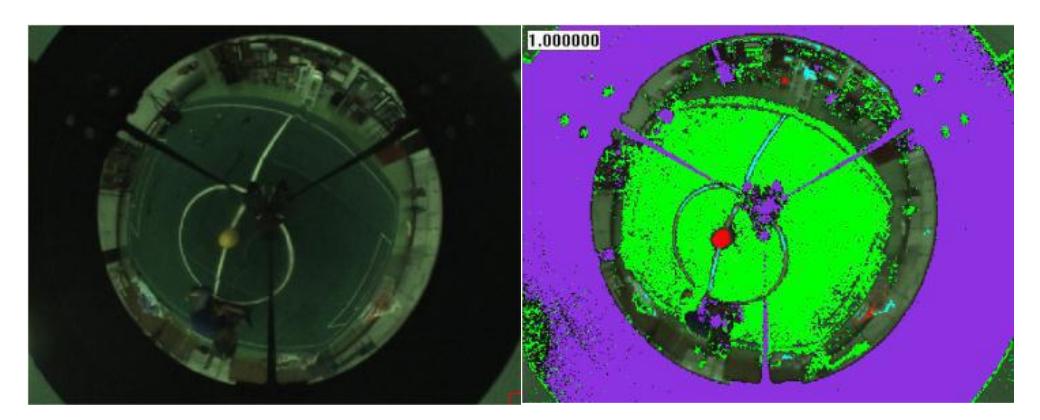
In the initialize process, we use clustering algorithm to separate YUV Color Space into N+Q classes, then comparing with the standard color table to register the N's valid classes and demonstrate the mapping relationship. (N refers to the number of interest colors, and Q is designed to represent the Main Interference Source ).
In the runtime process, the original image would be divided by this liner classifier constructed before.
3.1.3. localization & object recognition
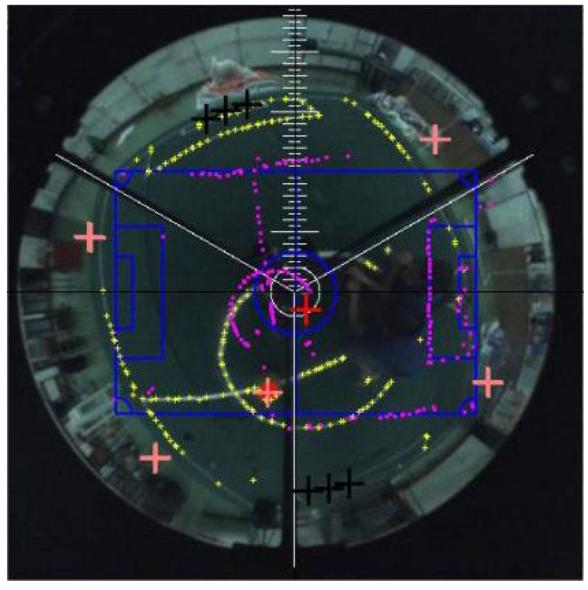
Self-localization based on white sideline recognition. The approximate distances can be calculated efficiently with the standard Pixel-Position map for reference.
3.1.4. contour detection
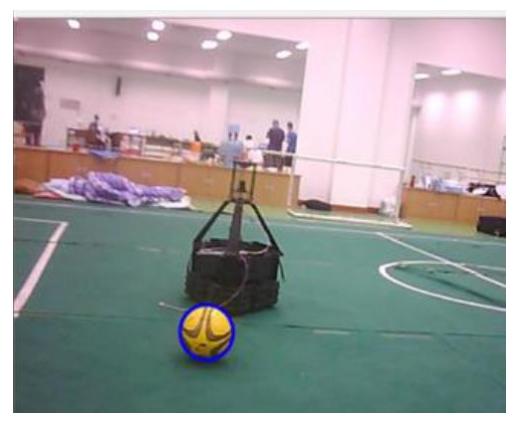
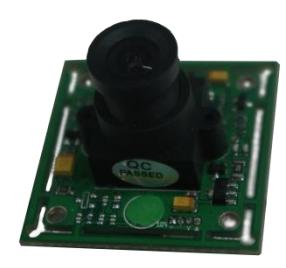
Since the color classification doesn't robust against external environment interference, and it's not sufficient to characterization of the ball and robot features. We attempted to add an adjunct monocular vision system and increase a distinctive feature such as shape, contour, or corner feature. We select circular contour to detect ball, affine invariant corner feature to accurate positioning and digital character shape feature to access the raw data for opponent modeling.
3.1.5. 3D vision
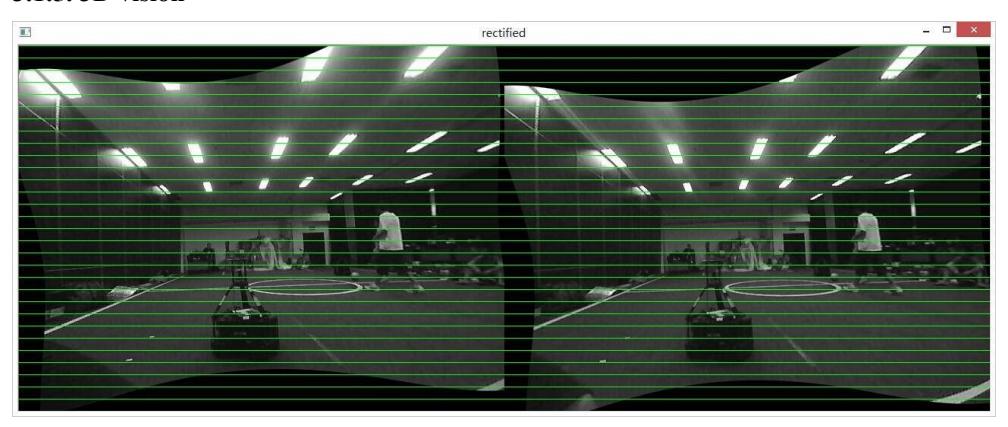
In order to extract practical and real data, we are currently working on 3D vison by using binocular vison system and Kinect sensor. Though facing varieties of difficulties, we believe that the 3D vision system will be accomplished soon on our Generation II robots.
3.2. Global Strategy
3.2.1. Agent control information
Decision-making system controls agent through agent control information. Control Information including the type of instruction, the target coordinates and target angle, the starting coordinates, defensive distance, defensive point of view, soccer coordinates and other feedback.
3.2.2. Soccer position discrimination
Online statistics of the soccer players identify soccer location information. First remove the interference of outside objects, and then examine the distance between the players and the ball, find the smallest distance with the agent for the most likely soccer coordinates of the full field.
3.2.3. Information sharing among teammates
Coach responsible for the information shared between the players, including online agent identification, coordinates, speed and angle, and the result of obstacle integration information.
3.2.4. Role-based global strategy
Global strategy arrangement is based on role-agent division, according to the study and the historical role of performance data to complete arrangements for the role. Specifically, when the ball is in our state, an agent as a striker, one or two agent responsible for assisting the attack or block the opponent, followed by the rest of the players as defensive player of the attackers and protect one`s own space to pass and action line, of course, an agent role to play goalkeeper. Once the goalkeeper role is determined, the change of role does not occur, while the rest of the game agent role will dynamically change as the race progressed. An attacker may move into the defender with the formation, and vice versa.
3.2.5. Examine the role of performance and dynamic allocation of decision-making process
Upon completion of multi-agent information fusion and acquisition to build the world model, decision-making system complete the game on the field of rational arrangement of formation. Based on soccer location, field obstructions information, players location information, decision-making system make the desired arrangement of the first results, and then verify the correct formation by the necessary arrangement with the competition rules conflict unreasonable, including the role of information generated array of decision-making.
According to agent status and have their own roles, decision-making system to complete the agent`s role is suitable for performance evaluation, complete array of decision-making tasks assigned to the agent to complete the decision-making process.
3.2.6. Multi-agent coordination and passing
To complete the multi-agent collaboration, we need to complete the unified multi-agent clock synchronization and the action within allowable error and the time difference. It can be achieved by setting the timer to complete cooperation depend on the time difference, multiagent work together to achieve a simple goal, even make accurate still passing action.
3.2.7. Obstacles statistics and integration
During the competition, according to the time frame, complete obstruction of statistics and information processing. Obstacles expired information, interfere with the goalkeeper defending moving obstacles, off obstacles, obstacles overlap with the teammate will be removed. Obstacles according to the time-framed integral, to prevent the obstruction of information instantaneous jitter is too large, so that obstacles statistics smoother.
3.3. Local Strategy
The Path Planning in MSLR is also an important factor. In need of strong real-time property, the robots have to switch role and behavior according to the competitor and the obstacle information. Find a shortest path start from the original state to the target state in the workspace.
Fuzzy logic is a way to make machines more intelligent enabling them to reason in a fuzzy manner like humans. But it has the lack of study ability and it's not easy to set fuzzy rules of the complex dynamic system.
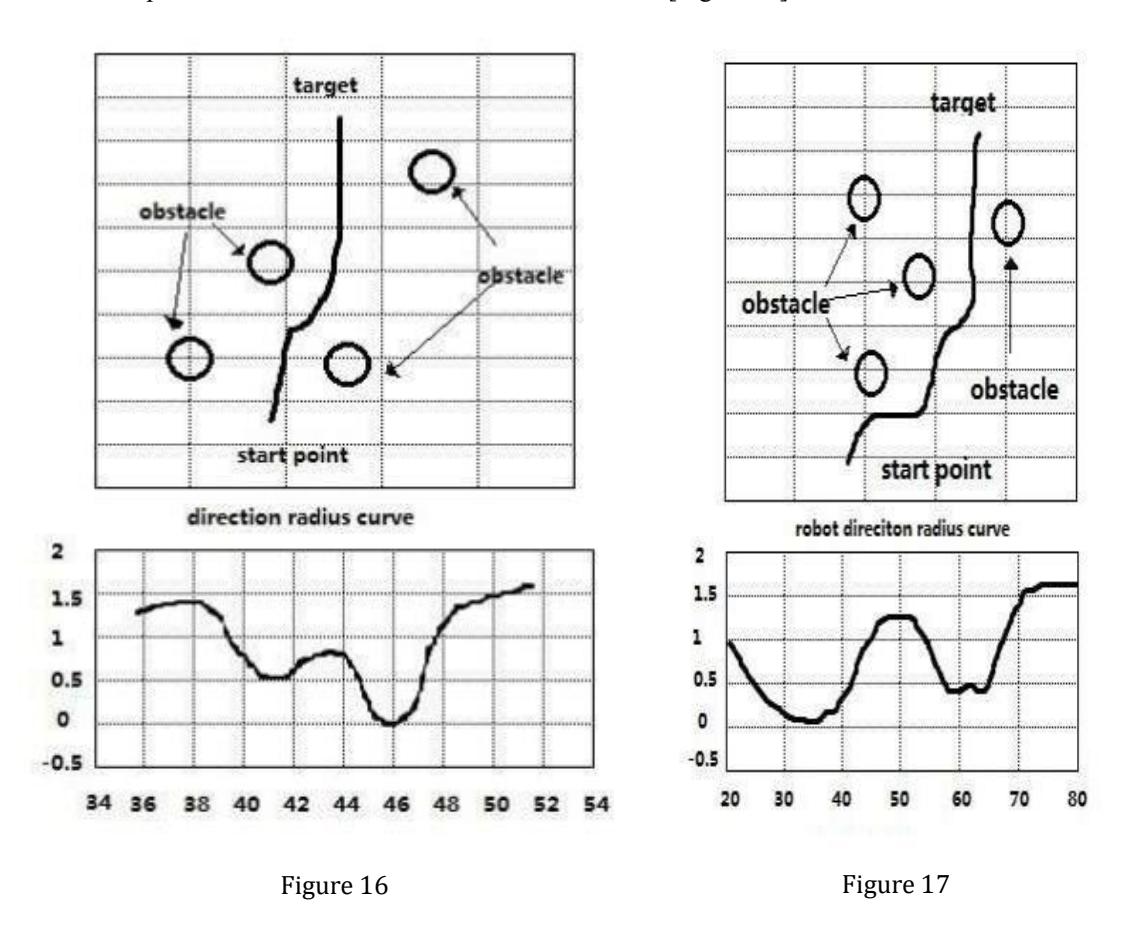
In the fuzzy strategy we build, fitness function contains 2 main parameters. 'a' describe the importance percentage of Distance take while 'b' describe the importance of Safety. GA is used for fuzzy roles on abstraction, optimization, line reorganization, and a fitness function is provided. The simulation results are as followed [Fig11, 12]:
4. Conclusion and Outlook
To optimize the performance of our machine, there are three parts of technique problems need to be solved. 1) How to improve the success rate of catching the passing ball from teammates through strengthening machinery section. 2) Finding a mechanism that robust against sudden illumination changes. 3) And how to deal with the information conveyed by those changes is also under researched. Moreover, Multi-agent collaboration always remains as the most significant challenge to be resolved. The ROBITs have started their work on figuring out effective solutions to the challenges mentioned above.
References
- A.K. Mackworth. On Seeing Robots[A]. Computer Vision: Systems, Theory, and Applications[C]. Singapore: World Scientific Press.1993:1-13
- Kitano, M. Asada. RoboCup: The Robot World Cup Initiative[A]. Proceedings of the International Conference on Autonomous Agents[C]. 1997:340-347.
- Snyder, W.E, Machine Vision[M]. ISBN 7-111-16790-2. 2004
- Ingo Dahm, Sebastian Deutsch. Robust Color Classification for Robot Soccer[C], RoboCup 2010: Robot Soccer World Cup XIII. Germany,2010
- K. Shimada1, Y. Takahashi1, M. Asada. Efficient Behavior Learning by Utilizing Estimated State Value of Self and Teammates[C]. RoboCup 2009: Robot Soccer World Cup XII. 2009
- J Ketill Gunnarsson.The Color and the Shape: Automatic On-Line Color Calibration for Autonomous Robots[A].in RoboCup 2005 International Symposium[C] .Osaka:Springer-Verlag,2005
- Haidong Fu. A robot soccer decision-making system based on the potential field theory [J]. Journal of Huazhong University, 2005,28(1):69-71,93.
- Niu Wang . The application based on the role allocation model simulated intelligent control in robot soccer system [J].Chongqing: School of Automation,2006,43(z1):430-434.
- Fengda Zhao. The design of a decision-making soccer robot system based on hierarchical model [J]. Journal of Harbin Institute of Technology,2005,37(7):933-935.
- Qizhi Wang. The motion control of obstacles robot based on Improved artificial potential field method [R].HongKong: Intelligent Automation Conference,2003.
- Zhicheng Xie. The research on motion control of three-wheeled omnidirectional mobile robots [D]. Changsha: Changsha University of Science and Technology,2010.
- Guoping Zhang. A new soccer robot behavior generation method [J]. Machinery & Electronics,2006, (1):51-53.