Tech United Eindhoven Team Description 2018
Ferry Schoenmakers, Koen Meessen, Yanick Douven, Harrie van de Loo, Dennis Bruijnen, Wouter Aangenent, Jorrit Olthuis, Wouter Houtman, Cas de Groot, Marzieh Dolatabadi Farahani, Peter van Lith, Pim Scheers, Ruben Sommer, Bob van Ninhuijs, Patrick van Brakel, Jordy Senden, Marjon van 't Klooster, Wouter Kuijpers, René van de Molengraft
Eindhoven University of Technology, De Rondom 70, P.O. Box 513, 5600 MB Eindhoven, The Netherlands
Abstract The Tech United Eindhoven Middle-size league (MSL) team achieved a second place in RoboCup 2017, To ensure a first place in RoboCup 2018 the team made a considerable amount of developments. For the sake of qualification for RoboCup 2018, this paper describes the most notable developments. Developments in hardware include: the realization of our eight-wheeled soccer player and an improved ball handling system. The following developments in software have been made: a new approach to ball state estimation has been designed and the human-alike dribble has been added to the TURTLEs skills.
1 Introduction
Tech United Eindhoven represents the Eindhoven University of Technology in the RoboCup competitions. The team started participating in the Middle-Size League in 2006. In 2011 the service robot AMIGO was added to the team to participate in the RoboCup@Home league. In the Middle-size league competitions, the team has been playing the final for 10 years now, while achieving the first place three times: 2012, 2014 and 2016. At the moment of writing the Middlesize league team consists of 4 PhD's, 1 PDEng, 8 MSc, 4 BSc, 5 former TU/e students, 3 TU/e staff members and one member not related to TU/e.
This paper describes the major scientific improvements of our soccer robots over the past year. First in Section 2, an introduction on the hardware and software of our fifth generation soccer robot is given. The developments in design and control towards our sixth generation soccer robot, the eight-wheeled robot, are presented in Section 3. Additionally, we are developing a new ball handling system, which is presented in Section 4. Improvements to the skills of our robots are presented in Section 5. Our progress on including concepts from artificial intelligence into the robot software are presented in Section 6. Section 7 gives concluding remarks and presents our outlook on the coming years.
2 Robot Platform
Our robots have been named TURTLEs (acronym for Tech United RoboCup Team: Limited Edition). Currently, we are using our fifth generation TURTLE while we are developing the sixth generation, which is presented in Section 3. In this section we will however treat the fifth generation, which makes up the biggest part of our team. Subsection 2.1 will treat the hardware of this platform, whereas subsection 2.2 will treat the software.
2.1 Hardware
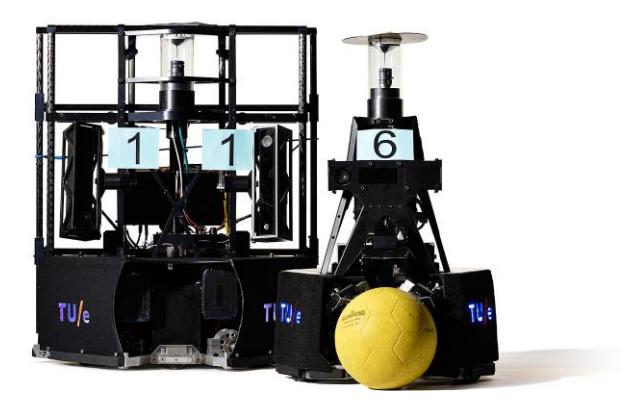
Development of the TURTLEs started in 2005. Through tournaments and numerous demonstrations, these platforms have evolved into the fifth generation TURTLE, a very robust platform. For an outline of our robot design the reader is referred to the schematic representation published in the second section of our team description paper of 2014 [1]. In 2016, a redesign of the upper body of the robot was made to integrate Kinect V2 cameras and create a more robust frame for the omni-vision unit on top of the robot. This prevents the need for recalibration of mirror parameters when the top of the robot is hit by a ball. A detailed list of hardware specifications, along with CAD files of the base, upper-body, ball handling and shooting mechanism, has been published on a ROP wiki.
2.2 Software
The software controlling the robots is divided into three main processes: Vision, Worldmodel and Motion. These processes communicate with each other through a real-time database (RTDB) designed by the CAMBADA team [2]. The vision process is responsible for environment perception using omni-vision images and provides the location of the ball, obstacles and the robot itself. The worldmodel combines the ball, obstacle and robot position information provided by vision with data acquired from other team members to get a unified representation of the world. The motion process is based on a layered software model. The highest level is strategy. Strategy defines actions which are executed by roles deployed on the TURTLEs. These actions consist of a limited set of basic skills such as shooting and dribbling, which require motion control of relevant actuators, the lowest level of the software. More detailed information on the software can be found in [3] or in the flow charts part of the qualification package.
3 Eight-wheeled Platform
This section elaborates on the design of the eight-wheeled platform. Subsection 3.1 will elaborate on some of the design features of the eight-wheeled platform. The challenges faced during the low-level motion control design are presented in subsection 3.2.
3.1 Design of the Eight-wheeled Platform
The current platform is equipped with three omni-directional wheels rigidly connected to the base, achieving holonomicity which makes our platform potentially agile. In this configuration, however, not all the torque delivered by the motors is used in the desired movement. Moreover, forward acceleration causes the front wheels to come of the ground, removing the ability to apply torque from the motors to the field. These drawbacks form the main motivation for the development of the eight-wheeled platform, also presented in [3]
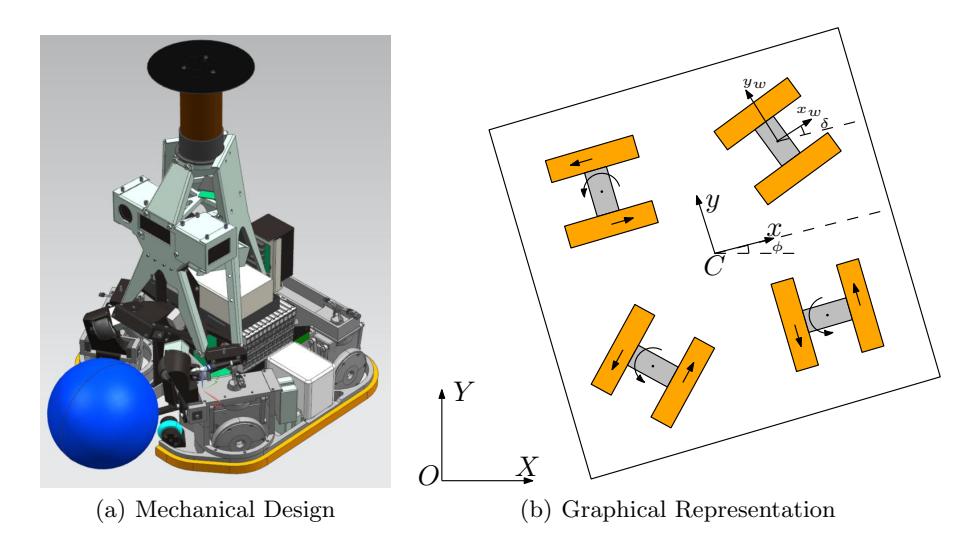
The challenge in designing a platform with four or more wheels is resolving the over-constrained system. The eight-wheeled platform, presented in Figure 2(a), has three degrees-of-freedom and is thus five times over-constrained. To allow five internal movements, each of the wheel combinations is suspended with the rotation point below the ground and the back wheels are suspended over a hinging axle. In this way, the wheels are always in contact with the ground to transfer the torque from the motors to the ground.
3.2 Low-level Control of the Eight-wheeled Platform
The setup of the platform is graphically represented in Figure 2(b). In this figure it can be seen that this platform consists of four sets each having two hub-drive wheels. Each pair of wheels can rotate around its suspension by actuating the corresponding wheels in opposite direction. As a result, strictly speaking the platform is non-holonomic, but due to the ability of each pair of wheels to rotate, in a relatively short time-intervals compared to the motion of the platform, a kind of semi-holonomicity is achieved.
In order to manipulate the position x, y and orientation $\phi$ of the center C of the platform, the control strategy of Figure 3 has been designed. Based on the desired velocity of the platform, $\dot{q}r = [\dot{x}\ \dot{y}\ \dot{\phi}]^T$, both the reference velocity for each of the eight wheels $v{w,r} \in \mathbb{R}^{[8\times 1]}$ and the desired pivot-angle $\delta_r \in \mathbb{R}^{[4\times 1]}$ can be determined in a feedforward fashion using the inverse kinematics of the platform. As three degrees of freedom are controlled using eight actuators, the system is over-actuated. Therefore, an error in the pivot $\delta$ of each wheelpair leads to undesired internal forces and slip. In order to correct for this pivot-error, via a feedback controller, a compensation is added to the wheel velocities. The magnitude of this correction term is equal for both wheels in each wheelpair, but they have opposite direction. Finally, by measuring both the wheel velocities $v_w \in \mathbb{R}^{[8\times 1]}$ and the pivot angle $\delta \in \mathbb{R}^{[4\times 1]}$, the velocity of the platform can be determined using the forward kinematics of the system.

4 Improved Ball handling System
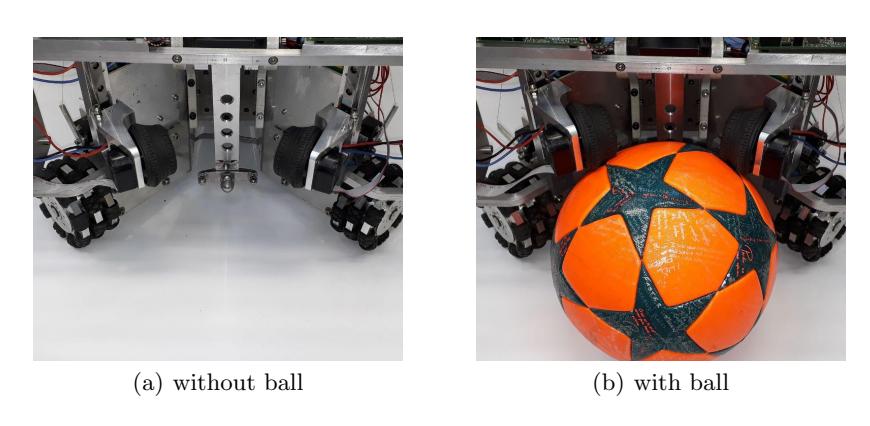
Our active ball handling system [4] has been proven to work well in dribbling and catching passes. Even though we adapted our system in 2013 [5], we are still aiming for improvements. The main goal is to downsize the system and decrease the weight. Furthermore, improved control is desired so even faster movements with the robot are possible. Towards a ball handling system with these improvements, a first test setup has been designed as shown in Figure 4(a). The new system consists of a vertical stroke system compared to the rotating levers presently used. The motors with worm wheel gearboxes are replaced by direct drive wheels, directly driving the ball, see Figure 4(b). This system results in a much smaller system, with decreased weight. The direct drive wheels allow for better control of the ball because of a reduction in gearbox losses and collocated system. At the time of writing the first tests with the system show promising results but more effort is needed to finalize integration and evaluate performance.
5 TURTLE Skills
This section focuses on two developments regarding the skills of the TURTLEs. Subsection 5.1 focuses on improving ball state estimation (position and velocity). The focus of subsection 5.2 is on the implementation of the "human-alike Dribble", a dribble where the TURTLEs softly push the ball forward using the ball handling.
5.1 Improved Ball State Estimate
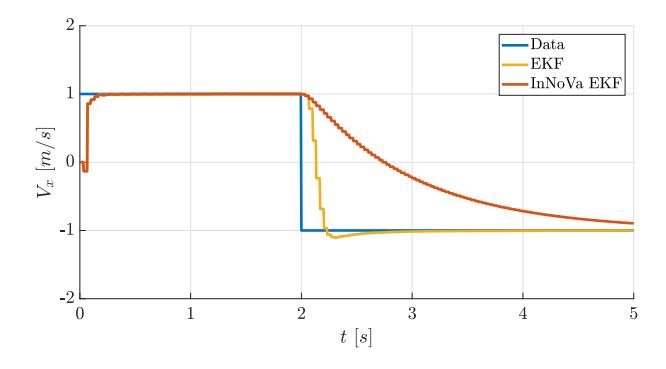
A correct ball position and velocity estimate is crucial for the TURTLEs. The performance of the present method is not satisfactory any longer in all situations. The current estimator buffers detections of the ball and fits this with a state trajectory in a least squares sense. In a highly dynamic environment, such as a MSL soccer field, the filter needs to adapt quickly to changing situations. A standard Extended Kalman filter would respond slow on a maneuvering ball depending on the process and measurement noise covariance matrices. To make sure the Kalman filter is able to adapt fast on a changing ball velocity, an Extended Kalman Filter with Inflatable Noise Variance (EKF with InNoVa) [6] is proposed.
Figure 5 presents a comparison between the response of the EKF and the EKF with InNoVa for a disturbance. One can observe from this comparison that the EKF with InNoVa converges to the actual velocity in x direction faster than the EKF. As similar performance is observed in other test cases, the proposed EKF with InNoVa will replace our present algorithm.
5.2 Human-Alike Dribble
Within the Middle-size league, robots have a confined dribble space defined as a 3 meters radius around the point where the robot intercepted the ball. Currently, the TURTLEs shoot or pass to let go of the ball. However, significant strategical advantages could be gained by softly pushing the ball forward and regaining it again. Previously, our robots had to shoot or give a pass to let go of the ball, therefore a controlled push was implemented.
Before giving a controlled push, the robot has to be aligned and the ball handling levers need to be in a predefined position. In the 70 ms the wheels have contact with the ball, the wheels ramp up the speed of the ball to about 0.5 m/s relative to the robot, to give a controlled push. Slip measurements are performed to determine the maximum acceleration before the ball handling wheels lose grip on the ball. Slip was found not to affect the velocity of the ball below 1.5 m/s which is thus large enough. The proposed control strategy consists of the existing feedback controller combined with a feedforward. This control strategy has been found to yield sufficient accuracy for executing the human-dribble.
6 Artificial Intelligence
We are exploring the possibilities of Artificial Intelligence for this league in two ways. Subsection 6.1 will elaborate on using Artificial Intelligence (AI) for detailed analysis of the omni-vision images. Another approach, where AI is used to predict the next action of the opponent is presented in subsection 6.2.
6.1 Detailed Opponent Detection
In last years team description paper [3] we reported on a detection method for opponent label detection using neural networks. Due to the new rule allowing robots to wear shirts, the presented approach was no longer practical. Therefore, we adopted a procedure where we first take pictures of every robot with a normal camera and then use the resulting images as input to the neural network. Every image undergoes augmentations in the form of rotations, scaling, color variations and distortions to resemble omni-vision images. Recognition of robots is now done on three levels. The first level classifies the robot's team. The second level classifies the robots orientation in front, left, right or back. The third level is, then again, the number on the number plate.
To understand the performance of the recognition, a visualization of the feature kernels and activation layers, additionally allowing the fine tuning of the network hyper-parameters. At the moment of writing the first level (team) has a reliability better than 95 %, the second level achieves a performance around 80 %. Work on the third level did not yield any valuable results yet.
6.2 Opponent Action Prediction
Being able to predict the opponents action grants a strategical lead with respect to the opponent. To train a network capable of this, the world state information of previous tournaments will be used to train the network. The world state information is spatially represented as a 8-bit occupancy map of 28x40 pixels, e.g. an opponent at a certain position will be represented by a red pixel at the coinciding occupancy map pixel.
Currently, the achievable performance of the convolutional neural network is determined with an indicative experiment, by recognizing the refbox tasks from this occupancy map. The network was able to classify the correct refbox tasks with an accuracy of 98.5 %, a promising result. With this promising result, research will proceed to predicting the opponents action.
7 Conclusions
In this paper we have described the major scientific improvements of our soccer robots over the past year. The sixth generation TURTLE is a robot with 8 wheels, designed for improved agility on the field. To downsize the current ball handling system, decrease its weight and to allow for better control performance, a vertical stroke system with direct drive wheels is proposed. The ball state estimation of the TURTLEs has been improved by means of and EKF with InNoVa, achieving better performance for the different ball situations. Also, the TURTLEs are now capable of doing a human-alike dribble, granting a new degree-of-freedom in the strategy. Work in the field of Artificial Intelligence focuses on detailed opponent detection and opponent action prediction.
Altogether we hope our progress contributes to an even higher level of dynamic and scientifically challenging robot soccer during RoboCup 2018 in Montreal, Canada. The latter, of course, while maintaining the attractiveness of our competition for a general audience. We are determined to create a new generation of TURTLEs with improved agility and ball handling. Meanwhile, our efforts in implementing a configurable strategy framework and applications of artificial intelligence in software will continue. In this way we hope to go with the top in Middle-size league for some more years and contribute to our goal in 2050!
References
- Lopez Martinez, C., Schoenmakers, F., Naus, G., Meessen, K., Douven, Y., Van De Loo, H., Bruijnen, D., Aangenent, W., Groenen, J., Van Ninhuijs, B., Briegel, M., Hoogendijk, R., Van Brakel, P., Van Den Berg, R., Hendriks, O., Arts, R., Botden, F., Houtman, W., Van 't Klooster, M., Van Der Velden, J., Beeren, C., De Koning, L., Klooster, O., Soetens, R., Van De Molengraft, R.: Tech United Eindhoven Team Description 2014. Springer International Publishing (2014)
- Almeida, L., Santos, F., Facchinetti, T., Pedreiras, P., Silva, V., Lopes, L.S.: Coordinating Distributed Autonomous Agents with a Real-Time Database: The CAM-BADA Project. (2004) 876–886
- Schoenmakers, F., Meessen, K., Douven, Y., Van De Loo, H., Bruijnen, D., Aangenent, W., Van Ninhuijs, B., Briegel, M., Van Brakel, P., Senden, J., Soetens, R., Kuijpers, W., Olthuis, J., Van Lith, P., Van 't Klooster, M., De Koning, L., Van De Molengraft, R.: Tech United Eindhoven Team Description 2017. Springer International Publishing (2017)
- de Best, J., van de Molengraft, R., Steinbuch, M.: A novel ball handling mechanism for the RoboCup middle size league. Mechatronics 21(2) (mar 2011) 469–478
- Schoenmakers, F.B.F., Koudijs, G., Lopez Martinez, C.A., Briegel, M., Van Wesel, H.H.C.M., Groenen, J.P.J., Hendriks, O., Klooster, O.F.C., Soetens, R.P.T., Van De Molengraft, M.J.G.: Tech United Eindhoven Team Description 2013. Springer International Publishing (2013)
- Zhang, J., Welch, G., Bishop, G., Huang, Z.: A Two-Stage Kalman Filter Approach for Robust and Real-Time Power System State Estimation. IEEE Transactions on Sustainable Energy 5(2) (apr 2014) 629–636