Team Description Paper : IRIS Team
Dzulfikar Ahmad Samhan, Muhammad Revo Khairullah, Dwiki Febrianto, Dhiaul Ma'ruf, Deksaraka Danier, Rudy Dikairono
Workshop Laboratory, ITS Robotics Centre, Institut Teknologi Sepuluh Nopember, Surabaya 60111, Indonesia
Abstract IRIS ITS is a robotic team that compete in the soccer robotic league. The team was found in the mid-2016 with the ambitious goal of competing in the international robotics competition. This paper presents the information of middle size league from IRIS team including team information, hardware information, and software information for RoboCup 2019. In this paper, we will introduce our mechanical system, electrical system, and also software of the robots.
Introduction
IRIS ITS is a robotic team that compete in the soccer robotic league. The team consist of several undergraduate students of Institut Teknologi Sepuluh Nopember Surabaya. The team was found in the mid-2016 with the ambitious goal of competing in the international robotics competition. IRIS ITS is a team that annually compete in the soccer robotic competition which held by Ministry of Research Technology and Higher Education of the Republic of Indonesia. In this competition, IRIS won the 3rd place, best design, best strategy, and best innovation in 2017. In 2018, IRIS won the 1st place and best strategy in regional competition and won the 2nd place in National competition. We also participated in the Robosot League in 2018 FIRA RoboWorld Cup and won 1st Place Passing Challenge, 3rd Place Obstacle Avoidance Challenge, and 3rd Place Localization Challenge. As time goes, our research focuses on mechatronics, computer vision, and software architecture and engineering.
Mechatronic
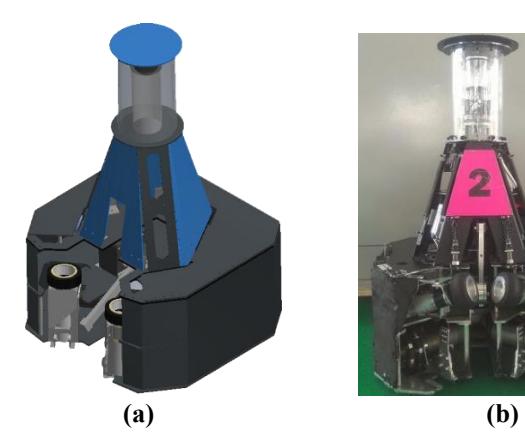
At the the start of the research, IRIS decided to develop its own robotics platform. MSL is autonomous robots play soccer. Meanwhile, football is a sport that has strong direct contact between players. Robots are designed and made with wheels as a driver and programmed to get attack and defence strategies like a football game. That's the reason why we designed the robot with the mixed capabilities of high speed and flexibility as well as robustness.
The mechanic of the robot was based on 4-Omni wheels so that the robot can move forward, backward, and even diagonally. The base design also represents the rectangular-cut edge with a 45cm x 45cm dimension. Aluminium plates are used for the entire body of the robot. For the actuator and motor, we use the Highly-torque DC motor 2 for the dribbling, 4 for the Omni wheels, and 1 for the kicking mechanism.
The robot was built not only moving, but also avoiding the obstacle, detecting the ball, looking for the opponent's goal, keeping the goal, passing the ball to friends, and scoring goal just like in the real football game. To do that, IRIS ITS use a 24-volt Liion battery to supply the electrical need of the motors, the mini PC, and other electronic components. There are some major components in the robot, the first one is the autonomic encoder and gyro accelerometer sensor so that the robot can determine its position on the field and the position of the goal.
We also put some ultrasonic sensors in the robot to make the kicker stable for the player robot and calibrate the goalkeeper robot. Motor drivers are also used in the robot to make the CW and CCW rotation on the motors. The next component is the microcontroller. To connect all of the sensors, actuator, and other electronics components, we use a microcontroller. We also use a mini PC as the main processor of the robot, so that all of the commands from microcontroller can have feedback to the PC. The main program of the robot such as detecting ball and obstacles, pick a strategy and other game modes will send into the PC on board.
Vision
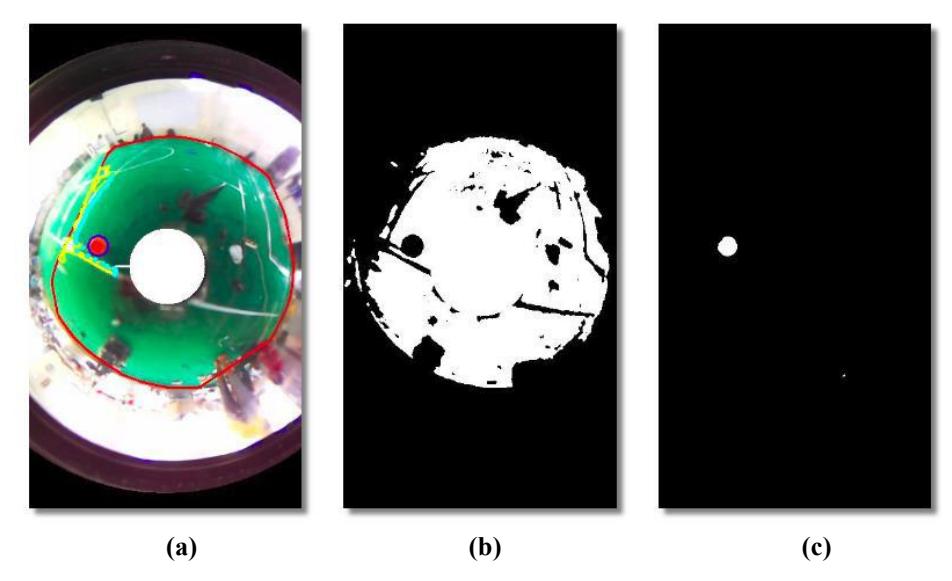
The RoboCup Middle Size League environment is currently color-coded, so we focus to design vision systems to recognize color-coded objects in the RoboCup environment. At the early version of our robot, the proven concept of omnidirectional vision is implemented. The omnidirectional vision system consists of a hyperbolic mirror and a webcam camera (Logitech Webcam Camera). Because of the wide angle of view in omnidirectional vision, the robot does not need to look around using moving parts (cameras or mirrors) or turning the moving parts.
The method that we use to recognize the environment is by thresholding using HSV color. HSV (hue, saturation, value) colorspace is a model to represent the colorspace similar to the RGB color model. Since the hue channel models the color type, it is very useful in image processing tasks that need to segment objects based on its color. The orange color will be the ball, green will be the field, and the other colors will be recognized as an obstacle. In ball, thresholding operation find the biggest contours, but in the field operation find the contours whose values are greater than the specified pixel value.
Software
There are few major programs in the software research and development of the robot, and the first algorithm is the calibration. The calibration uses the Fiber sensor to detect the white line on the field and the rotary encoder to get the "x" and "y" that can be used for positioning the robot. After the robot can find its location in the field, the next job is to detect the ball. We use the 360-degree camera to get the vision of the ball.
After the ball has been detected, the next part is to score a goal. The robot uses an algorithm that can determine the opponent's goal and its position on the field. The process of making a score depends on how complex the situation on the field if the
opponents are defending with very tight, the robot can avoid the opponents using the obstacle avoidance. Finally, after getting a clear shot, the robot can decide which way to make the goal, both left or right side of the goal, and even the centre of the goal. The robot can also play various of game mode depending on the match situation.
CONCLUSION
As a new participant in the RoboCup community, IRIS will have to prove the success of its approach to robot soccer. Promising achievements show that the balanced mix of reusing existing knowledge and software, components and new improvement can lead to competitive advantage.
Technological research streams embedded in this project include machine learning, software architecture and technology, embedded motion control, and localization, planning, and sensor fusion. Further, the project is an excellent case study for researching the processes and practices of integrated high-tech systems development projects.
References
- A. Giusti dkk., "A Machine Learning Approach to Visual Perception of Forest Trails for Mobile Robots," IEEE Robotics and Automation Letters, vol. 1, no. 2, page. 661–667, Jul 2016.
- B. M. Faria, L. P. Reis, N. Lau, and G.Castillo, "Machine learning algorithms applied to the classification of robotic soccer formations and opponent teams," 2010, pp. 344-349.
- Y.-R. Hou, "Moving target detection in the robot system based on Omni-Vision and laser rangefinder," 2015, pp. 1162-1166.