RobotSports Team Description Paper
Ton Peijnenburg, Jürge van Eijck, Noah van der Meer, Charel van Hoof, Rob Burgers
VDL ETG, De Schakel 22, 5651 GH Eindhoven, The Netherlands
Abstract Robot Sports is an open industrial team, meaning that its participants are all employed by or have retired from various high-tech companies in the Dutch Eindhoven region or are active students. The team participates intending to develop additional skills that must be added to traditional engineering practices for high-end mechatronic equipment to develop autonomous robotic systems or teams of autonomous robotic systems. Technologies from the domain of Artificial Intelligence in turn may be used to improve high-end equipment and its development effectiveness and efficiency. Most of the participants currently work on robotic products and/or robotic technologies in their products. This year, the team will report on newly designed hardware for the soccer robots and on the progress of applying deep neural networks to improve object detection.
Keywords: robotics · machine vision · machine learning · artificial intelligence · motion control · RoboCup · MSL.
Introduction
The Robot Sports team is an open industrial team supported as main sponsor by VDL, an international industrial family business with 105 operating companies, headquartered in Eindhoven the Netherlands. The team shares a dedicated facility with the ASML Falcons team in the city of Veldhoven, near Eindhoven. This year the team will play with new robots, which have evolved from the previous generation. The previous generation robots of the Robot Sports Team were developed as a mix of the Philips robot design used in the MSL competition [1], design advancements developed by the Philips team after the last tournament participation, and the Tech United TURTLE robot design from the year 2012 [2]. A new generation of robots enabled with our latest insights and improvements.
Robot hardware
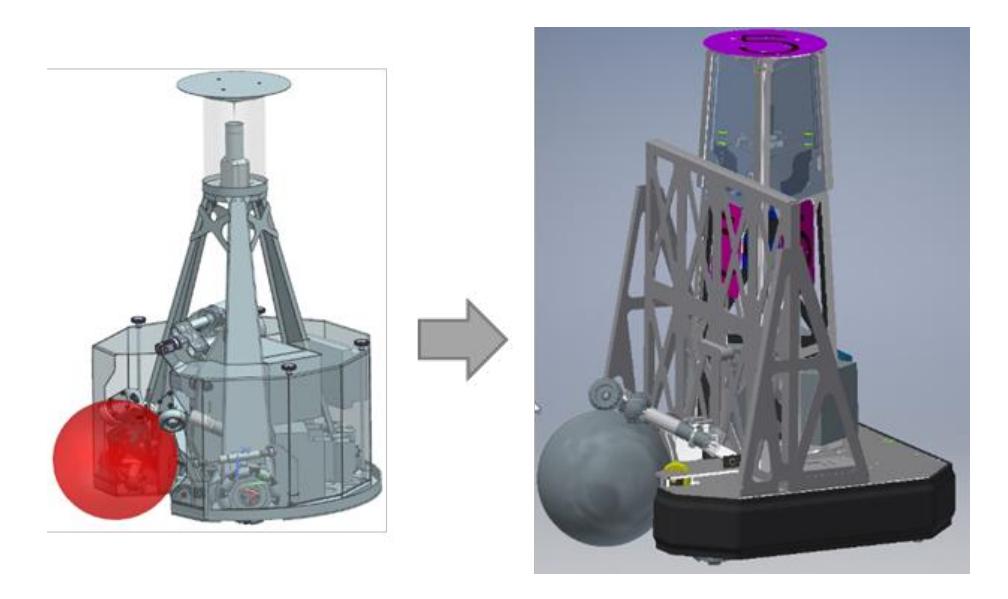
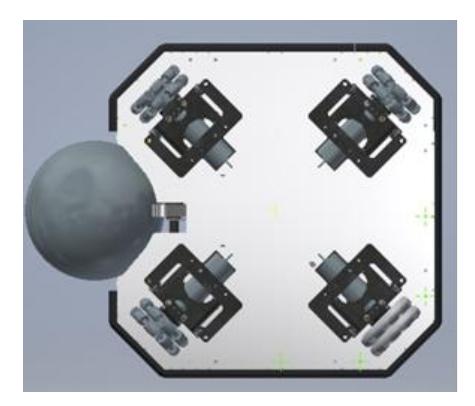
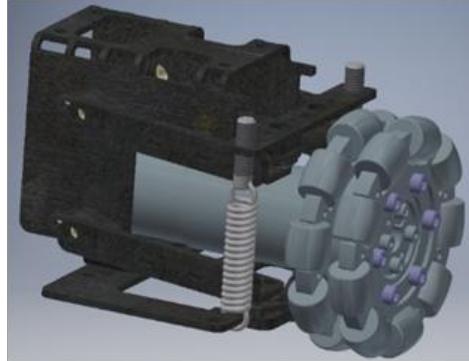
The revisions to our robots' hardware are aimed at making them faster, more reliable, easier to service, safer and more efficient to transport. Robots will have four omni-directional wheels for better stability and traction, an improved ball handler mechanism with better placement of passive and active wheels, and a new camera tower that can be separated for transport and provides more easy access for camera adjustments. In addition, the control electronics will be modified to include off-the-shelf motion controllers as well as custom designed, micro-controller based I/O, control and safety modules. The new design also facilitates the housing of a stereo depth sensor camera.
Visual sensing
Our robots have a GigE camera from Point Grey with a 1280 x 1024 pixel image sensor. The camera and omnimirror combination is designed with a compromise in resolution close by and far away. This compromise comes at the cost of some image distortion and a closed-down iris. For the self-localization samples from all visible field lines used. After translating samples of lines from camera coordinates into robot coordinates, these line samples are matched with hypotheses of field orientations at a resolution equal to the line width in a 2x 1D fashion. Knowledge about the long and short edges of the field is considered here. To resolve north south playing field ambiguity, an electronic compass unit is used. With the camera, a ball sized object can be detected up to 7 meters. Discrimination between a ball and environment is done based on color segmentation in the YUV domain. Color segmentation for field and ball colors is based on (semi) auto calibrated segmentation parameters. We have recently worked on integrating an additional stereo vision system to supplement the omni-directional vision system installed on the robot. Specifically, we have worked with the ZED2 2K Stereo Depth sensor developed by Stereo-Labs [5]. The ZED2 contains two synchronized high-resolution RGB cameras which can deliver frames up to 100fps.
Through specific calibration and triangulation, these two cameras can be used to estimate the depth of objects present in the image. The ZED2 device can be used to determine distances between 0.5m and 20m with a very tolerable error [6]. The main advantages of using the ZED2 are that the estimation of positions of objects is typically more accurate than what can be achieved using the omni-directional vision system, and the fact that it allows for the detection of airborne objects such as balls passing through the air. In the past, we have used similar devices such as the Microsoft Kinect to supplement the omni-directional camera with great success. In indoor environments with artificial lighting, these devices that essentially employ active IR projection and detection to estimate depth perform quite well. On the other hand, performance in out-door conditions under direct illumination from the sun is typically severely limited. The ZED2 does not suffer from this constraint due to the passive nature of the depth estimation. As the RoboCup community moves closer to its 2050 goal of challenging human opponents, this is highly relevant as it would allow for outdoor matches. In order to detect objects such as the ball and other robots in the frames delivered by the ZED2 sensor up to high distances, we have worked with Deep Neural Network frameworks such as Tensorflow [7] and PyTorch [8]. Recently we achieved very promising results with the YOLO neural network using the latter framework [9]. We are currently also investigating the use of the MobileNetV3 network developed by Google, which is supposed to be particularly suitable for resource-constrained systems [10].
Behavior and reasoning
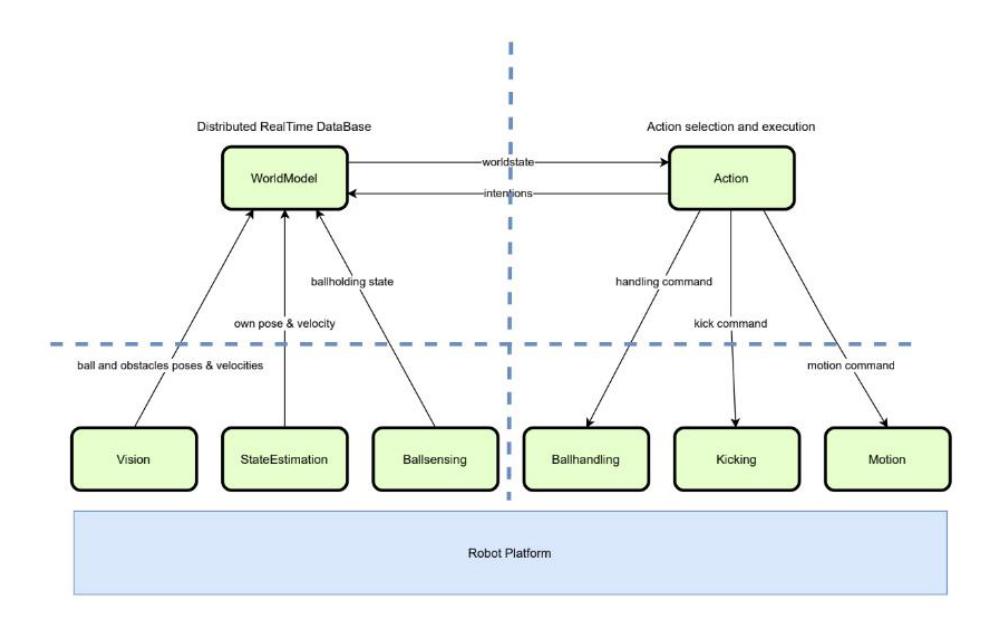
We believe that the reasoning that is required for soccer should be responsive. Our robots must react quickly, making a non-optimized but appropriate decision. This is a trade-off between timing and quality. The robot behavior is implemented as a set of executable skills. These skills have dedicated responsibilities and effectively run parallel. A finite state machine (FSM) controls the highest-level states of the robot. The FSM decides when and which transition is made. When a transition is made the set of skills that are relevant for that state are made active. Our robot planner is a variation of the visibility graph [11], which was used on the first general purpose mobile robot Shakey [12], fitted for the soccer domain. Heuristic functions can be applied on the edges of the created visibility graph (robot planner). Via these heuristics the opponents can be avoided, while maintaining distance to the field boundaries. By restricting the edges towards the target and additional heuristics the approach angle of the ball can be influenced. Also, the robot's own velocity vector can be taken into consideration. Via constraint-based optimization the best path is determined. The result of the robot planner is a list of x-y points. This describes a rough path. The rough path is used by a movement skill, which smooths the path and takes velocity and acceleration constraints into account. The skill then sends velocity set-points to the motion system of the robot. Rotation skills can in the meantime perform orientation of the robot while driving. We are using a heuristic based team planner, which uses the robot planner to calculate for every available player a path to an objective, until no players are available. The team planner combines dynamic role assignment and strategic positioning. The dynamic role assignment is made more robust by taking previous assignments into account and allowing some hysteresis. The Robot Sports Team uses RTDB [13] to exchange and synchronize data between team players, which results in a fast and accurate shared world model. A major change in the team behavior is the change from zone defense to a man-to-man defense. For this feature it is required to select the most dangerous opponent to be defended. The algorithm to determine this opponent, is inspired by the paper on Prioritized Role Assignment for Marking [14].
The team is replacing the home brew FSM solution by Behaviour Trees (BT), aiming at more flexibility, faster decisions and improved debugging and replay capability. A BT defines a composition of a set of tasks and the switching between these tasks. It also allows complex tasks to be composed of simple tasks, which matches with the current setup of our software architecture. The implementation is based on the BehaviourTree.CPP [15]. Groot is used for editing, display and replay [16].
Open Software Development Kit
Robotsports has opened up their robots for students to design, implement and test robot control software. In collaboration with Fontys University of Applied Sciences Eindhoven, Robotsports has created a Software Development Kit that offers students the necessary tools to use soccer robots of Robotsports in their practical studies.
Outlook
For a future generation of robots, we are considering two-wheeled robots. We aim for a cost-effective platform based on technology of a hoverboard, e.g., an Oxboard [18]. Key advantages include a much higher wheelbase than the typical MSL robots, creating compatibility with natural sports environments including artificial and natural turf, and the ability to create mixed settings with human players. Speed and out-door capability have been demonstrated by the so-called Mobile Virtual Player, a remote-controlled platform used to augment professional sports training [19]. After finalizing our current platform revision, we plan to continue our work on the design of this two-wheeled robot platform. On a shorter term, our team participates with ASML Falcons in a follow-up to the 2020 MSL workshop to define a mixed-team protocol and create a demonstrator for a mixed-team match using robot players from both Falcons and Robot Sports. We consider the mixed-team option as an important element for accelerating innovation by allowing more teams to participate in RoboCup MSL, even with less than five robots, and to make steps towards matches where humans can play with (or against) robots.
Conclusion
In the previous season 2019-2020 we started with revision of our robots. We extended into season 2020-2021 and 2021-2022 due to the COVID19 lockdowns, their impact on team work, as well as the cancellation of all physical RoboCup events. With our previous hardware, we benchmarked our performance against European teams, and specifically the ASML Falcons during our monthly practice matches in our shared facility. This brought us to the level where we are now: we can play a basic level of robot soccer. In order to close the gap to the top teams, we need to make our robots more robust and at the same time, more advanced. Making the hardware more robust prevents downtime during tournaments and automating calibrations reduces the time we need unboxing our robots to be ready for a fist match. This challenge is not unlike installation and calibration of high-tech equipment in its production environment. More robust also includes more robust sensing for different/changing environments. More advanced in our case implies faster motion, better ball control and faster responses. Especially the latter is performance characteristic that has system-wide impact when improving. When improvements for these aspects have been made, more advanced robot and team behavior will become more relevant.
References
- A.T.A. Peijnenburg, T.P.H. Warmerdam et.al.: Philips CFT RoboCup Team Description. In: preliminary proceedings 2002 RoboCup conference, July 2002.
- Turtle Robot description on robotic open platform, http://www.roboticopenplatform.org/wiki/TURTLE, last accessed: 2020/01/30.
- Basicmicro RoboClaw Dual 34VDC, https://www.basicmicro.com/motorcontroller2, last accessed 2021/03/20.
- PJRC Teensy 4.0 Development Board, https://www.pjrc.com/store/teensy40.html, last accessed 2021/03/20.
- Stereolabs, "StereoLabs Website," 2021, accessed: 2021-03-18. [Online]. Available: https://www.stereolabs.com/.
- Ortiz, L. E., Cabrera, E. V., Gonçalves, L. M. (2018). Depth data error modeling of the ZED 3D vision sensor from stereolabs. ELCVIA: electronic letters on computer vision and image analysis, 17(1), 0001-15.
- Abadi, M., Barham, P., Chen, J., Chen, Z., Davis, A., Dean, J., ... Zheng, X. (2016). Tensorflow: A system for large-scale machine learning. In 12th USENIX symposium on operating systems design and implementation (OSDI 16) (pp. 265-283).
- Paszke, A., Gross, S., Massa, F., Lerer, A., Bradbury, J., Chanan, G., ... Chintala, S. (2019). Pytorch: An imperative style, high-performance deep learning library. arXiv preprint arXiv:1912.01703.
- Bochkovskiy, A., Wang, C. Y., Liao, H. Y. M. (2020). Yolov4: Optimal speed and accuracy of object detection. arXiv preprint arXiv:2004.10934.
- Howard, A., Sandler, M., Chu, G., Chen, L. C., Chen, B., Tan, M., ... Adam, H. (2019). Searching for mobilenetv3. In Proceedings of the IEEE/CVF International Conference on Computer Vision (pp. 1314-1324).
- Lozano-Pérez, Tomás; Wesley, Michael A. (1979), "An algorithm for planning collision-free paths among polyhedral obstacles", Communications of the ACM 22 (10): 560–570, doi:10.1145/359156.359164.
- http://www.ai.sri.com/shakey/.
- Santos, F. , Almeida, L., Pedreiras, P. ; Lopes, L.S.: A real-time distributed software infra-structure for cooperating mobile autonomous robots. In Proceedings of 14th IEEE Interna-tional Conference on Advanced Robotics, Munich, Germany (2009).
- MacAlpine P., Stone P. (2017) Prioritized Role Assignment for Marking. In: Behnke S., Sheh R., Sarıel S., Lee D. (eds) RoboCup 2016: Robot World Cup XX. RoboCup 2016. Lecture Notes in Computer Science, vol 9776. Springer, Cham.
- https://www.behaviortree.dev/
- https://github.com/BehaviorTree/Groot
- https://github.com/RobBurgers/rsopenapi
- Oxboard homepage, http://www.oxboard.eu, last accessed: 2020/01/30.
- Mobile Virtual Player homepage, http://www.mobilevirtualplayer.com, last accessed: 2020/01/30.