Team Description Paper: IRIS Team 2023
Rudy Dikairono, Azzam Wildan Maulana, Danendra Clevero Ananda, Hafiz Zain Fahrizal, Hanif Ariq Wibowo, Wahyu Sholeh P., Ahmad Jawhari Fauzi
Workshop Laboratory, ITS Robotics Centre, Institut Teknologi Sepuluh Nopember, Surabaya 60111, Indonesia
Abstract IRIS is a team of robots competing in the soccer robot league. The Team has founded in mid-2016 with the ambitious goal of competing in international robotics competitions with continuous technological developments. This paper presents the middle league information of the IRIS team including team information, hardware information, and software information for RoboCup 2021. In this paper, we will introduce the mechanical system, electrical system, and software of our robot.
Keyword: RoboCup Soccer · Middle-Size League · multi-robot · vision locallization · ball-handling
1 Introduction
IRIS (acronym for ITS Robots with Intelligence System) is a robotic team that competes in the soccer robotic competition, focusing on the Middle-Size League. IRIS team represents Institut Teknologi Sepuluh Nopember Surabaya (ITS), whichconsists of 37 undergraduate students and two magister students. The team was formed inmid-2016 with the ambitious goal of competing in the international robotics competition. IRIS competes in the middle-size soccer robot competition which is held annually by the Ministry of Research Technology and Higher Education of the Republic of Indonesia called KRSBI-B. This first competition was held in 2017 and our team wonvarious awards, then continued the following year until the last year, we got 1st place in KRSBI-B Regional II, 1st place in KRSBI-B National competition, and best strategy in KRSBI-B National competition. We have also participated in RoboCup Asia -Pacific 2022 and got 1st place in Open Challenge and Cooperation Challenge. Especially, during RoboCup 2022 in Thailand, we won 3rd place in Middle Size Robocup League. The paper describes IRIS research improvements over the last year. First, in section 2, we added our developed localization using omni-vision. Then, in section 3, implemented new mechanism for holding the ball naturally was added.Next, in section 4, describes the application of gazebo simulation in developing IRIS program remotely. Finally, Section 5 provides a conclusion.
2 Vision Locallization
After looking at our robot's performance in Robocub 2022, IRIS's localization was lacking in terms of error minimization. Being able to locate a precise location in the field and synchronize it on real time with a back station could give us opportunities in making fast and accurate future decisions about robot movement. Hence, we need to overcome it with our omni vision. Before initiating this idea, we had been using several rotary encoder and ultrasonic sensors.
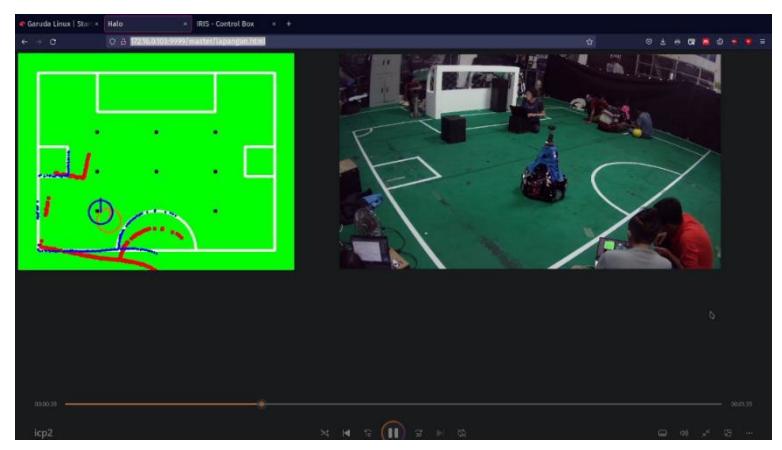
Omni vision localization works by scanning lines in the field and comparing this data with a static map which has been created before. After receiving vision data, our robot will fusion this data with encoder and ultrasonic data. Thus, the robot would know its current position and estimated position.
The image shown above was the first prototype of our visual localization which has been fused with rotary encoder. As we can see in the left part of image, there are blue lines showing actual robot and red lines estimating robot coordinates. Our target is achieving minimum error in localization which can be indicated by overlapping blue and red lines.
After encountering stuck in the middle of development, we assumed perfect localization cannot be attained using camera controlled by program only. Therefore, we came up with the solutions by measuring the line distance relative to our robot. In order to make that happen, we performed several methods as below.
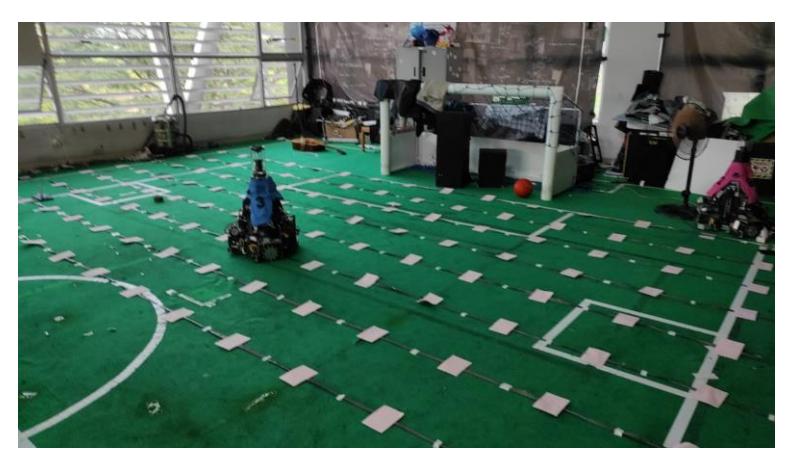
In order to calibrate the camera visual localization, our robot was placed in every single point in the field. The distance between one point to another is measured correctly and spread in entire field. The result of this method could really decrease the localization error and improve robot performance.
3 Ball Handling
Ball handling is robot's mechanism controlling ball position toward specific location and specific level. The main issue in ball handling is controlling ball movement relative to robot movement. When robots carry the ball without proper ball handling, the ball will have friction against the field. In the fast velocity, greater friction will occur making ball become harder to control and eventually, come off from dribbles grip.
Using natural ball handling will make dribble spin the ball with specific speed controlling the ball in exact position with minimizing friction. This friction can be decreased because dribbles spin the ball making translation and rotation movements making almost zero friction.
Natural Ball Handling is a main rule of Robocup. In 2023 IRIS Finally managed to complete this task. In order to complete this task, there are a lot of things that should've done. We should change all of the current ball handling system. From the mechanical, electrical, and also the program.
3.1 Mechanical
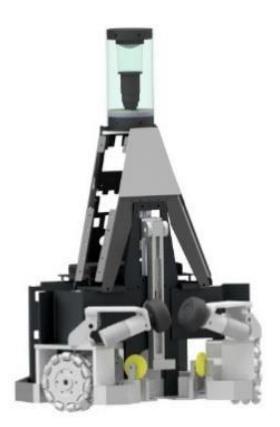
The main problem of our ball handling is the mechanical design that doesn't support the robot to have such abilities to control the ball. Our old robot has this kind of design
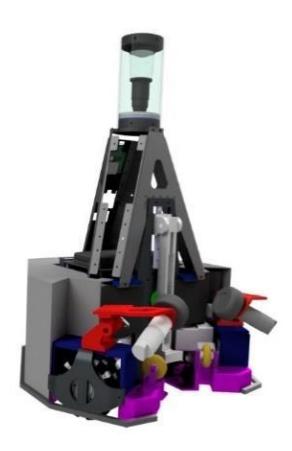
As we can see, the dribble is designed to catch the ball as strong as possible. In that way would make the ball become harder to control. The solution that we came up with is that we should re-design the dribble design, so that the robot would be able to handle the ball correctly. And here is the design that we came up with.
The dribble position is getting higher and wider, thus the dribble's wheel would touch the ball a little more than our last design. Increasing dribble wheel contact area could also increasing the grip hence increasing ball control.
3.2 Electrical
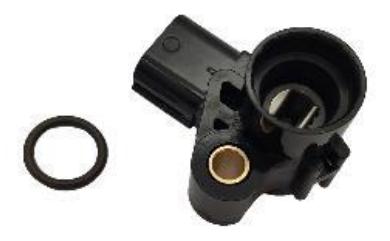
For the electrical part, we add one more sensor that can be used to determine the arm lever's position, this way the dribbler could have control on our ball position, etc. The sensor that we're using is angle position sensor. To withstand any mechanical impacts and environmental influences, the actuating mechanism needs to be reliable and easy to operate. Through the arm lever shaft and a metal or plastic connecting part, the actual movement is changed into a rotary movement. Using the induction approach, the sensor determines the precise angular location.
3.3 Programs
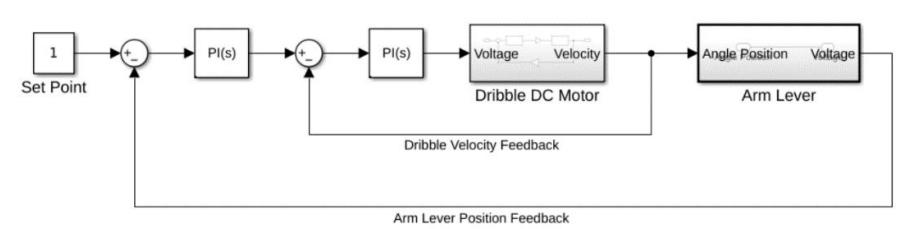
This is our flowchart of our new ball handling mechanism.
4 Gazebo
Gazebo, open-source 3D robotics simulator, is a powerful robot simulation environment managed by Open Robotics which is also part of a group looking after ROS. This robot simulator is widely used by industry and academia to advance progress of robot development with powerful tools that could be able to calculate physics, generate sensor data, and support OpenGL rendering.
Many tools which can be configured easily emulating real world environment matching with IRIS robot conditions are advantageous especia lly in robot research. Every data such as friction, force, momentum are important things that differ between real world and simulation.
In 2019 gazebo had not been fully used by our team, then in 2020, when COVID started, the IRIS team was faced with a problem. The problem is, we have difficulty in developing and exploring new programs that will be applied for the robot due to the pandemic protocols and semester breaks. At this point we realize how Gazebo is important and seriously needed.
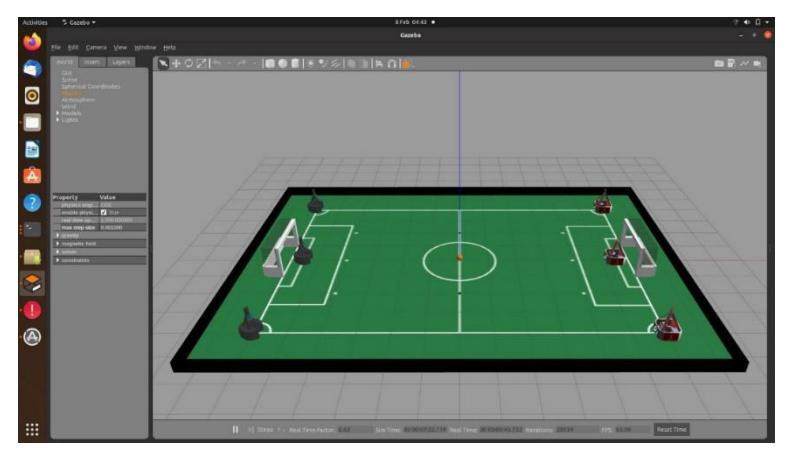
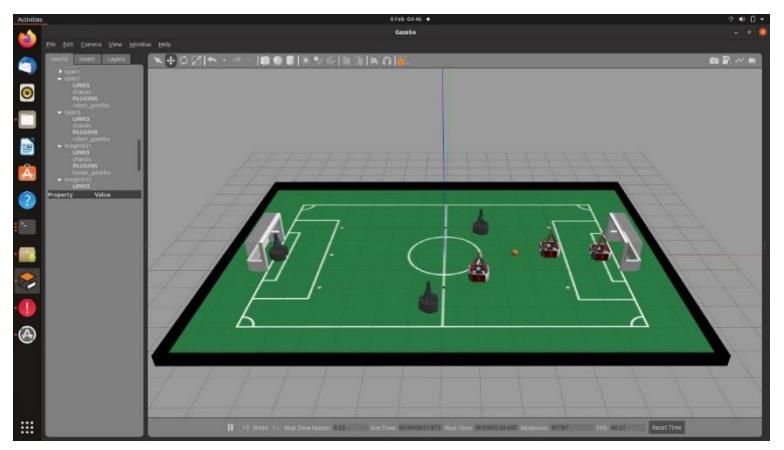
In Gazebo's simulation program, we can create three dimensional simulations. Laws of physics are also being applied here. Below is an illustration of Gazebo's simulation program where we can do a few matches. The illustration below, is an example of a three-on-three match.
There are a few things that we emphasize while using Gazebo's simulation program. According to our experience, there are limits on developing robots through online, one of them is the imprecise results or projections with the real world due to X factors. Unlike a strategy that does not require complicated laws of physics, we are able to fully develop strategies prototype in Gazebo's simulation program that will be projected precisely in the real world. In conclusion, strategy is one of the factors that we highlight most while using Gazebo.
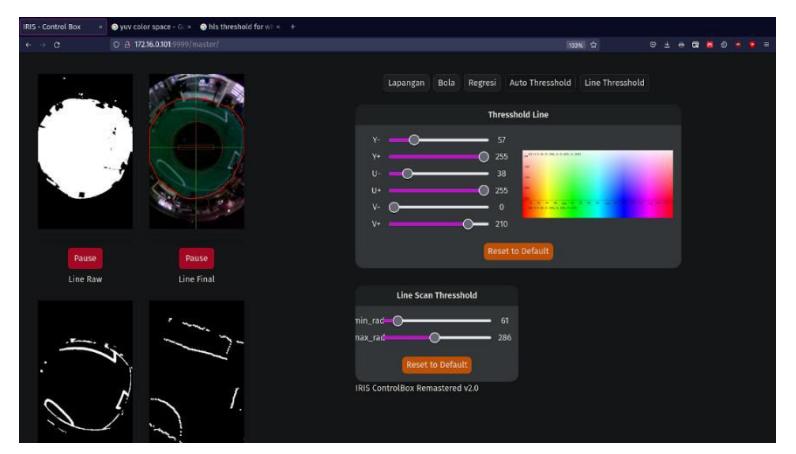
In the Gazebo simulation, each robot must be programmed so that the simulation can run as we want. To simplify the configuration of the robot, we created a program which we named control box. Control Box is a web-based application where it has the ability to configure various features in a robot. Some of the features in the control box include detecting lines, balls and also the field. Using this control box feature in Gazebo, it allows all cameras of each robot in the simulation to be displayed. Hence, we are able to see various points of view from each robot.
5 Conclusion
Based on the achievements of our team in National Leagues and the experience in participating in RoboCup 2022 in Thailand, IRIS will have a strong commitment to participate in RoboCup 2023 proven by the development of the robot in the software platform and mechatronic system.
The major improvements that were made for this past year are mostly about softwareplatform. First, we got our first localization system, this system helped us a lot, where it brought us to become a first winner in robocup Asia pacific 2022. Last but not least we got our first and most robust ball handling system, actually, our team has a natural ball handling system before, but it was not a perfect system and was hard coded. But in the beginning of 2023 IRIS's managed to develop a whole new ball handling system which was not being hard coded, and this brought us to fulfil robocup's prerequirement that the robot should be able to do natural ball handling in order to be able to participate in the game.
References
- A. Giusti dkk., "A Machine Learning Approach to Visual Perception of Forest Trails for Mobile Robots," IEEE Robotics and Automation Letters, vol. 1, no. 2, page. 661–667, Jul 2016.
- B. M. Faria, L. P. Reis, N. Lau, and G.Castillo, "Machine learning algorithms applied to theclassification of robotic soccerformations andopponent teams," 2010, pp. 344-349.
- Y.-R. Hou, "Moving target detection in the robot system based on Omni-Vision and laser rangefinder," 2015, pp. 1162-1166.
- Falithurrahman, Maulana, "Implementasi Lidar pada Robot Sepak Bola Beroda untuk Tendangan ke Gawang", Institut Teknologi Sepuluh Nopember, Surabaya, 2019.