UQ CrocaRoos2k2 Simulation Team
Gordon Wyeth, Mark Venz, Rex Heathwood
School of Information Technology and Electrical Engineering, University of Queensland, BRISBANE
Abstract This paper describes the CrocaRoos simulated soccer agent, a development platform for testing multi-agent intelligence systems and dynamic object prediction. The agent uses the Multi Agent Planning System (MAPS) for coordination and has been redesigned in 2002 to address latency issues by implementing centralized data storage and predictive world models instead of linear data processing.
Overview
The CrocaRoos simulated soccer agent is a development platform, to test the feasibility of multi-agent intelligence systems, and algorithms determining the future locations of dynamic objects. The second determining factor, in the design of the base, is to make the agent small and efficient enough to be included as the intelligence systems of physical robot teams. These two factors largely affected the design of the CrocaRoos player-agent base.
Multi Agent Planning System (MAPS) has been used successfully in all of the University of Queensland Robot teams that have participated in RoboCup Robot Soccer World Cups[1, 2]. MAPS requirements are primary focus in the design of the agent.
MAPS technology was developed for use in the University of Queensland's smallsize league team, the RoboRoos. MAPS has demonstrated very promising results as a general coordination system in both competition and testing environments[3–5]. It improves coordination among agents by choosing individual goals for each agent that will improve the probability of achieving the team's goal. MAPS coordinates agents through the superposition of potential fields. Each field reflects the probability of positive or negative influence of an environment attribute on the team's goal in the near future. The summation of all these fields, calculates the best choice of action for a particular agent and where on the field it should that action should take place.
In the small-sized league, MAPS utilizes a world model obtained from an overhead camera, and as such has a complete world model. Even with this world view MAPS considers the world from each players perspective when making decisions that accomplish coordinated multi-agent plans[3].
Each robot receives a complete world model from the vision system as well as the MAPS command, which when combined with its own reactive navigation routines, enable it to navigate or kick to the desired location.
In RoboCup Simulation League each agent has to perform independently, utilizing data received from the server as sensor information to build a world view. Data received by each player is relative to that player. MAPS, on independent agents, has to determine actions that will fulfill teams goals based on individual observations. To determine these actions MAPS requires a complete as possible world view.
CrocaRoos 2001 was the previousincarnation of the simulated agent. The former base had a linear approach to processing the data and determining an action.
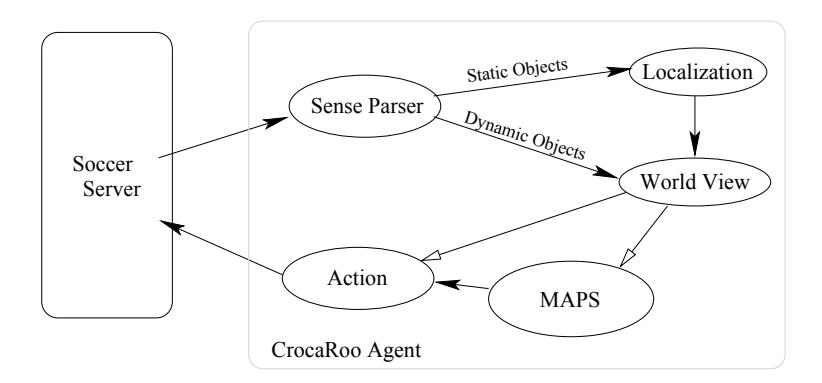
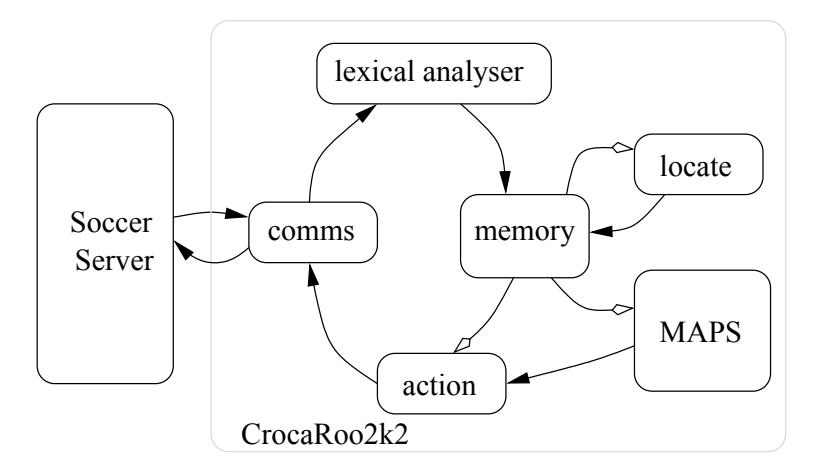
Continuing Work
MAPS is currently configured as though it where still receiving a reliable single global view of the field and as such makes plans as though it has correct information of the entire field. To make a decision in the required time, the grid MAPS uses to generate a plan is necessarily coarse. Working in conjunction with determining the most probable locations of moving objects, the MAPS grid and parameters will be refined so that MAPS develops plans more for the immediate area surrounding the player, and on a much finer grid.
Work is also continues on the prediction of where moving objects will be in the robot's near and immediate future. This information and the player agent code eventually helping the GuRoo, the University of Queensland's humanoid robot[6], play soccer, and enabling other teams of robots to work safely in heavily dynamic spaces.
References
- Wyeth, G.F., Tews, A., Browning, B. UQ RoboRoos: Kicking on to 2000. In: Stone, P., Balch, T., Kraetzschmar, G. (eds.): RoboCup 2000: Robot Soccer World Cup VI Lecture Notes in Artificial Intelligence, Vol. 2019. Springer-Verlag, Berlin Heidelberg New York (2000) 527–530
- Chang, M.M., Browning, B., Wyeth, G.F.: ViperRoos 2000. In: Stone, P., Balch, T., Kraetzschmar, G. (eds.): RoboCup 2000: Robot Soccer World Cup VI Lecture Notes in Artificial Intelligence, Vol. 2019. Springer-Verlag, Berlin Heidelberg New York (2000) 527–530
- Tews, A. and Wyeth, G.F. MAPS: A System for Multi-Agent Coordination. In: Advanced Robotics, Vol 14 (1). VSP / Robotics Society of Japan (2000) 37–50
- Tews, A. and Wyeth, G.F. Multi-Robot Coordination in the Robot Soccer Environment. In: Proceedings of the Australian Conference on Robotics and Automation (ACRA '99), March 30 – April 1, Brisbane. (1999) 90–95
- Tews, A. and Wyeth, G.F. Thinking as One: Coordination of Multiple Mobile Robots by Shared Representations. International Conference on Robotics and Systems (IROS 2000) 1391–1396
- Wyeth, G., Kee, D., Wagstaff, M., et al. Design of an Autonomous Humanoid Robot Australian Conference on Robotics and Automation 2001 available at: http://www.itee.uq.edu.au/ damien/guroo/publications.htm. (2001)
- Stone, P., Riley P. and Veloso M. The CMUnited-99 Champion Simulator Team In: Veloso, M., Pagello, E., Kitano, H. (eds.): RoboCup 99: Robot Soccer World Cup III Lecture Notes in Artificial Intelligence, Vol. 1856. Springer-Verlag, Berlin Heidelberg New York (2000) 35–48