UTUtd2002 Simulator Team Description
Pooyaun Masoumi, Amin Bagheri, Mostafa Hadian, Pouya Nasir Abadi, Farid Amir Ghiasvand, Pedram Ghodsnia, Payam Mahmoudian
Department of Computer Science, University of Tehran, Iran
Abstract In line with UTUtd2001 Team's policies [1], this year we benefited from the advanced and contemporary studies in fuzzy evaluation technologies. In what follows, we will have a brief introduction to the main concepts regarding UTUtd2002 development. We would like to thank Tsinghuaeolus Team [2] for their great low-level abilities, which we used as our bench work. The paper is organized as follows: In section 1 we will define the 3rd dimension, which would construct the base for nearly all fuzzy actions in the team. Section 2 will discuss a kind of globally computable geometric area. In section 3, usage of the above mentioned two concepts integrated with fuzzy shoot and fuzzy passing system will be discussed. And finally section 4 will conclude with some points on developing such systems and the Team's future work.
1 Introduction
As mentioned in [1], the environment simulated by the soccerserver shall not be considered as a reliable source of information. Making decisions upon these unreliable information has made robocup a challenging problem for researchers all around the world. Since the fuzzy set theory has been suggested as a proper conceptual framework of decision-making [3], our main attention has been focused on fuzzy action evaluation and selection (FAES) algorithms [4]. Before delving into making the problem show us its' delicate fuzzy viewpoints, here we shall define the 3rd dimension to be used later. By 3rd dimension we don't mean bringing Z-axis to work but instead simulating it by assigning a probability function to all the points in the field in every cycle during the match. Every point in the field then shall be considered consisting:
- X 2. Y 3. Z = P(X,Y,A)
Where 'A' is the action to be done on that point in a given cycle. This helped us a lot in devising the entire system.
2 Globally Computable Geometric Areas
In every given cycle during the match each agent, with the ball or without, has to make the best action to do. The main point to consider here is that the selected action shall not just be suitable for the agent it self but in a rather more important degree shall be appropriate and useful to other agents around him by providing them situations to approach their time-critical goals. This is where our Globally Computable Geometric Area comes to work. Assigned to each high-level action, like passing or shooting, are some global parameters. By global parameters here we mean variables that are the same for every agent in the field. Based upon these global parameters, each agent can construct the desired Geometric Area inde pendently for each action. The interesting point here is that the constructed Geometric Area is almost the same for a given action in a given time for every agent on the field. We define the Geometric Area G for the action A, a set of vertices in the field (of course expressed in a non-linear equation) where while in those vertices in the next 5 cycles, the action A will be accomplished successfully with a probability of 95% or higher. By solving this non-linear equation and interpolating the achieved points we reach to the desired geometric area that would be suitable for accomplishing the desired action.
3 Sample Usages of 3rd Dimension and Globally Computable Geometric Area
By building upon the above-mentioned two concepts we can reach to the complex behaviors in the field. Because of space limitations and for simplicity reasons, here we take a look at simplified versions of the shooting mechanism and passing system in brief. Note that how these two actions can be seen as a single behavior in the field by combining their involved parameters.
3.1 Shoot
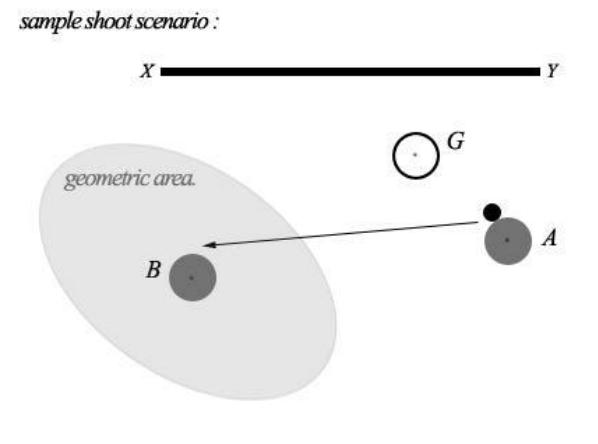
Take a look at the situation illustrated in figure 3.1. This situation is often seen during most of the matches. Based upon some very basic and simple calculations it will be obvious that agent A cannot make the ball pass through the goalie and make a goal. Our global parameters here consist of XY line, G(x,y) and a few more parameters which are provided for both A and B by their world model or via our saying mechanism. Thus the Geometry Area as shown in the figure 3.1 can be computed by both A and B independently. As mentioned above, here the geometric area would be the region within which shooting towards a special point on the line XY would result in sc oring with a probability of 95% or higher. Note that here the shape of this area is taken very simple for studying purposes and shall not be the same in reality. Agent A does not find itself within the computed geometric area so it will send the ball to the first agent among its' teammates which would be in the above-mentioned area, for example here agent B.
3.2 Pass
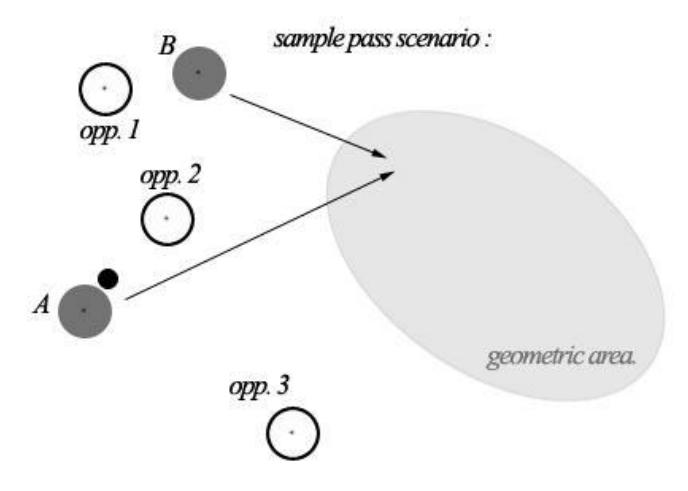
Most of our passing parameters are based upon UTUtd2001 Team. Added to them are the new 3rd Dimension and Globally Computable Geometric Area, which enhanced our passing system in many ways significantly. Take a look at the situation illustrated in figure 3.2. This is one of the most challenging situations where most of the teams do not show an appropriate behavior against this illustrated defensive system. The positioning of the opp.1, opp.2 and opp.3 are showing us a chain defending system in real football games which has its' origins in Italy. In such situations agent A can not make it pass through this defensive wall by passing directly to the agent B or by dribbling the ball among opp.2 and opp.3 in which they will get the ball easily. Our approach to such situations is to compute the geometric area based upon some globally accessible parameters. Here again for studying purposes we've shown the computed region very simple. So both agents A and B know where the pass should be sent to be safe and out of reach of the opponents so agent A will send the ball to a defined point within the region where agent B has already started dashing towards. With this system our offenders were able to make it pass through nearly all defensive systems in robocup easily.
4 Future Work
We are now concerned about low-level skills of our team and are working to build or improve the necessary ones. Also it must be beared in mind that working with a fuzzy decision making system like the one we have devised is a very time-consuming workout and even little changes in a parameter may result in a very big improvement or decline of a formula and also side affects in playing style and behaviors of all agents. We are also working on a method to integrate all behaviors of a team into a single fuzzy decision making system [4].
References
- Pooyaun Masoumi, Amin Bagheri, Mostafa Hadian, Pouya Nasir Abadi ; UTUtd2001 Team Description.
- Tsinghuaeolus Source Code.
- R.E. Bellman and L.A. Zadeh, Decision making in a fuzzy environment, Manage. Sci. 17 (1970) 141-164.
- Rudolf Felix, Relationships between goals in multiple attributes decision making, (1994) Official publication of the IFSA.