Team YowAI-2002
Koji Nakayama, Takuya Ako, Toshihiro Suzuki, Ikuo Takeuchi
Department of Computer Science The University of Electro-Communications Chofu, Tokyo 182-8585, Japan
[http://ne.cs.uec.ac.jp/ koji/](http://ne.cs.uec.ac.jp/ koji/)
Abstract The target of YowAI-2002 is realizing "human-like agent". "Human-like agent" is an agent which realizes its own action decision and cooperation with other agents by a similar method as a human player has taken in actual soccer. As part of the realization of a human-like agent, YowAI-2002 tries to adopt "communication by short shout" and "recognition of the tactical situation and opponent's actions by referencing world model history".
Until now, most of strong team such as FC Portugal and CMUnited uses large amount of numerical and/or symbolic information such as absolute coordinates and elaborate plan sequence[1][2]. We have proposed "communication by shrot shout" as the method which does not use amount of numerical and/or symbolic information. Since a short shout can abstract particular situation at an instant of a game, it can be the means of sufficient communication that uses only several bytes of information, thereby with only minimum utterance. Communication that uses only short shouts has been a challenging trial in RoboCup.
Our former agent depends almost on the current information represented in its world model in the action determination. Therefore, it was not able to recognize opponent action such as dribble, and pass. YowAI-2002 acquired an advanced recognition mechanism of situation and action by judgement virtue of world model history.
Previous YowAI's are evaluated as having precise world modeling[3][4]. However, we have succeeded to equip YowAI-2002 with more accurate self position calculation method, and improved the quality of the world model.
1 Introduction
The target of YowAI-2002 is realizing "human-like agent". "Human-like agent" is an agent which realizes its own action decision and cooperation with other agents by a similar method as a human player has taken in actual soccer. As part of the realization of a human-like agent, YowAI-2002 tries to adopt "communication by short shout" and "recognition of the tactical situation and opponent's actions by referencing world model history".
Until now, most of strong team such as FC Portugal and CMUnited uses large amount of numerical and/or symbolic information such as absolute coordinates and elaborate plan sequence[1][2]. We have proposed "communication by shrot shout" as the method which does not use amount of numerical and/or symbolic information. Since a short shout can abstract particular situation at an instant of a game, it can be the means of sufficient communication that uses only several bytes of information, thereby with only minimum utterance. Communication that uses only short shouts has been a challenging trial in RoboCup.
Our former agent depends almost on the current information represented in its world model in the action determination. Therefore, it was not able to recognize opponent action such as dribble, and pass. YowAI-2002 acquired an advanced recognition mechanism of situation and action by judgement virtue of world model history.
Previous YowAI's are evaluated as having precise world modeling[3][4]. However, we have succeeded to equip YowAI-2002 with more accurate self position calculation method, and improved the quality of the world model.
2 Team play by shouts
The essence of a short shout is that it can inform a player of the tactical situation of the team and give the addressed player a hint to the tactical judgment and action selection. The judgment or action selection is not forced, however. Moreover, the tactical situation told with a short message must be a highly abstracted concept based upon common understanding among teammates probably established by long teamwork training.
YowAI-2001 realized some coordinated play by this kind of shouts. But, it cannot be said that its objectives had been fully attained. The shouts newly taken in YowAI-2002 and the corresponding abstract tactical situations are as follows.
yokose pass to me free you are free one-two make a short pass and dash forward shoot shoot agero push up our defense line shibore come inside, cover inside hirake go outside hattero stand by apart from opponents cross make the ball cross greatly tate make a forward pass or run forward ohkiku give a big kick to clear the local pinch tsunage keep ball possession with short pass exchanges keep keep the ball yourself mon pass the ball through a gate between opponents ura pass to the space behind opponents urawomiro attend your behind through don't touch the pass, because a more advantageous player is behind you kakome surround the opponent who has the ball by a couple of players kire kick the ball outside because we are now confused
kakome surround the opponent who has the ball by a couple of player kire kick the ball outside because we are now confused yosero mark the opponent more tightly who has the ball okurasero delay an opponent's attack until our defense gets solid motteke carry your ball forward as far as possible shobu don't think about passing, you have a big chance
3 Situation and Action Recognition
When an agent decides what to do in the next step, it refers to its own world model to recognize the situation and decide the next action. But the YowAI-2001 world model contains only the most recent snapshot, so that it is difficult to understand what the opponents are doing, such as dribble or one-two pass exchange, which can be understood only with some temporal sequential memory.
In order to realize such advanced recognition, the function of short term history was added to our agents. The short term history consists of the class HistoryElements which holds the information obtained at each clock, a pointer which shows the most recent element, and tables of opponent player's uniform numbers it cares. HistoryElement contains time, position and velocity of the ball, positions of agents (opponents, self, and teammate), and information about which agent was nearest to the ball, and who was controlling the ball.
By using not only recent information but also history information, recognition of opponent agent action became possible, which cannot be done by our former agents.
The ball motion is determined by the simulation done by SoccerServer according to rule of internal physics. Since the acceleration of the ball changes only when an agent kicks, nearby agents can recognize that the ball was kicked by measuring the change of ball speed acceleration. Acceleration change is calculated by observing the position and velocity of consecutive clocks. However, because of error and noise supplied by SoccerServer, this method is not suitable when the ball is kicked weakly, which is often observed in ball keeping and dribble.
In order to recognize an opponent's action that uses kicks of weak power continually, such as dribble and ball keeping, the concept of ball control was introduced. If an agent is observed to be able to kick the ball almost certainly at its present position and the future anticipated position, the agent is deemed to be "controlling" the ball. The information who was controlling the ball is recorded on the history at each clock. By using this history, several non-instantaneous recognition became possible. For example, by checking the last agent who controls the ball, an agent can judge which team is attacking now. This judgment can be used for the change of action plan, say, whether to be offensive or defensive. When the same opponent agent continues on controlling the ball over a number of clocks, our agents can guess the opponent player is dribbling or keeping the ball. Dribble and ball keeping are distinguishable by following the past on a ball position. Dribble is the motion toward a certain direction but ball keeping is not so.
The improvement of the agent performance was obtained by adopting adequate behaviors based upon these advanced situation recognition.
4 Accurate Self Position Calculation
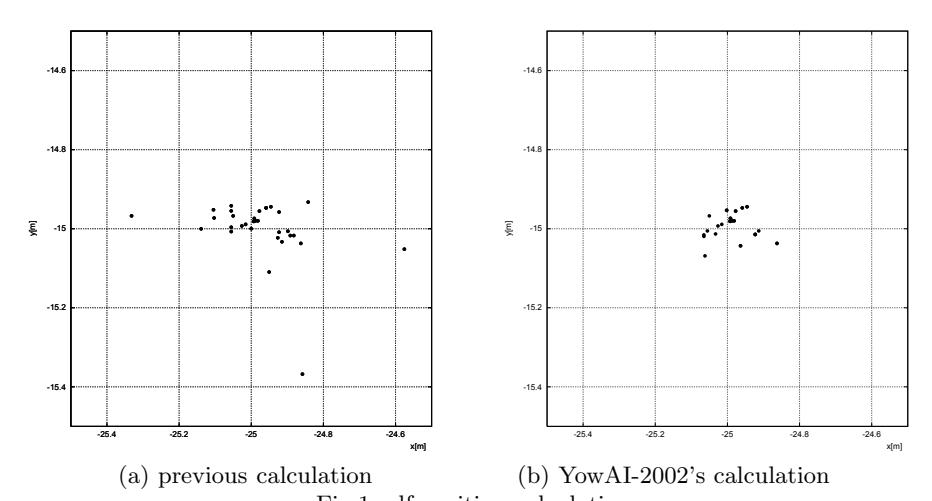
In YowAI-2001, an agent looks at a flag in the virtual field, and approximates the range within it exists by a small rectangle. Then, it gets other approximation rectangles looking at other flags it can see. These rectangles contains altogether the player's exact position inside. Therefore, the intersection of these rectangles surely contains exact position. The intersection of overlapped rectangles can be calculated quickly. Thus we could narrow the possible range of the agent exact position.
An approximated includes surplus range. Thus, cutting off surplus range will improve the accuracy of self positioning.
The calculated rectangle is divided into some smaller rectangle. If the center point of a smaller rectangle is out of the range of the quantization error of a flag position, the smaller rectangle is cut off. The self position is estimated as the gravity point of all these smaller rectangle that have not been cut off.
5 Future Work
The weakness of a short shout is that improvement of individual tactical and strategic ability is required to make such short shouts work well. This improvement will be our future research.
We have to extend our recognition methodology to wider variety of situations and opponent actions and improving the accuracy of our recognition. For toward next step, we have to consider introduction of coach client for dynamic strategy changing.
References
- Luis Paulo Reis, Nuno Lau. FC Portugal Team Description: RoboCup2000 Simulation League Champion, In Peter Stone, Tucker Balch, Gerhard Kraetzschmer, editors, RoboCup-2000: Robot Soccer World Cup IV. Springer, 2001
- Petor Stone, Patrick Riley, Manuela Veloso. The CMUnited-99 Champion Simulator Team, In M. Veloso, E. Pagello, H. Kitano, editors, RoboCup-99: Robot Soccer World Cup III. Springer, 2000
- Takashi Suzuki. Team YowAI Description, In M. Veloso, E. Pagello, H. Kitano, editors, RoboCup-99: Robot Soccer World Cup III. Springer, 2000
- Takashi Suzuki, Shinnosuke Asahara, Hideaki Kurita, Ikuo Takeuchi. Team YowAI-2000 Description, In Peter Stone, Tucker Balch, Gerhard Kraetzschmer, editors, RoboCup-2000: Robot Soccer World Cup IV. Springer, 2001