Aria 2004 Team Description
Hesam Montazeri, Ahmad Nickabadi, Sajjad Moradi, Amir Ghaderi, Sayyed Ali Rokni Dezfouli, Omid Mola, Vahid Kazempour, Mojtaba Solgi, Saeed Akhondian, Hamid Reza Baghi
Robotic Research Center Computer Engineering & IT Department Amirkabir University of Technology
Abstract For the first time Aria soccer simulation team participated in the RoboCup 2003 competition and it won 7th place among 46 teams. This paper describes key innovation that we have done for RoboCup 2004 in Lisbon. Our key innovation is using option evaluation architecture for decision making .We use this architecture in our agent visual decision making.
1 Introduction
One of the most important parts of the agent program design is to choose the decision making architecture. Decision making is the process which the agent selects the best action according to its knowledge base. We used option evaluation architecture for our visual decision making. Visual decision making determines the point where the agent should look at within the next cycle. We are going to describe our visual decision making architecture in this paper.
2 Visual Decision Making Architecture
Our decision making architecture has two layers. Bottom layer generates the possible options and the upper one selects the best option.
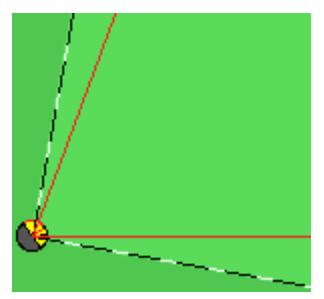
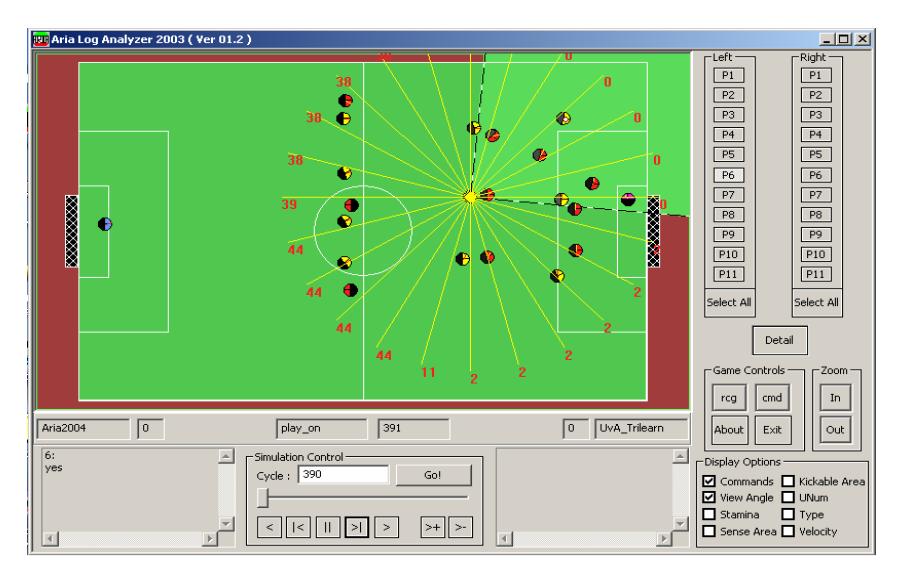
If this architecture is used in visual decision making, the bottom layer calculates the view range where the agent can look at in the next cycle and then generates all possible options with discrete angles in the view range. Each option determines a direction that the agent can look at within the next cycle.
At the upper layer, the agent selects the best option by using several rules and an evaluation function.
Before describing our approach in details we define some terms.
One of the most important parts of the agent program design is to choose the decision making architecture. Decision making is the process which the agent selects the best action according to its knowledge base. We used option evaluation architecture for our visual decision making. Visual decision making determines the point where the agent should look at within the next cycle. We are going to describe our visual decision making architecture in this paper.
It was mentioned upper layer has several rules that the agent uses to select the best option. Each rule can be triggered or not. A triggered rule means that its condition has been satisfied and the agent should not ignore this rule to choose the best option. Each triggered rule consists of:
- Target point that the agent should look at within next cycle.
- The rank which each satisfied rule gives to the agent.
- Main range which is the range that target point of the rule should locate in while the agent is looking at a direction.
An option satisfies a rule if and only if after its execution, the agent can see the target point of the rule by considering its main range.
After generating all the options, the agent determines the triggered rules and then considers which rules are satisfied by each option. If there are not any options which satisfy all the rules then the agent selects the option with maximum rank of rules. But when there are some options that satisfy all the rules, the agent will use an evaluation function to select the best one among the remaining options.
Evaluation function which we have developed uses some values that the agent has in his knowledge base. These values show the visibility of each direction around the agent. The evaluation function selects the option with minimum visibility in its direction.
3 Conclusion and future work
This paper described visual decision making architecture of the Aria soccer simulation team. Our architecture has two layers: the bottom layer generates the possible options and the upper one selects the best option.
We believe this architecture is flexible enough to be applied in the decision making of the agent when possesses the ball .Currently we are working on this issue.
References
- Peter Stone and David McAllester. An architecture for action selection in Robotic Soccer. In Fifth International Conference on Autonomous Agents(Agents'2001)
- Yao Jinyi, Lao Ni, Yang Fan, Cai Yunpeng, and Sun Zengqi. Technical solutions of TsinghuAeolus for Robotic Soccer. In RoboCup International Symposium 2003.
- Stuart Russell and Peter Norvig . Artificial Intelligence: A Modern Approach Prentice Hall, 1st edition (January 15, 1995).