ISocRob 2004 Team Description
Carla Penedo, João Pavão, Pedro Nunes, Luis Custódio
Institute for Systems and Robotics Instituto Superior Técnico Av. Rovisco Pais, 1 – 1049-001 Lisboa, PORTUGAL
http://socrob.isr.ist.utl.pt/indexSim.php
Abstract This paper briefly presents the main concepts that describe the ISocRob 2004 soccer simulation team. At first, the architecture underneath a soccer player is introduced and then some learning methods used to improve the team's performance are mentioned.
1 Introduction and Overview
The ISocRob soccer simulation team is the result of the combined efforts of three master students working in their final thesis. The team participated in the RoboCup World Cup for the first time in 2003 in soccer and online coach competitions and game presentation and analysis sub-leagues. ISocRob 2003 used the base code released by UvA Trilearn as a starting point for the development of a reactive team in which the major topic was the definition of high-level behaviours and strategy.
ISocRob 2004 extends its predecessor in several ways. Firstly, the developed architecture integrates personality in the attempt of resembling a real soccer team played by humans based in the Social-Cognitive Learning Theory from Walter Mischel [1]. In a real world match there aren't two players alike and so they don't exhibit the same behaviour when facing identical situations. By studying the idiosyncrasies that give each one a unique character it is possible to capture some of the diversity inherent to people's behaviour and understand its influence on the actions performed by humans. In this way it is possible to integrate and take advantage of such knowledge to define different strategies and formations in a soccer game. On the other hand, some learning methods that enable agents to analyse the results of their actions and behave accordingly after and during the games are currently being integrated.
2 Architecture
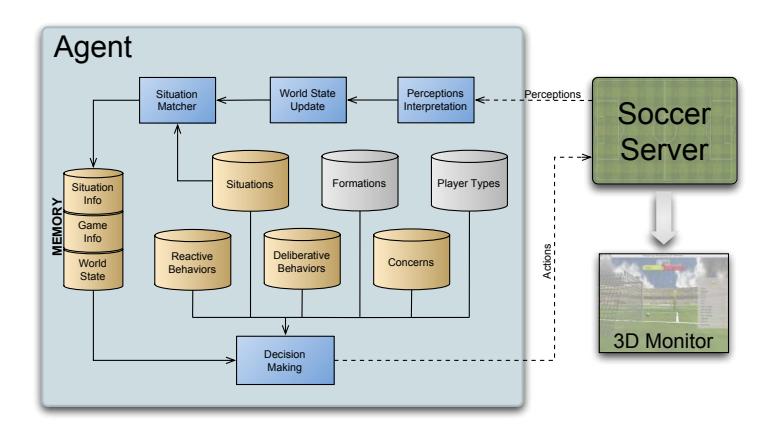
The structural model of an ISocRob player is described in Fig. 1. Generally, the agent uses its perceptions (received by the "Perceptions Interpretation" module) to update the world state and therefore selects an action based on the available information ("Decision Making")[^1].
After interpreting the sensor data, the agent identifies the situation it is facing by consulting a situational data base ("Situations"). A situation can be defined as a group of conditions that must be satisfied to execute a certain behaviour. Then, the agent decides which is the best action to execute. At this stage, the agent can adopt a purely reactive behaviour or act in a deliberative manner. The deliberative behaviour is determined by several factors such as "Formations" and "Player Types".
Independently of the global team's goal, meaning to win the game or score more goals than the opponent, each player has its own goals varying accordingly individual preferences. These preferences translate into different reactions and the team behaviour then emerge from the individual actions taken together. In the proposed architecture, these preferences are modelled based on the concern concept, whose definition was inspired by the psychology field [2].
A concern may be activated ou disactivated by situations. If a specific situation is not compatible with a certain concern, then this one is activated and the agent will adopt a behaviour allowing the answer to this need. The concerns are a sort of "demons" that remain asleep and are awaken by relevant features of the world's state. This is different from the concept of goals that only exist while they are unmet.
Each player has its own concerns presenting different levels of importance. Bearing in mind this reality, a level of relevance was attributed to each concern.
[^1]: The hatched arrows indicate the communications among the agent and the soccer server while the solid arrows represent dependency relations between the modules outputs and inputs.
So, when a situation activates more than one action, the decision about the choice to be made is taken based only in the most important active concern.
3 Learning Methods
The ISocRob players use neural networks to complete the information about the world state. In this way, if an agent doesn't have information about a specific opponent (can't see or hear), it uses a trained network to obtain an estimated value of its location (output) based only on the ball position (input). The neural network was trained in order to recognise several teams or types of teams by using logfiles from different games. The final weights of the connections were then stored so that they could be used during games.
Currently, other machine learning techniques are being developed such as decision trees that incorporate action-logfiles from other teams in order to fine tune the decision mechanism.
4 Conclusions
Most of the current teams build for the RoboCup Soccer Simulation consider different player types based on the position they play on field. In this way, the possible behaviours are distinguished between attacker, midfield and defensive actions. The proposed architecture for ISocRob 2004 team is based on the creation of several kinds of personality that can be combined to test the performance of different strategies and teams.
References
- Mischel, W. Personality dispositions revisited and revised: a view after three decades. In: Handbook of personality: theory and research. L. A. Pervin, New York, Guilford (1990) 111–134
- Fridja, N.H. In: The Emotions. Cambridge University Press (1987)