Virtual Werder 2004 Team Description
Tjorben Bogon, Hendrik Mangels, Janosch Neuweiler, Cord Niehaus, Florian Rother, Philippe Schober, Arne Windhorst, Ubbo Visser
TZI - Center for Computing Technologies, University of Bremen, Universitätsallee 21-23, D-28359 Bremen
Abstract Virtual Werder 2004 is mainly based on Virtual Werder 2002 which was developed from scratch. Since then several improvements were made and a multiplicity of new ideas were integrated into the architecture. In most instances the source-code has changed, has been modified or was completely rewritten. The last two years our work was mainly focused on our new structure and on our main goal of research, the recognition of opponents behaviour and the integration of our knowledge about our opponent into our own behaviour.
1 Introduction
Studying computer science at the University Of Bremen includes a two year project and Virtual Werder 2004 is part of the RoboCup II project, which also features a Small-Size-League and a Sony-Four-Legged-League team. Due to close collaboration with the other two teams we can share a lot of the knowledge and we even design common solutions for similar problems, like self-localisation or general design of agents in dynamic environments.
To recall the past, Virtual Werder 2004 improved it's self-localisation, which is by now based on the "Monte-Carlo-Localisation" technique. This is also implemented in our Sony-Four-Legged-League. Furthermore, the new architecture of Virtual Werder 2004 should allow better performance when analyzing the opponent. The team is also making use of information obtained by observation. In particular, the team changes formation if this step is considered to be reasonable. Additionally, we experimented with potential fields, a new score method which calculates the plausibility of scoring by using Gauss' curves and Kalman filter.
2 Architecture
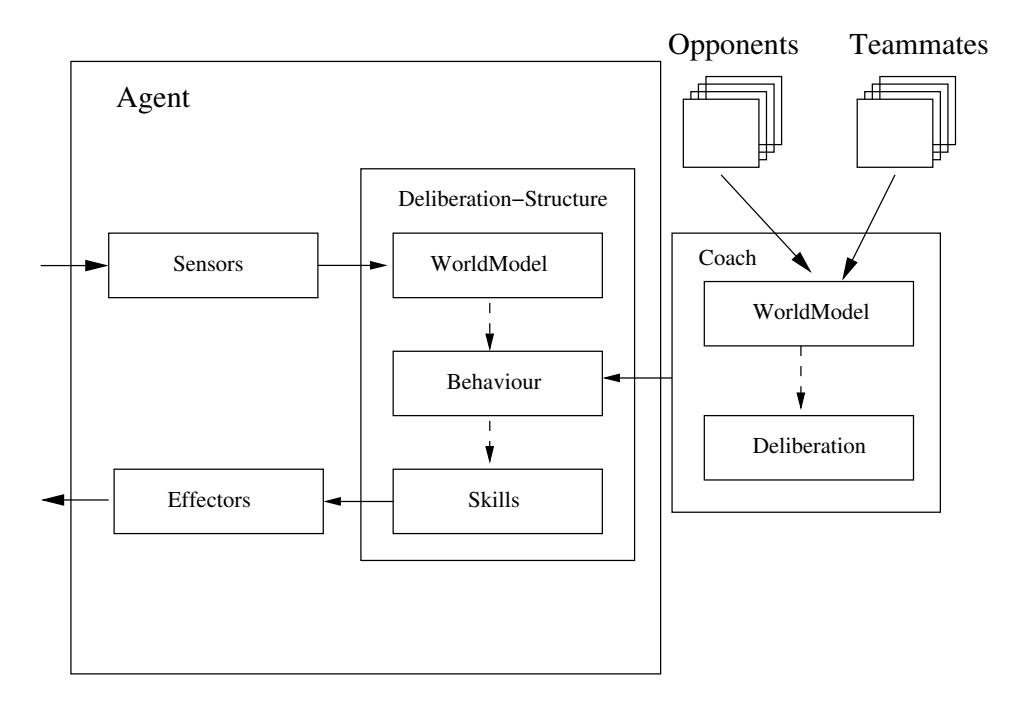
Virtual Werder 2004 is a modular construction. The team splits up into sensors, world model, deliberation-structure, effectors and some other smaller modules. Virtual Werder 2004 also uses a coach which is analyzing the match and advises his players to change formation, or to alter the tactic.
2.1 Deliberation-Structure
The deliberation-structure is intended to arrange all incoming information and it is also intended to build up logical structures of the environment. Our behaviour is based on this structure, e.g. all of our agents can switch between different behaviours, like attacker or mid-field, and the deliberation-structure is intended to undertake the task of doing things like that. Therefore, the deliberation-structure falls back on a highly reliable world model. Furthermore, the deliberation-structure is the central interface for both the planning-system and our coach. Our main structure is quite simple. We use a Sense-Think-Act structure but it is possible to take corrected actions, which in fact are done by our coach.
World model: Every agent keeps track of what is happening on the field and all of the agents have internal states for the history. To approximate the position of an opponent, which is not in the individual field of vision, Virtual Werder 2004 makes use of the Kalman-Filter.
For the difficult task of self-localisation we implemented the Monte-Carlo-Localisation technique, which allows us to be more precise. The discrepancy between the calculated and the true position does not exceed 10 cm.
Behaviour: Particularly with regard to the behaviour Virtual Werder 2004 is very flexible. Every agent is able to change his specific role during the game according to many different well-defined roles. Furthermore, our team supports a number of formations and also allows to change formation during game. Every agent recognizes this and behaves appropriately. Most of these highly extensible features are used by the coach, which is intended to analyze the game and to come to a decision about how to change the behaviour of the team with regard to success.
Our team also supports heterogeneous player types and the coach is also taking reasonable decisions concerning this topic. This structure of the behaviour allows us later to use and to react to the abstract tactics of our opponent.
Skills: All of our skills can cope with heterogeneous player types and we did a lot of fine tuning here. Furthermore, we implemented a new scoring method allowing an agent to be more efficient in calculating a good position to score. In addition, our agent can switch between numerous dribbling-skills.
3 Coach
The coach is new and has been written from scratch. He has got his own world model and is in principle autonomous. He is responsible for the arrangement of the heterogeneous player types and he is also responsible for major tactic changes like the formation or something similar.
4 Conclusion and Future Work
We did a lot on bug-fixing and fine tuning, but there are still a lot of things to do concerning this topic. On the other hand we will continue to work on the integration of our knowledge about the opponent, because to us this approach looks very promising. A new look-around method is ready on the conceptual level and waits for implementation. This method gives a better world model and allows the efficient use of communication between the agents. To adjust the behaviour of all agents this method is required.
References
- R. de Boer and J. R. Kok. The Incremental Development of a Synthetic Multi-Agent System: The UvA Trilearn 2001 Robotic Soccer Simulation Team. Master's thesis, University of Amsterdam, The Netherlands, Feb. 2002.
- Röfer, T., Jüngel, M. (2003). Vision-Based Fast and Reactive Monte-Carlo Localization. In: Proceedings of the IEEE International Conference on Robotics and Automation (ICRA-2003), Taipei, Taiwan. 856-861.