WrightEagle 2004 Simulation 2D Team Description
Li Zhenyu, Chen Xiaoping, Fan Changjie, Bai Peng
AI Center, University of Science and Technology of China, Heifei, China
Abstract In WrightEagle2003 team a Decision-Theoretical agent has been implemented. But the cooperation between players is lacked. This year we try to make some extensions so that the tactics pattern in human soccer can be perform by the agents. By describing the tactics pattern all the agents can cooperate with others. In this paper some details will be given out.
Introduction
The WrightEagle2004 soccer simulation team is built on the basis of the WrightEagle 2003, which is the top 6 in 2003. We have implemented the Decision-Theoretical agents in the simulation team 2003. Every agent can generate all possible behaviors and evaluate the possibility and the utility, and then choose the one with maximum expected utility. The wrigheagle2003 scores less than the other teams of top 8 in last year's competition. We think it is because of lacking cooperation between players.
In our current work, we have made some extensions so that the pattern of tactics in soccer can be denoted and executed. It will help the agent to understand how to cooperate. Some similar works have appeared. The coordination graphs have been used in UvA trilean team [2] and a scheme mechanism has been applied in tsinghu-Aeolus team.[3]
Description of Tactics Pattern
The tactics can be considered as a long term behavior which several agents take part in. It is composed of two main parts: the trigger and the body.
- The trigger: there are two triggers for one tactics; one means the start of the tactics and another means the break. The trigger always consists of several restrictions on the states. The starting trigger restricts the start state and the breaking trigger restricts the state to break the tactics.
- The body: it describes the process of the tactics and the rules for making action choice. The process of a tactics is described as a group of state sets and it tell the agents what states we want to achieve on schedule. We can also think the state set as a sub-goal. Obviously the state set at the end of the tactics is the goal of the tactics.
We use a queue of state nodes to denote the process. Each state node denotes a set of states. There is restriction on the state node. Each state node leads to several action nodes (perhaps none, obviously the last state node) and each action node leads to one state node. The state node is choice node and there is branch condition on the edge from state node to action node. The body of tactics is like a decision tree, but it is not a real decision tree because it is ringed.
Perhaps there is variable in restrictions because we only define tactics pattern here not concrete tactics. The evaluation of variable is determined by the situation.
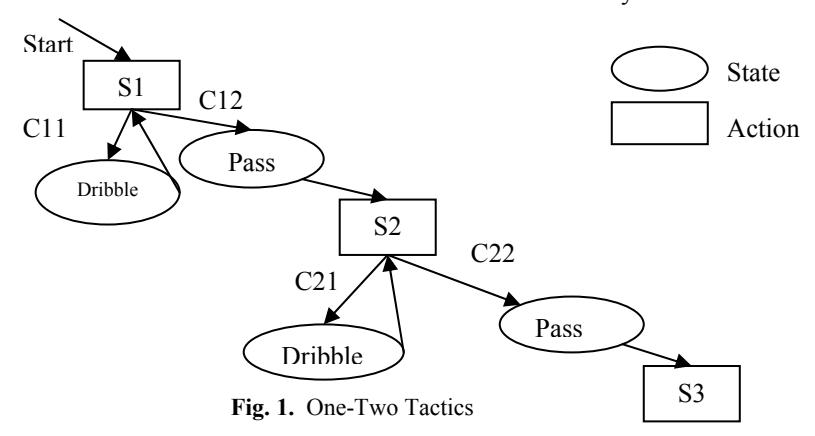
Implementation of Tactics
By setting certain players as the members of tactics pattern the pattern becomes several concrete tactics. The different settings mean different tactics while they are in same pattern. For example, the one-two tactics pattern can perform by number 9 and number 10 while number 9 and number 11 also satisfy the restriction. Each pattern generates some concrete tactics. The agent evaluates the possibility and utility of all the tactics and common behavior, and then chooses the one with maximum expected utility.
When a tactics is in progress, the agents act according to the description of the tactics. Without being broken the tactics will continue until the whole tactics has been finished. Two things break the tactics, one is the trigger of end and anther is a better behavior or tactics has been found. The tactics in progress will be evaluated at every cycle. The agent will stop the current tactics if another tactics or behavior with better value has been found. For preventing turn around so frequently there is bonus in the evaluation of tactics in progress.
In progress of a tactics the agent perhaps do an action which leads to the same state node. Such things mean that the agent should stay here to wait for a chance. In the example of one-two tactics the dribble action will be done when the pass action is not possible. Sometimes there is no valid action branch to choose, and then the tactics will return zero possibility which means the tactics is not possible to go on. Any other behavior or tactics will be thought as a better one than the current one. The tactics will be substituted. The whole mechanisms of behavior and tactics generation ensure that at least one substitution will be generated.
Conclusions
By using tactics to describe the cooperation in soccer the agents get to know how to cooperate with other agents. It will improve the performance of WrightEagle2004. We have not provided the experiments to test the improvement because the whole implementation has not been finished yet. But the current works show the great potential.
References
- S. Russell& P.Norvig. Artificial Intelligence: A modern approach. Prentice Hall 1995
- J. R. Kok, M. T. J. Spaan, and N. Vlassis. Multi-robot decision making using coordination graphs. In Proceedings of the 11th International Conference on Advanced Robotics, Coimbra, Portugal, 2003
- Yao Jinyi, Lao Ni, Yang Fan, Cai Yunpeng, and Sun Zengqi. Technical solutions of TsinghuAeolus for Robotic Soccer. In Proceedings of the RoboCup Symposium 2003, Padova, Italy, 2003