Aria 2005 2D Soccer Simulation Team Description
Hesam Montazeri, Ahmad Nickabadi, Sajjad Moradi, Sayyed Ali Rokni Dezfouli, Mojtaba Solgi, Hamid Reza Baghie, Omid Mola
Amirkabir University of Technology
Abstract This paper addresses the research was done by Aria2D soccer simulation Team for preparing Robocup 2005. 2D soccer simulation environment provides a distributed, complex, dynamic, and real-time environment. We believe that the problems regarding this test-bed can not be solved with a typical programming in a reasonable way. Therefore, we paid more attention to use machine learning method for solving the various problems of this test-bed.
1 Introduction
Aria soccer simulation team began its activities on Robocup domain in December 2001. In the first attempt, Aria could take 7th place at Robocup international competition 2003 Padova. In the next year competition, because of having some technical problems in the matches, it couldn't advance from second round. After the competition, Aria team paid more attention to use learning machine methods for solving various soccer simulation problems. Several researches were performed in the machine learning context by other teams. For instance, supervised learning was used in intercept skill and pass evaluation in [1] and reinforcement learning was used in [2,3] successfully. This paper addresses the use of Sarsa Lambda methods for implementing the intercept skill and explaining the experimental results in comparison with analytical one.
2 Learning the intercept skill
One of the most important skills used by soccer simulated agents is intercepting the ball. By using the intercept skill, agent is able to get the moving ball at any distance. This skill affect on offensive and defensive affairs. It used to get the ball from the opponents, receive pass from teammates, and catch the free ball. At least, in any moments, one of the players of each team is performing this skill. Main goal of intercept skill is determining optimal point to reach the ball based on current location and velocity of the player and the ball, and then going to that point with maximum speed. Because of noise existence in ball displacement and not having complete information from environment, it's not simple to implement this skill. Existence of noise causes that anticipating next locations of the ball and calculating optimal position for catching the ball become complicated. Suppose that the player recognizes the receiving location of the ball. Then he moves toward this point. If during this movement, for mentioned reasons, the location of the receiving ball is changed, it should have a turn toward this point. This turn considerably increases the time of reaching the ball.
Various methods are proposed and used to implement this skill. For example, in a method which is offered in [4], first possible point for reaching the ball is calculated by predicting the ball position in next cycles. Other empirical methods such as supervised learning with using neural networks [1,5], reinforcement learning with real-time dynamic programming [2], and learning automata are used to implement this skill. In new research used in Aria team, learning of this skill has been done with Sarsa Lambda using linear approximator with tile coding and due to cognition of operation of learner method; it is compared with analytical methods.
3 Reinforcement Learning
Standard episodic reinforcement learning is a framework for interaction between learner agent and Markov's decision making process. Each episode contains T time steps, $s_0, a_0, r_1, s_1, a_1, ..., r_T, a_T, s_T$ with the states $s_t \in S$, the actions $a_t \in A(s_t)$, the rewards $r_{t+1} \in R$ which are the random variable with the mean $r_{s_t}^{a_t}$, and the next state $s_{t+1}$ is chosen $p_{s_t, s_{t+1}}^{a_t}$.
Given a state, $s_t$, 0 < t < T, the action $a_t$ is selected according to probability $\pi(s_t, a_t)$ or $b(s_t, a_t)$ depending on whether policy $\pi$ or b is in force. We always use $\pi$ to denote target policy, the policy that we are learning about. In the on-policy case, $\pi$ is also used to generate the actions of the episode. In the off-policy case, the actions are instead generated by b, which we call the behavior policy. Sarsa Lambda is an on-policy method the details of which cab be found in [6].
4 Learning Scenario
For generating the intercept examples, we define a training scenario. The training scenario is:
- Coach places the ball at specific position with arbitrary initial velocity.
- Coach places the player at a random position around the ball and announce the start of episode.
- Player selects an action in each cycle and gets the previous action's rewards until it reaches the ball.
- When the player reaches the ball, coach announces the end of the episode and the next episode is started.
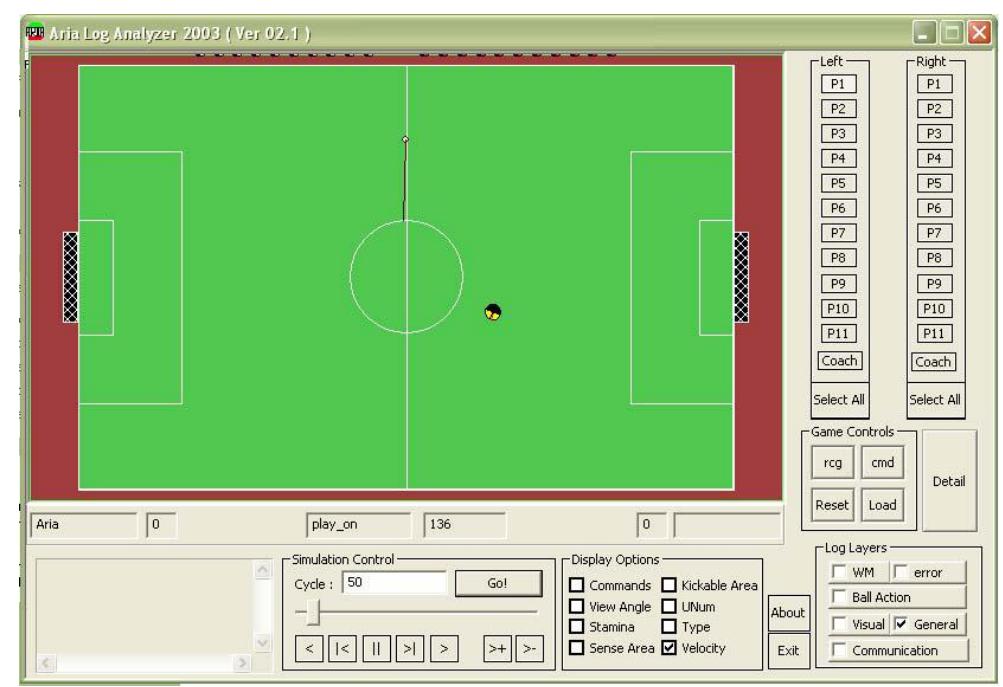
Notice that the agent should consider location of the ball and itself in a relative coordination. With relative coordination, the learned skill can be used in the other part of the field. Fig. 1 shows an example of initial situation of an episode.
5 Experimental Results
To be able to evaluate the learning method, we need a parameter which shows how the player is successful in an episode. We use the number of turns which are issued by the agent in the episode as our performance measurement. Small value of the performance parameter leads to better intercepting the ball. With the scenario mentioned in section 4, episodes are generated. In each episode, agent selects next action using the Sarsa Lambda method and also updates its learning weights. With passing the time, agent's performance is increasing more and more and learning method eventually converges to intercept the ball with a minimum number of turns. In the Fig. 2, the mean of the number of turns over episodes is shown. In the beginning of the learning, agent just does exploratory actions, so the performance measure is about 17 turns per episode. After finishing the 32000 episodes, the mean of the performance parameter becomes less than 5. When the learning is over, we repeat the experiment with learned skill, but now the agent does not perform the exploratory actions. In this case, the mean of the number of turns becomes 3.10. If we do the experiment with analytical method which was used in Aria2004 team, the performance parameter becomes about 4.08. In table 1, summarized results are shown.
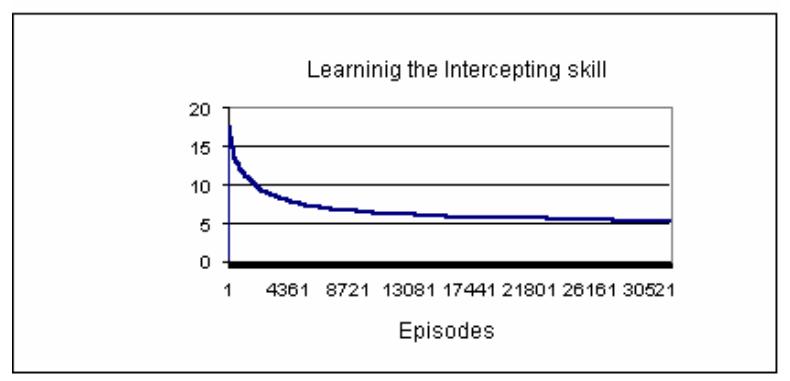
Table 1. The mean of the number of turns per episode.
| Method | Mean of the number of turns |
|---|---|
| Sarsa Lambda | 3.10 |
| Analytical Method | 4.08 |
6 Conclusions
This paper describes the learning of intercepting skill with Sarsa Lambda algorithm and also presents the experimental results in comparison with analytical one. Our experiment shows that learning method can perform much better than analytical intercepting method used in Aria2004 source code.
We suggest using the model-based methods in future works, because Sarsa Lambda is model-free algorithm, but soccer agents have a model of environment. This model is not complete and is noisy one. Even in this case, we think using the model-base learning method may converge faster and better than model-free methods.
References
[1] P. Stone, Layered Learning in Multi-Agent Systems, PhD. thesis, Carnegie Mellon, Pittsburgh, PA, Dec. 1982. [2] M. Riedmiller and Artur Merke, " Using machine learning techniques in complex multiagent domains," In I. Stamatescu, W. Menzel, M. Richter and U. Ratsch, editors, Perspectives on Adaptivity and Learning, LNCS, Springer, 2002. [3] P. Stone and R. S. Sutton,"Scaling Reinforcement Learning toward RoboCup Soccer," In Proceedings of the Eighteenth International Conference on Machine Learning, pp. 537–544, Morgan Kaufmann, San Francisco, CA, 2001. [4] R. de Boer and J. Kok, The Incremental Development of a Synthetic Multi-Agent System: The UvA Trilearn 2001 Robotic Soccer Simulation Team, Master's thesis, university of Amesterdam, Netherlands, 2002. [5] P. Stone and M.Veloso, "A Layered Approach to Learning Client Behaviors in the RoboCup Soccer Server," Applied Artificial Intelligence, 1998. [6] R. S. Sutton, A.G. Barto, Reinforcement Learning: an Introduction, Cambridge: MIT Press, 1998.