OXSY 2006 Team Description
Marian Sebastian
Oxygen-SYstems laboratory; Lucian Blaga University
Abstract Oxsy team was founded in July 2002 for a graduation project of one student, Marian Sebastian, in the field of Multi-Agent Systems at the Department of Computer Science of Lucian Blaga University (Sibiu - Romania).After graduation he continued the work on this project and so was born Oxsy team.
Introduction
In July 2003 at RoboCup competitions, held in Italy, we won the first round group and for us it was a good surprise for first year of participation. Then, next year we participated in Lisbon for the second time and again we obtained a good result (the 11-th place).Last year we participated for the third time in Osaka and finally we entered in the first 8 teams in the world soccer simulation league of RoboCup.
This year in Germany we want to go as far as we can in this 2D competition, as probably will be the last time when we participate in 2D league, just because starting with next year we will emerge on 3D definitely.
React before event occurs
This year we continued our work at this neuronal method that was tested for the first time last year in Osaka and we believe that our agents have put in the pitch successfully our ideas.
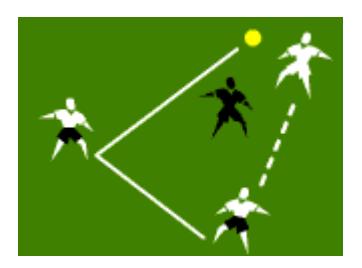
The basic idea of this method is that the agent, must react as it happens in real soccer, when two or many players collaborate to create a particularly phase of defense or attack, like when they are the only one brain. These automatisms for the real players, of course where created in very many hours of trainings and therefore they seems to work very simple and normally for watchers, but in our world of simulation these things are not so easy. One of the simplest examples of some that we calls "react before event occurs" is the so called "give-and-go" (fig. 1). In this case a player will pass to another teammate and then he will run in some free spaces, or in one clearly direction, to receive the "future" pass of the player that received his first pass. So, this implies that he must anticipate the "future" pass so he reacts before event occurs.
Switch roles
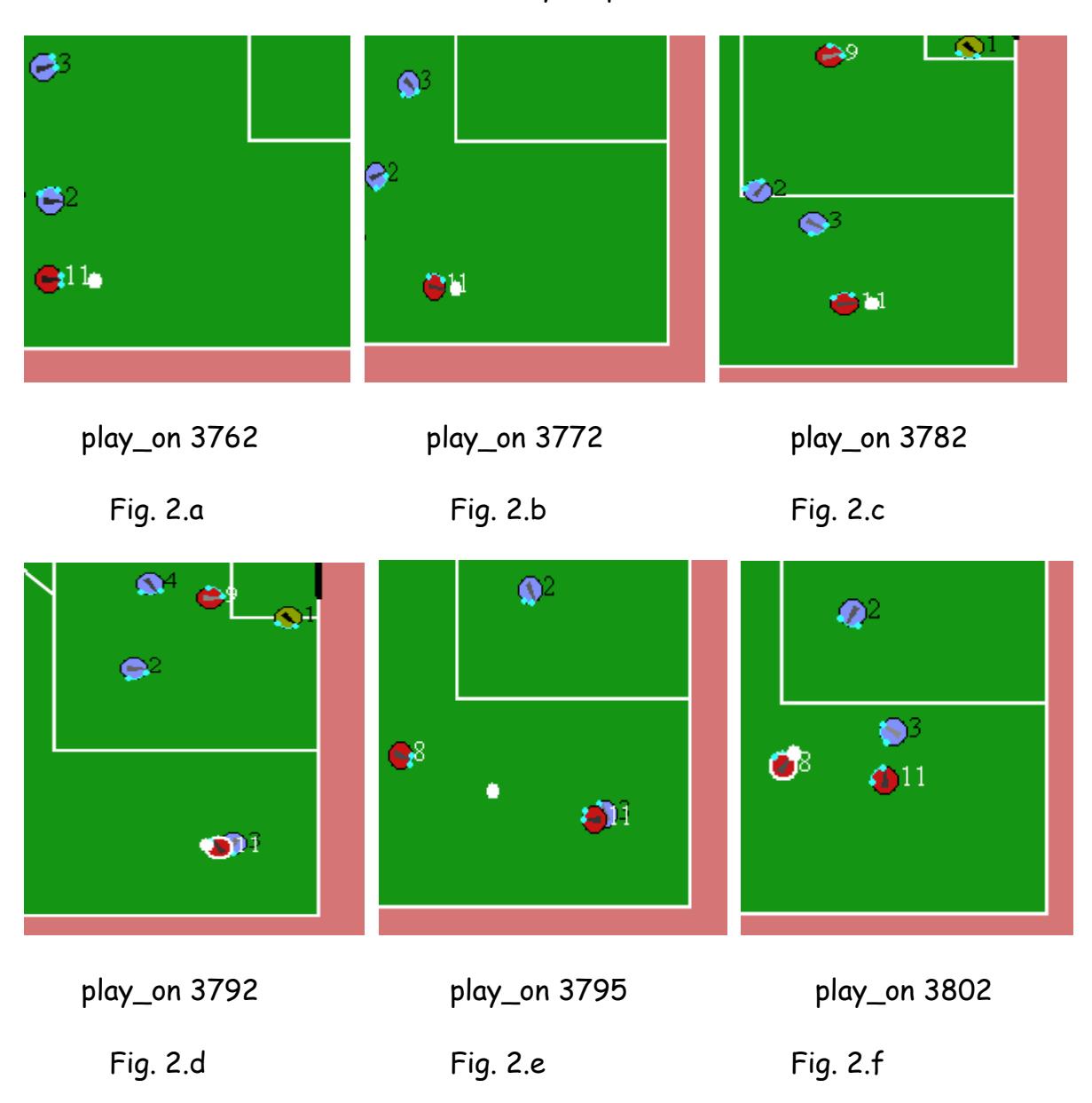
Last year in Osaka we had implemented this mechanism of "react before event occurs" in our defensive phase, in so called "switch roles" of defenders. This is usually happens when a striker from opponent team, escape with ball on the side of the field from marking/tackling made by one of our side defenders and one of our center defenders, take now the roles of the one that was beaten. Meantime this side defender that was beaten will go in the center of the defense, to take the roles of his teammate that now is face whit the opponent striker. All this actions described above made by two players, are calls "switch roles". In this type of action the center defender was "react before event occurs", just because he didn't wait the striker to come in his active zone to face it, but he attacks him before this event occurred (fig. 2.a-2.e).
RoboCup 2005, Osaka, Group F, Round 2
Oxsy - Apollo
We believe that this kind of reactions, before an event to be occurring from our agents, improves the team ability to handle any unexpected situation and more than that they make our team more unforeseeable. In these above images we can see an interchange of roles between our defenders players number 2 and 3.
Give and go
For this year we extended this neuronal method of reaction in our offensive phase. We teach our agents to react before pass coming from one teammate. This is about what we talking before, when two players collaborate to throw out from game an opponent defender. We talk about "give-and-go" and about how the agent must react before event occurs. In this way we improve our offense, because in most of time we surprise opponent defenders in the moment of the final pass from this "give-and-go" combination, with their backs to their own goals and our strikers just running through opponent goals, between two opponent defenders. Of course is important that the player who makes the final pass to serve our striker who is running through opponent goal, just before he will go in offside, but this is the job of the passer who understand in the same way this mechanism of reactions, just because even himself is a piece of this gearing.
Future work
We hope that we can improve more segments of our agent's brain with this neuronal method of reacting, as long as we will try next year to emerge these solutions to the new 3D players. Because these types of actions are not really hang it by any physical forms and is all about of the pure tactical segment, we strongly believe that this type of reaction can be expand it in the next future, in any kind of 3D simulator even if the players will be without or with any kind of legs or joints.
References
- Peter S. Layered Learning in Multi-agent System [D]. Pittsburgh: school of computer science, Carnegie Mellon University, 1998.
- Jinyi Yao, Jiang Chen, Zengqi Sun. An application in RoboCup combining Qlearning with Adversarial Planning. Available in http://robocup.lits.tsinghua.edu.cn/download/ document/ tsinghuaeolus_kick.zip.
- M. Riedmiller and Artur Merke, " Using machine learning techniques in complex multiagent domains," In I. Stamatescu, W. Menzel, M. Richter and U. Ratsch, editors, Perspectives on Adaptivity and Learning, LNCS, Springer, 2002.
- Itsuki Noda et al, Soccer Server Manual, RoboCupFederation. http://www.robocup.org.
- Y. Jinyi, C. Jiang, and S. Zengqi. An application in RoboCup combining Qlearning with Adversarial Planning. In the 4th World Congress on Intelligent Control and Automation (WCICA'02), Shanghai, China, June 2002.
- Peter Stone and David McAllester. An Architecture for Action Selection in Robotic Soccer. In Proceedings of the Fifth International Conference on Autonomous Agents, pages Pages: 316–323, 2001.
- Takashi Suzuki. Team YowAI Description. RoboCup 99: Robot Soccer World Cup III, 2000.