Team description paper (TDP) Ri-one
Masayoshi Nakamura, Dadayuki Miyasaki, Yoshihiko Terashi, Yusuke Kondo, Takayoshi Inaba, Riyo Ishihara, Tomohiro Iwasaki, Shinya Otsuki, Koji Ohnaka, Tatsuhiko Katayama, Chiharuko Kakizoe
team member of Ri-one: project team of Ritsumeikan University College of information science and engineering, Japan
http://www.spice.ci.ritsumei.ac.jp/~robocup/
Abstract The Ri-one are project team of Ritsumeikan University College of information science and engineering in Japan. We have been studying 2D Soccer Simulation in extracurricular activities of University. Our team was inaugurated in April 2005 and there are 11 team members which are faculty-students.
About us
The Ri-one are project team of Ritsumeikan University College of information science and engineering in Japan. We have been studying 2D Soccer Simulation in extracurricular activities of University. Our team was inaugurated in April 2005 and there are 11 team members which are faculty-students. We challenge Robocup world cup first time.
The policy of Ri-one
In this competition, our objects are to make strong team and to develop agents with cooperating in all members.
The feature of Ri-one
This team program is based on part of the source code of UvA Trilearn 2003 and we added a lot of original programs. We had divided the team members into the groups for every position: offense and defense, and had developed agents into each group.
The contents of our tactic
The selection method of friend agents to pass we would like to describe about our selection method. Those friend agents, will be selected, are nine agents without a goalkeeper. Our method computes a success probability about the pass from the agent who has a ball. And this method is selecting the agents who have the highest evaluation. So, the success probability is designed from some geometric computing of our experience and subjective tests.
See an process of our method, we designed.
- If there are enemy agents inside of a circle; radius R of the friend agents to pass or there are enemy agents inside of a cone; wide W of the friend agents to pass then rejects those friend agents. In this competition, we have adjusted R=5,20 W=30 for our team.
- In the pass success probability to each agent, weight parameters are set by the relative position of the enemy agents from the friend agent with a ball. See fig.1. This fig shows weight parameter of minus by the relative enemy agent position. See table1 and table2. These tables show how mach weight is applied to receiver on fig.1.
- Finaly, specific agent, has max evaluation value, is selected as the pass agents.
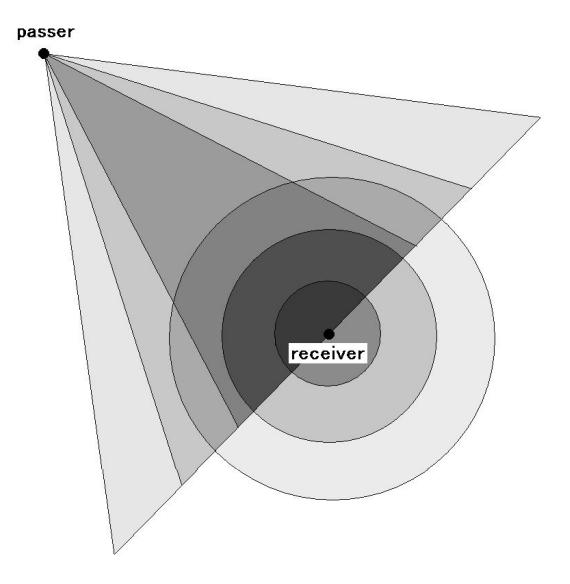
Weight parameters for every distance between receiver and opponent agent.
| Distance between receiver | weight |
|---|---|
| and opponent agent | parameters |
| within 3m | -35 |
| within 6m | -15 |
| within 9m | -5 |
Weight parameters for every cone width from passer.
| Cone width from passer | weight |
|---|---|
| parameters | |
| within 30 | -60 |
| within 50 | -30 |
| within 80 | -10 |
The mark by "one for one" for the defense
We concentrated whole human resource to create the defense algorithms. We specifically strengthened a mark algorithm about our defender agents. We make two conditions the defender agents to mark on some enemy agents.
- The distance, from the enemy agent of the goal to it ,less than the threshold.
- This agent is nearest position from target agents.
However, there is a lot of mistakes, which the agent misses the condition 2, because the sight information is incomplete. Therefore, several agents sometimes mark to one enemy agent at a same time. To improve that, all friend agents can take sensor information about the distance to the enemy agents from target agents by using the talk command. We made a specific talk algorithm. When there is a friend agent, is matched a condition by the information. If this agent is not myself then doesn't do a mark. Thus, we were freed from the mistake of a condition 2.