YowAI2006 Team Description
Shuhei Shiota, Yasuyuki Yamazaki, Shinichi Takahashi, Yosuke Taniguchi, Ikuo Takeuchi
Department of Computer Science The University of Electro-Communications
Abstract No abstract provided in the original paper.
1 Human-like Agent → YowAI
The target of YowAI2006 is realizing "human-like agents". A human-like agent is an agent which makes its own action decision and cooperation with other agents by a similar way as a human player takes in actual soccer. To achieve this goal, YowAI2006 has been focusing on the following points.
- Efficient method to cooperate with other agents with minimum communication (Short Shout).
- Correct understanding of tactical situation and opponent's action.
- Basic skills and world modeling to realize high-level action.
- Guess the player's ability and the object's position using history information.
2 Short Shout
In real human soccer, communications among players do not include precise numbers. They use eye contact and short shouts that are bare minimum information they need. For example one says "Agare" (which means "move forward" in Japanese) when he wants to tell "Move forward the defense line". One of the reasons why they don't say it fully is that it is impossible to say it in a flash, and it is hard to understand in a wink. YowAI2006 agents use this short shout not only for short tactical terms, but for sharing information without using any cipher or data compression. By communicating player's tactical move, a shout gives the receiver a hint what he should do next. To send strategic information by short shouts one has to abstract the situation relevant to the strategy. To understand abstract information represented by a short shout the receiver has to attach the meaning of the short shout to what situation he understands. Therefore more intelligence is needed than communicating accurate numerical values. Using short shouts in RCSS has been one of the answers to achieve team cooperation. YowAI2006 agents cooperate with each other by "short shout" like humans.
2.1 Short Term Tactical Shout
We have achieved short term and reflective cooperation by using "short term tactical shout". A player can progress the tactical situation of the team, and give the addressed player a hint to the tactical judgment and action selection. The judgment or action selection is highly recommended.
The following example is a short term tactical shout.
2.1.1 Mae
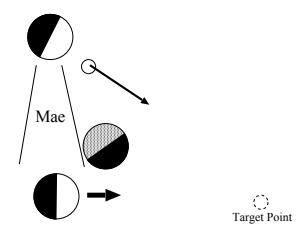
When one controls the ball and there is a space in front of a particular teammate to pass, he will say "Mae". The actions the sender and the receiver (agent number 10) should do will be the following.
sender Calculate where to pass, kick the ball, and send message "(say "Mae 10") ".
receiver Run forward to prepare for receiving the pass.
"Mae" will bring the ball forward and make an advantage in attacking (Figure 1).
2.2 Information Shout
A player can request other players' information about where particular object is. The player that knows the answer replies to the players' request in a few bytes by telling rough information about the object.This sort of shout is also used in human actual soccer.
2.3 Strategic Shout
As shown in examples in Section 2.1.1, shouts did achieve cooperation but were more like instantaneous pairwise combinations of related players than team plays or team plans. The shout effects the members that are related to the ball which are only two; the sender and one receiver. On the other hand team play is a part of team planning that includes not only combination chains but also formationing. Team plays can not only effect the members near the ball but also the members that are not near the ball. To achieve team play we use "strategic shout". These make team plays a advanced cooperation than those cooperation achieved by short term tactical shout. By using strategic shouts, agents can share the objectives of team plays and make decision on what to do to help success team plays.
The following example is a strategic shout.
2.3.1 Back2Toward
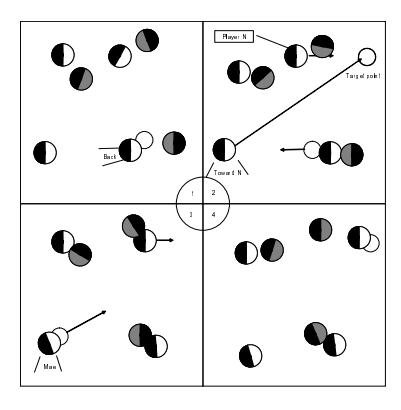
The target of a strategic shout named " Back2Toward" is to break through the opponent's defense line. By passing the ball back once to a player that can see the opponent's defense line exactly than the passer, it will make it easier to break through the opponent's defense line. The moves related to the ball are as follows.
- If the ball controller thinks that it is hard to carry the ball forward and cannot find a good pass course, he will say "Back2" (Figure 2 -1).
- If one thinks that there is a pass course from the ball controller to him, and there is a chance to pass a more forward player than where the ball is located, he will say "Toward N"; N is a particular teammate he thinks the best teammate to pass at that time.
- The Ball controller will pass to the teammate who said "Toward N". During the pass, the player N will move to make a clear space in front of him (Figure 2 -2).
- After the player that said "Toward N" gets the ball, he will first check if can pass in front of the player N. If he can he will pass to him, but if can't he has to find a better teammate to pass.
- When passing the sender might use short shouts such as "Mae"(Figure 2 -3).
3 History Information
When an agent determines its action, it depends on its current world model. Therefore it is not easy to recognize tactical situation, team's strategical term and opponents' action, formation, and so on. To resolve these problems, YowAI2006 implements an advanced recognition mechanism of situation and actions by utilizing "history information" such as time-series of world model information.
3.0.2 Recognize tactical situation
An agent analyze a set of the data of the players' past positions.Then he can recognize which team dominate the game , what action is taken by the opponent player, and so on. While an agent observes each opponent player's moving area and can guess the formation of the opponent team.
3.0.3 Guess the heterogeneous player type
An agent has to find out the correct heterogeneous player type of each opponent to predict the opponent player's next action precisely. To guess the opponent's player type, an agent analyzes the data of opponent's running speed.
3.0.4 Guess the out-of-sight player's position
There are many invisible player, who is always moving.Therefore, an agent has to guess the position of the invisible player for accurate grasping of the situation. In advance, an agent gathers the data of the each opponent's position when they are in the agent's sight.Then he can guess the invisible opponent's position.
4 High-quality Skill
Needless to say, high-quality basic skills and world modeling are also important to realize above-mentioned functions. YowAI2006 has been improved in some basic skills and world modeling, such as dribble, shoot, velocity calculation, ball move prediction, ball catching, and so on. These basal modification helps a high-level team play and correct situation recognition.
5 Future Work
These are our future work that we are planning to do.
- Extend the recognition method for the following points.
- Enormously complicated situations.
- Opponent tactics.
- Implement long term tactical strategy.
- Implement dynamic strategies using a coach client.
- Implement higher-quality basic skills.
References
(none)