OXSY 2007 Team Description
Marian Sebastian
OXygen-SYstems laboratory Str. Constantin Noica, Bl.5, Sc.C, Ap.36, C.P. 550169, Sibiu, ROMANIA
Abstract Oxsy team was founded in July 2002 for a graduation project of one student, Marian Sebastian, in the field of Multi-Agent Systems at the Department of Computer Science of Lucian Blaga University (Sibiu - Romania).After graduation he continued the work on this project and so was born Oxsy team.
1. Introduction
In July 2003 at RoboCup competitions, held in Padua - Italy, we won the first round group and for us it was a good surprise for first year of participation. Then, next year we participated in Lisbon - Portugal for the second time and again we obtained a good result (the 11th place). In 2005 in Osaka - Japan we participated for the third time and finally we entered in the first 8 teams in the world soccer simulation league of RoboCup as we won (the 8th place). Last year in Bremen we won (the 7th place) in this amazing competition of soccer simulation.
This year in Atlanta – Georgia (U.S.A) we want to obtain a better result in 2D competition, as probably will be the last year when we try to improve high level skills for the 2D agent, just because starting with next year we will try to develop, in most of time that we have to spent for the RoboCup project, low level skills for the humanoid robot used in 3D soccer simulation.
2. React before event occurs
This year we continued our work at this neuronal method that was tested for the first time in Osaka and we believe that our agents have put in the pitch successfully our ideas.
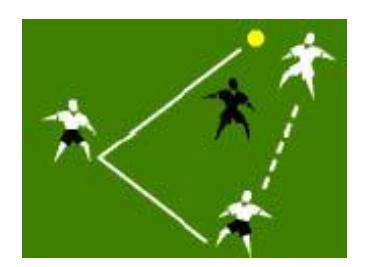
The basic idea of this method is that the agent, must react as it happens in real soccer, when two or many players collaborate to create a particularly phase of defense or attack, like when they are the only one brain. These automatisms for the real players, of course where created in very many hours of trainings and therefore they seems to work very simple and normally for watchers, but in our world of simulation these things are not so easy. One of the simplest examples of some that we called "react before event occurs" is the so called "give-and-go" (fig. 1). In this case a player will pass to another teammate and then he will run in some free spaces, or in one clearly direction, to receive the "future" pass of the teammate that received his first pass. So, this implies that he must anticipate the "future" pass and in this case he reacts before event occurs.
2.1 Defensive phase – block opponent passes
The objective of the defensive phase is to win the ball. A team's defensive and offensive phases are closely connected. The better a team's defense is at winning the ball, the more opportunities the team will have for a quick and decisive counterattack by the offense. Just as on offense, it is also important that the defense has a team strategy, so that the players move in a coordinated way. The necessary steps to winning control of the ball are:
- Forcing the opponents' action towards certain zones of the field.
- Winning the ball upon the opponents' pass.
- Stealing the ball from the opponent
- Winning the ball subsequently.
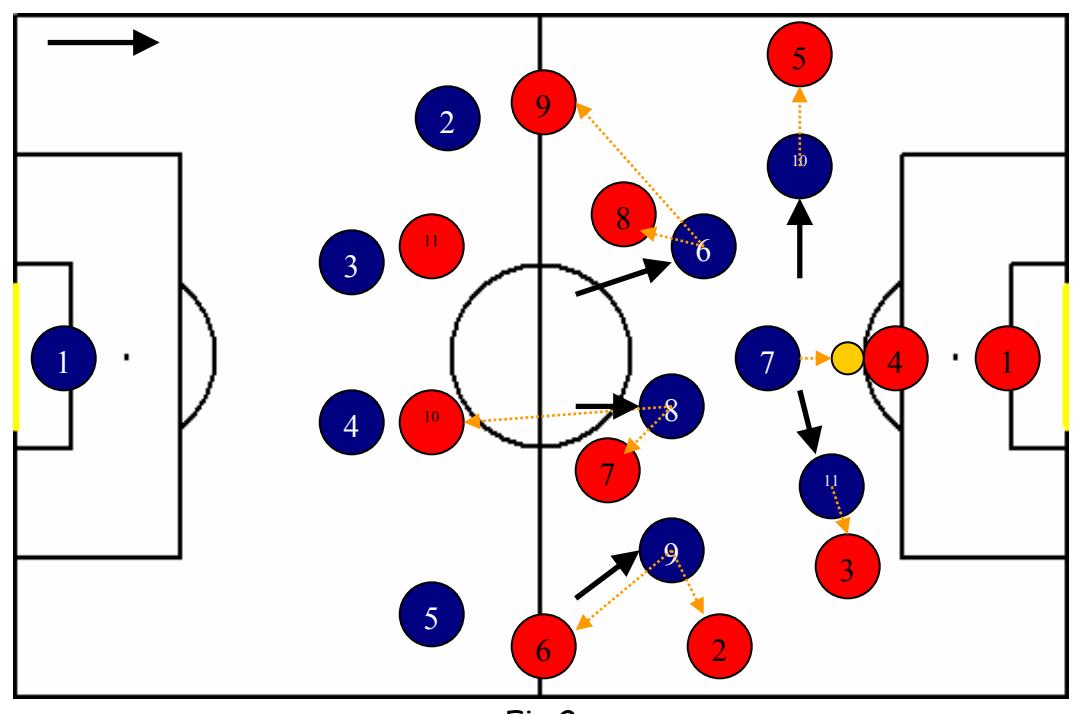
After forcing the opponents into a certain zone of the field, the team places one or more players in the position called "watcher". The objective of the "watcher" is to intercept the pass independent of the movement of the offensive player, just like a goalkeeper does when a crossing pass is made. He is near the ball and places himself in a position between the ball and the direction where he expects the play to develop. The "watcher" does not mark an opponent: his objective is to intercept the pass (fig. 2).
So, our neuronal network teaches the player again to react before events occur. So it takes like parameters "the ball and the direction where the play was developed" in many situations, so after many examples it can provide us the direction where it expects the play will be develop. In this way our players involved in these kinds of actions will have reactions before many events should be occurring.
2.2 Offensive phase – create free spaces
The objective of the offensive phase is to score. The necessary phases which lead to scoring are:
- Refraining from losing the ball (avoid risky moves in the defensive area).
- Taking the ball forward towards the opponents' goal.
- Getting the ball to a teammate who is free from his opponent's marking, placing him in a position to shoot.
- Shooting effectively.
On offense, the player with the ball can either kick it (pass it or shoot) or dribble it (also dribbling past an opponent) while his teammates are moving without the ball.
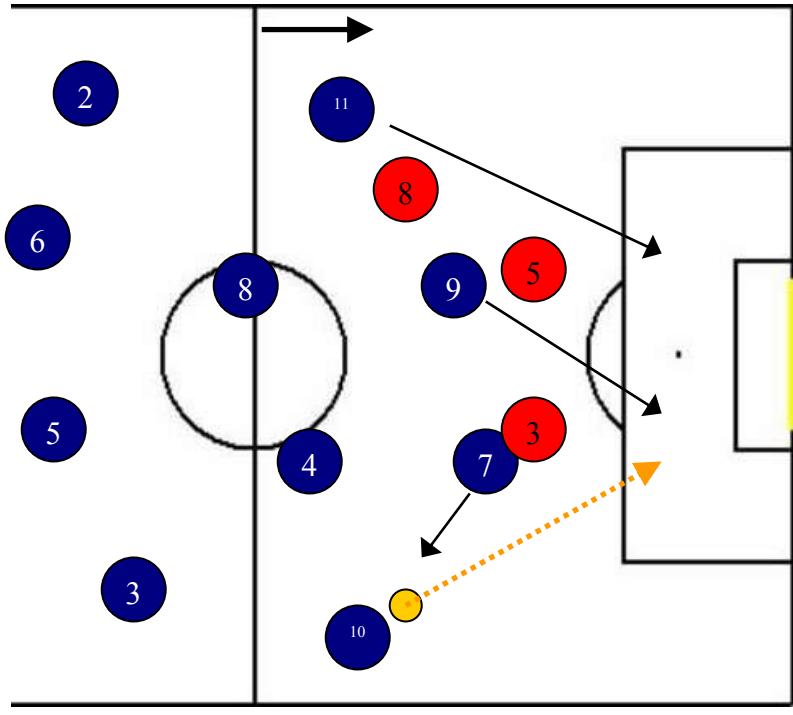
An offensive player, who helps to take the ball towards the opposing goal by making himself available for a pass forward, is referred to as an "assisting player". He can receive the ball in two ways: either with the opponent at his back or by unmarking himself. He has the opponent at his back when he comes towards the ball or when he cuts towards the corner flag. He tries to receive the ball unmarked when he cuts towards the opposing goal or when he penetrates to receive the pass from his teammate.
In (fig. 3) we show an example of assisting movements with both a first and a second movement cut-in. While the forward (player number 7) who is closer to the ball goes towards it and creates space, the other forward (player number 9) carries out a converging cut-in, trying to shake off his marker in order to receive a depth pass, placing himself in a position for a shot on goal. At the same time, the left side midfielder (player number 11) carries out a second movement – a vertical cut-in – exploiting the space created by the movement of the forward (player number 9).
3. Future work
We hope that we can improve more segments of our agent's brain with this neuronal method of reacting, as long as we will try in the next years to emerge these solutions to the new humanoids players as more as we would can. Because these types of actions are not really hang it by any physical forms and they all talk about the pure tactical segment, we strongly believe that this type of reactions can be expand it in the next future, in any kind of 3D simulator even if the players will be without or with any kind of legs or joints.
4. References
- Peter S. Layered Learning in Multi-agent System [D]. Pittsburgh: school of computer science, Carnegie Mellon University, 1998.
- Jinyi Yao, Jiang Chen, Zengqi Sun. An application in RoboCup combining Qlearning with Adversarial Planning. Available in http://robocup.lits.tsinghua.edu.cn/download/ document/ tsinghuaeolus_kick.zip.
- M. Riedmiller and Artur Merke, " Using machine learning techniques in complex multiagent domains," In I. Stamatescu, W. Menzel, M. Richter and U. Ratsch, editors, Perspectiveson Adaptivity and Learning, LNCS, Springer, 2002.
- Itsuki Noda et al, Soccer Server Manual, RoboCupFederation. http://www.robocup.org.
- Y. Jinyi, C. Jiang, and S. Zengqi. An application in RoboCup combining Qlearning with Adversarial Planning. In the 4th World Congress on Intelligent Control and Automation (WCICA'02), Shanghai, China, June 2002.
- Peter Stone and David McAllester. An Architecture for Action Selection in Robotic Soccer. In Proceedings of the Fifth International Conference on Autonomous Agents, pages Pages: 316–323, 2001.
- Takashi Suzuki. Team YowAI Description. RoboCup 99: Robot Soccer World Cup III, 2000.
- Soccer Tactics. An analysis o attack and defense, by Lucchesi Massimo, originally printed in Italy – 1999 by Edizioni Nuova Prhomos Via O.Bettaccini.