OXSY 2008 Team Description
Sebastian Marian, Dorin Luca, Bogdan Sarac, Ovidiu Cotarlea
OXygen-SYstems laboratory, Str. Constantin Noica, Bl.5, Sc.C, Ap.36, C.P. 550169, Sibiu, ROMANIA
Abstract Oxsy team was founded in July 2002 for a graduation project of one student, Sebastian Marian, in the field of Multi-Agent Systems, at the Department of Computer Science of Lucian Blaga University (Sibiu - Romania). After graduation he continued the work on this project and so was born Oxsy team. If we will qualify to the competition, this year we will reach at the 6th participation in RoboCup Soccer Simulation League.
Introduction
In July 2003 at RoboCup competitions, held in Padua - Italy, we won the first round group and for us it was a good surprise for first year of participation. Then, next year we participated in Lisbon - Portugal for the second time and again we obtained a good result (the 11th place). In 2005 in Osaka - Japan we participated for the third time and finally we entered in the first 8 teams in the world soccer simulation league of RoboCup as we won (the 8th place). In 2006 the competition was held in Bremen – Germany and we won (the 7th place). Last year (2007) in Atlanta – Georgia (U.S.A) we obtained (the 5th place) in this amazing competition of soccer simulation.
This year the competition will be held in Suzhou – China, and we want to obtain a better result, because we already have a good experience in this league of "2D Soccer Simulation". We hope that our ideas and our new improvements for this year will be materializing in the competition where we will can tests many others tactical elements improved.
Situation of Equality or Inferiority in Numbers in the Defensive Phase with Application of the Off-Side Trap
This year we have concentrated more on our defensive phase, as we observed that we have a very bad average of goals received, in all the games that we have played since we entered in this competition, compared with many other teams. While there are some teams that handle very well the offensive phase we also find that we can group them in two very clearly attacking styles.
First group tries to attack on the sides while the other group tries to go through the middle of the field between the central backs or between one central back and one side back defender.
We also remarked that in 70% percent of these kinds of attacks we remain in equality or even in inferiority in numbers of defenders. So, we received many goals from these types of actions, which are incorrect handled by our defense.
For these both styles of attacking, we found a common solution, which if it is very well handled and synchronized, it will remarkable reduce the opportunity of scoring phases for the opponent team. We talk here about the application of the Off-Side trap. So, we tried to implement a Neural Network, which cans recognize the moment when we can apply with success the Off-Side trap with some certain patterns, after a good analyze of the shape of some players involved in that phase. How most of teams, in 2D Soccer Simulation League, attack with three players in the first line, we will analyze in next pages these types of actions, when our defense is surprised in equality or inferiority in numbers by three opponents.
In the general strategy of the team, the off-side trap could be defined as all these actions aiming at regaining possession of the ball, which can take place in two specific ways:
- By receiving an indirect free kick;
- Taking the ball away from the opponents thanks to the application of pressure.
If we opt for the application of the off-side trap, the simultaneous application of pressure is absolutely essential. When applying an off-side trap, one of the two central backs must "lead" the offside, calling the time of its execution even with a password.
As we have already said, the off-side trap needs a simultaneous application of pressure; to leave the opponents off-side without applying pressure on the player with the ball would mean to "invite" the latter to perform a single action, with a high chance of success.
Situation: 3 v 3 (Equality in Numbers) with Application of the Off-Side Trap
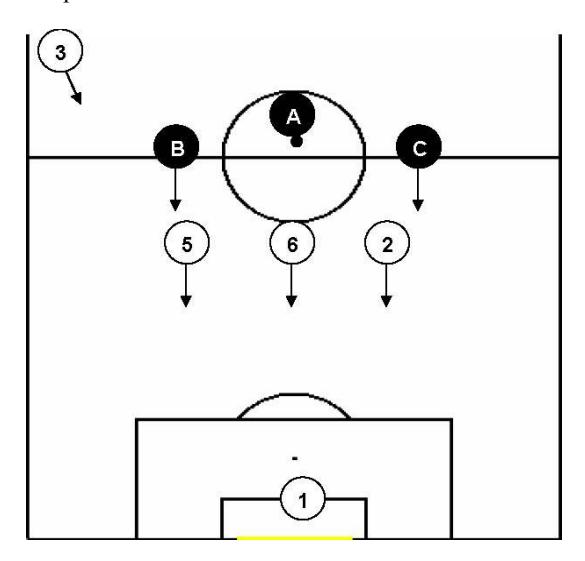
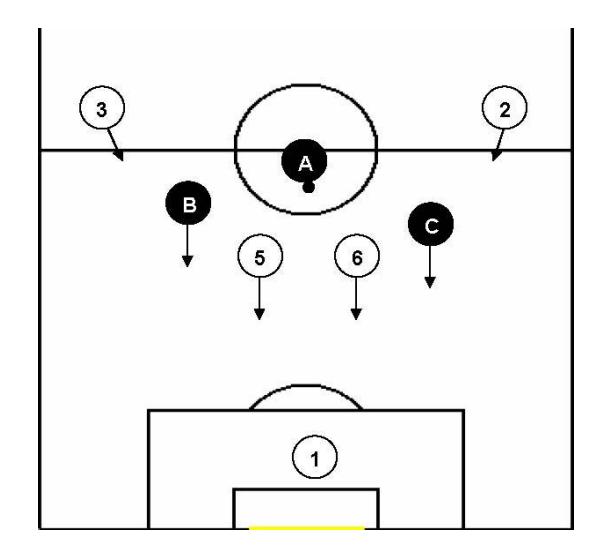
(Fig. 1) shows a counter-attack by the opponents in conditions of equality in numbers. Player "A" moves quickly forward with the ball, supported by forwards "B" and "C". There is equality in numbers and the team applies the off-side trap which we exemplify; however, in such situations other options are possible. The offside tactics are applied in conditions of inferiority in numbers and it could be applied also in conditions of equality in numbers. In the situation shown, we have wanted to give an example of the application of the offside trap in conditions of equality in numbers, but other forms of interdiction could be possible.
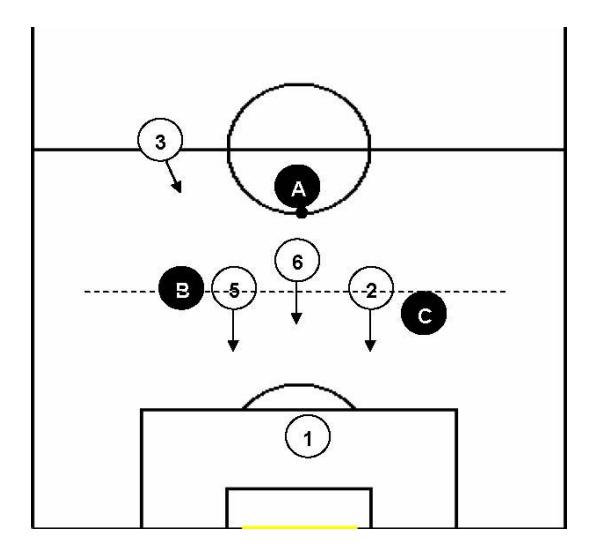
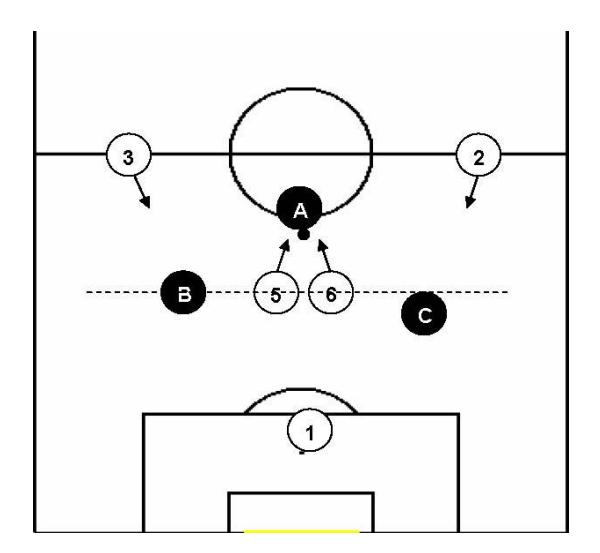
In (Fig. 2) the three backs (number 5, 6 and 2) step backwards, biding their time to apply pressure on the player with the ball and to apply the off-side trap. Number 6 faces the player with the ball and plays for time, so as to seize the right moment to attack "A" supported by the other two backs (number 2 and 5) who place themselves along the same line with the forward further back "B" in (Fig. 2).
Playing for time is important, not only when choosing the right time to attack, but also in order to give one's teammates the time to return. For example, even if we have a 3 v 3 situation, we showed a returning back (number 3) in (Fig. 2).
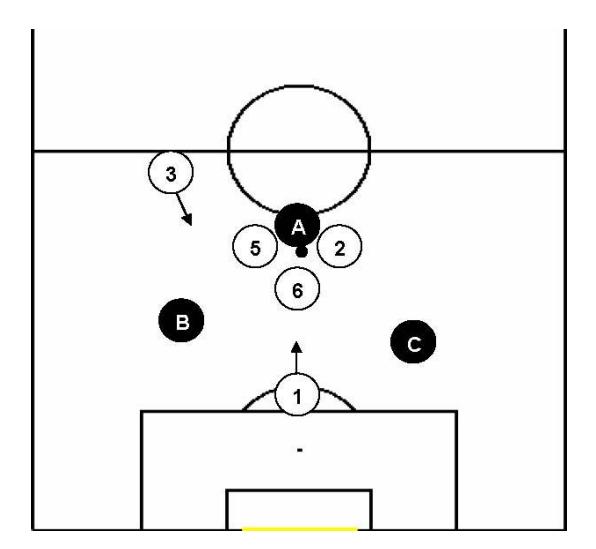
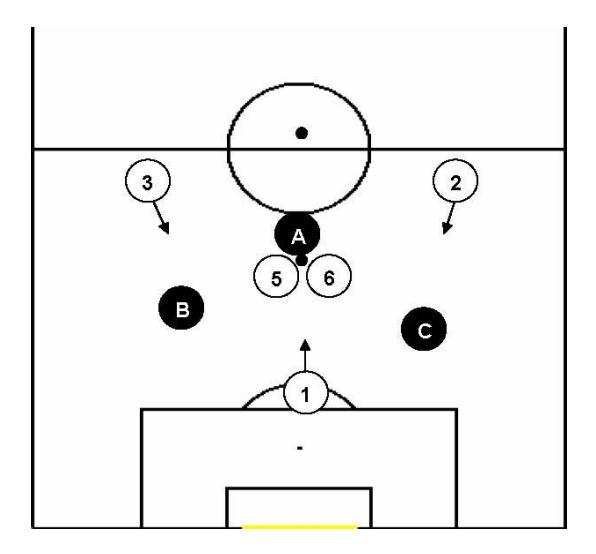
In (Fig. 3), when number 6 attacks the player with the ball number 5 and 2 move immediately forward, thus triple-teaming "A" and leaving "B" and "C" off-side if either of them should receive a pass from "A". Given the resulting superiority in numbers (1 v 3), if "A" decides to dribble and not to pass the ball, the three backs have good chances of seizing the ball. In the application of the off-side trap the goalkeeper is extremely important: he must be ready to get out of his penalty area and stop the attack if the off-side trap does not work.
Situation: 3 v 2 (defensive inferiority in numbers) with Application of the Off-Side Trap
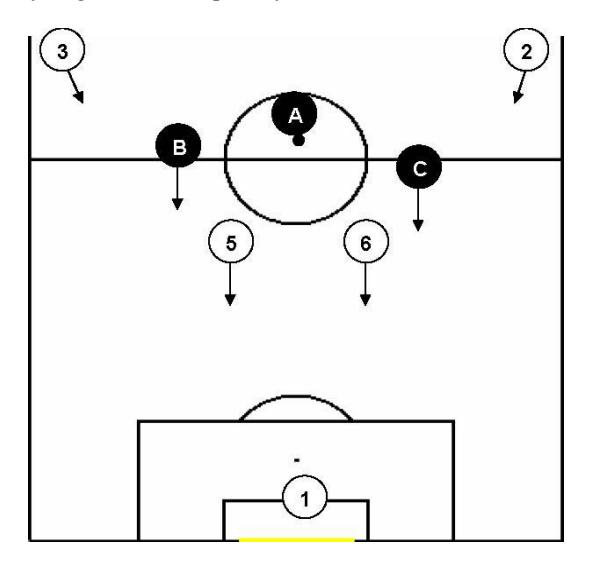
(Fig. 4) shows a counter-attack by the opponents in conditions of inferiority in numbers. Player "A" moves quickly forward with the ball, supported by forwards "B" and "C". Given the inferiority in numbers, the team applies the off-side trap as shown in the example.
From (Fig. 4) to (Fig. 5), we can see that number 5 and 6 play for time and at the same time shorten their distance from the player with the ball. Besides giving other teammates (in this case, number 2 and 3) the time to return, the two central backs aim at placing themselves along the same line as the trailing forward (in (Fig. 6) it is forward "B"); as soon as they are along the same line, the two backs apply the off-side trap and at the same time apply pressure on "A" (see (Fig. 6)).
(Fig. 7) shows the situation resulting from pressure aiming at leaving the opponents off-side.
It should be noticed that when the two central backs apply the off-side trap the goalkeeper is ready to get out of his penalty area.
Future work
We also want to apply more of these types of tactical elements, with helps of this neural network, which will recognize the moment, when some players are positioning in some kind of shapes, from which we can start some kind of tactical actions.
In this way, we want to introduce for next year two new tactical elements, one for defensive phase and one for offensive phase.
In defensive phase we want to introduce a good synchronized double teaming, as well as in the offensive phase we like to introduce a conventional movement of the forward pairs, just to handle very good situation of equality and superiority in numbers in attack.
References
- Peter S. Layered Learning in Multi-agent System [D]. Pittsburgh: school of computer science, Carnegie Mellon University, 1998.
- Jinyi Yao, Jiang Chen, Zengqi Sun. An application in RoboCup combining Q-learning with Adversarial Planning. Available in http://robocup.lits.tsinghua.edu.cn/download/document/tsinghuaeolus_kick.zip.
- M. Riedmiller and Artur Merke, "Using machine learning techniques in complex multiagent domains," In I. Stamatescu, W. Menzel, M. Richter and U. Ratsch, editors, Perspectiveson Adaptivity and Learning, LNCS, Springer, 2002.
- Itsuki Noda et al, Soccer Server Manual, RoboCupFederation. http://www.robocup.org.
- Y. Jinyi, C. Jiang, and S. Zengqi. An application in RoboCup combining Q-learning with Adversarial Planning. In the 4th World Congress on Intelligent Control and Automation (WCICA'02), Shanghai, China, June 2002.
- Peter Stone and David McAllester. An Architecture for Action Selection in Robotic Soccer. In Proceedings of the Fifth International Conference on Autonomous Agents, pages Pages: 316–323, 2001.
- Takashi Suzuki. Team YowAI Description. RoboCup 99: Robot Soccer World Cup III, 2000.
- Soccer Tactics. An analysis o attack and defense, by Lucchesi Massimo, originally printed in Italy – 1999 by Edizioni Nuova Prhomos Via O.Bettaccini.
- Coaching the 4-4-2. Zone Play, The Flat Back Four Defense, Attacking Schemes, by Floriano Marziali and Vincenzo Mora, originally published in Italy by Edizioni Nuova Prhomos.