LsuAmoyNQ 2009 RoboCup Soccer Simulation 2D Team Description
Li Xin, Cai Jianhuai, Li Wei, Yu Wuyi, Tu Quanzhao
Department of Electrical & Computer Engineering, and Center for Computation & Technology, Louisiana State University, USA; Department of Automation, Xiamen University, Xiamen, China
http://www.robocup.de/RC08/standing.html · http://ai.ustc.edu.cn/rco/rco08/scores.php
Abstract The report presents a heterogeneous-player strategy used in LsuAmoyNQ team. We use fuzzy evaluation to evaluate all heterogeneous players of various roles, and construct a fuzzy inference system to dynamically select equal heterogeneous players for various roles. The simulation experiments and competition results show the heterogeneous-player strategy is feasible and effective.
Keywords: RoboCupSoccer simulation 2D; fuzzy evaluation; fuzzy inference; heterogeneous players strategy
Introduction
LsuAmoyNQ is established by Department of Electrical & Computer Engineering, and Center for Computation & Technology, Louisiana State University, USA, and Automation Department, Xiamen University, China, in September, 2008. The Automation Department of Xiamen University, China, established AmoyNQ team in 2003, and participated actively in the previous Robocup and Inter-Open with good results. AmoyNQ took the 4th place [1] in RoboCup 2008 and 1st place [2] in RoboCup China Open 2008.
In order to adapt to the changes of the latest version of ressserver on the model of heterogeneous players, we have adopted a new heterogeneous-player strategy. The strategy uses fuzzy evaluation to obtain the evaluation results of all heterogeneous players on various roles, and constructs a fuzzy inference system to dynamically select equal heterogeneous players for various roles.
Fuzzy Evaluation and Fuzzy Inferrence
Fuzzy evaluation model [3] consists of factor set U, evaluation set V, and evaluation matrix R. According to the known factor set $U = {u_1, u_2, ..., u_m}$ and evaluation set $V = {v_1, v_2, ..., v_n}$ , the weight of every factor is assigned to the fuzzy subset $W = {w_1, w_2, ..., w_m}$ of U, while $w_i$ points to the weight of the No.i factor and $\hat{\Sigma}^{(v_1)}$ . The simple element evaluation of the No.i factor is the fuzzy relation $R_i(r_1, r_2, ..., r_m)$ from U to V, so the m-dimension
evaluation matrix can be $\underline{R} = (V_0)_{mea}$ . Therefore the synthetic evaluation is $\underline{R} = \underline{W} \circ \underline{R} = (b_1, b_2, \cdots, b_n)$ , and it is one of the fuzzy subset of V. In the formula, $\underline{W} \circ \underline{R}$ is defined as generalized fuzzy synthetic operation between $\underline{W}$ and $\underline{R}$ , which can be individually adopted to main factor determination model $(\land, \lor)$ , outstanding main factor model $(, \lor)$ , and weighted average model $(, \lor)$ , etc.
Substantively, fuzzy inference system [4] is a parametric nonlinear mapping, and uses a group of rules to reflect the functional relationship between inputs and outputs. Its mainly includes a set of in-out-puts, the corresponding fuzzy language variable set, and a Rules Set. The format of the rule is shown in formula (01) below:
$$R_i: If S_1 \text{ is } L_1^i \wedge \cdots \wedge S_m \text{ is } L_m^i \text{ Then } Y_1 \text{ is } O_1^i \wedge \cdots \wedge Y_n^i \text{ is } O_n^i$$
Here, $R_i$ presents the NO. i rule in the rules set. $S = S_i \times S_2 \times \cdots \times S_m$ is a set of inputs and $Y_i (j \in {1, \dots, n})$ is a set of outputs in fuzzy inference system. $L_i$ is the fuzzy language variable of input variable $S_i$ while $S_i$ is that of $S_i$ in rule $S_i$ . The membership function of $S_i$ is marked as $pL_i$ .
Heterogeneous Players Strategy
To better simulate the real football game, heterogeneous player begins to be imported into Soccer Server from the 7th version. Some parameters which are randomly generated during the game are used to reflect kinds of ability of heterogeneous player. Proceeding from the vital importance to the ability of playing games of a soccer robot team, how to ultimately and beastly utilize the heterogeneous player is a problem every designer should solve. In the newest SoccerServer, 17 kinds of heterogeneous player besides homogeneous player are available, each reflected by 11 parameters. After the detailed analysis of every parameter and the motion model of SoccerServer, we adhibit an evaluation factor set $U = {\text{Max_Speed}, \text{Accelerate}, \text{Stamina_Consume}, \text{Stamina_Resume}, \text{Kick_Area}, \text{Turn_Inertia}}$ . These six factors can be computed as in the formulas (02)-(07). The evaluation set V adopts a three-grade comments set, and that is $V = {\text{good}, \text{general}, \text{bad}}$ .
$$Stam Cons = (1 - player_decay) / dash_power_rate * effort_max$$
$$Iner = 1/(1 + MaxSpeed* player_decay* inertia_moment)$$
To build the fuzzy membership function for the factor set on the evaluation set is the most crucial step. By using the knowledge of football expertise and observing the effects in the actual game, we repeatedly modified and fixed membership function for six factor-focusing indicators. So, based on the parameters of every kind of player randomly generated by SoccerServer, we can get each player's fuzzy relation matrix $R_{ac}$ . To determine the weight of every factor in the factor set is also an important step in fuzzy comprehensive evaluation. A soccer robot team includes 11 players, each playing a different role. In our team, there are seven roles. They are goalie, side back, centre back, side midfielder, centre midfielder, side forward, and centre forward. Since SoccerServer prescribes that only homogeneous player can be goalie, we consider heterogeneous choices for other six roles. The six factor-focusing indicators have different weights on players of different role. According to the knowledge of football expertise and repeated test, we use the formulas (08)-(13) as below to fix on the weights of six roles.
$$W_{\text{rd-SR}} = (0.30, 0.10, 0.18, 0.27, 0.10, 0.05)$$
$$W_{\text{ref-CR}} = (0.30, 0.10, 0.18, 0.27, 0.05, 0.10)$$
$$W_{\perp \alpha \beta} = (0.25, 0.10, 0.20, 0.30, 0.10, 0.05)$$
$$W_{\text{start}} = (0.25, 0.10, 0.20, 0.30, 0.05, 0.10)$$
$$W_{\text{stars}} = (0.40, 0.10, 0.15, 0.20, 0.10, 0.05)$$
$$W = (0.40, 0.10, 0.15, 0.20, 0.10, 0.05)$$
For a role "rd", the evaluation result of the player whose type is "id" is $B_{nt-ut} = W_{nt} \circ R_{ut} = (b_{nt-ut-1}, b_{nt-ut-2}, b_{nt-ut-3})$ , in which the operation $\circ$ is weighted average model $(\cdot, \oplus)$ . To "rd", a good membership of the "id"-type player is $b_{nt-ut-1}$ , a general one is $b_{nt-ut-2}$ , and a bad one is $b_{nt-ut-3}$ . We sort the $b_{nt-ut-1}$ in a descent order for all 17 kinds of heterogeneous players to be candidates for role "rd". Here we can get candidate player type matrix $c_{and} t_{bot}$ , for all roles and its corresponding weight matrix $pr_{t_{bot}}$ . To better simulate the real soccer game, SoccerServer regulates that no more than one kind of heterogeneous players can be used at the same time. It always comes out that a variety of roles may need some certain kind of "good" type of player.
Fuzzy Evaluation on Heterogeneous Player
(Covered in parent section Heterogeneous Players Strategy)
Heterogeneous Players Strategy Based on Fuzzy Inference System
To solve the problem above that how to distribute the same type of heterogeneous player among a variety of roles, what offensive and defensive strategy the team will take ought to be considered. In our team, we adopt enhancing defense strategy, balancing defense and offense, and enhancing offense strategy these three holistic strategies. Under different strategy, different role will get different weight to use heterogeneous player. According to the knowledge of football expertise and repeated test and revision, we compute the weight as in the formulas (14)-(16).
$$W_{\text{Strotegy=Defence}} = (0.215, 0.225, 0.165, 0.155, 0.125, 0.115)$$
$$W_{\text{Strategy=Balance}} = (0.165, 0.175, 0.165, 0.155, 0.175, 0.165)$$
$$W_{\text{Strategy=Offence}} = (0.115, 0.125, 0.165, 0.155, 0.225, 0.215)$$
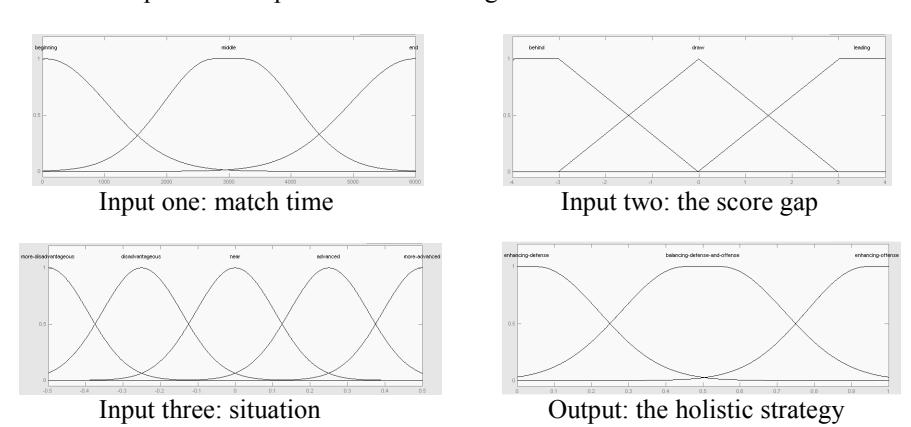
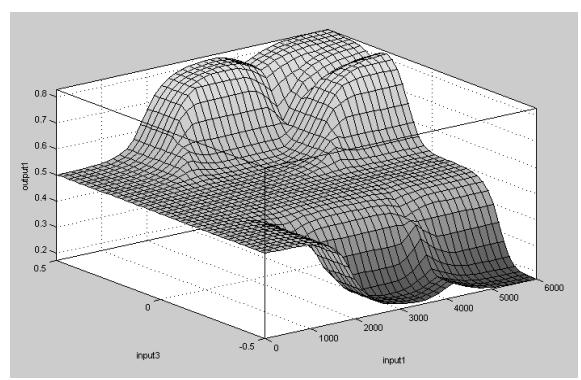
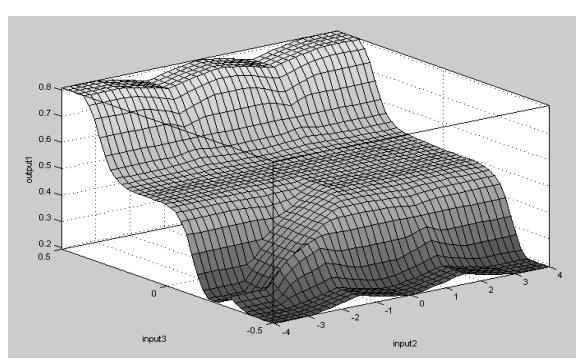
On the basis of the former model of fuzzy inference system, we construct a fuzzy inference system to dynamically choose different holistic strategy in the game. The premise of constructing a fuzzy inference system depends on the choice of inputs and outputs and the membership function. We choose match time, the score gap and situation three parameters as inputs. The output of a system is which strategy to choose. Match time is the number of cycles from the beginning of the game to current cycle and set to be three fuzzy variables: the beginning, the middle, the end. The score gap is the difference of our goal and the opponent's goal and set to three fuzzy variables: behind, draw and leading. The situation is described as situation of our team from the beginning of the game to current cycle. It is represented by the average attack-defense sensitivity of the position of the ball which is set to five fuzzy variables: more disadvantageous, disadvantageous, near, advanced, more advanced. The holistic strategy is set to three fuzzy variables: enhancing defense strategy, balancing defense and offense, and enhancing offense strategy. The membership functions of inputs and outputs are shown in figure 1 below.
The Experimental Results
Two teams, the simulation robot soccer team LsuAmoyNQ which bases on this heterogeneous strategy and the other team LsuAmoyNQ_2 which bases on random heterogeneous strategy, play games respectively with the top 7 teams of the RoboCup2008 simulation group. The results are shown in table one.
Table 1. The game results with different teams
| Opponent | LsuAmoyNQ | LsuAmoyNQ_2 |
|---|---|---|
| Brainstormers | 12win5draw3lose | 3win3draw14lose |
| WrightEagle | 9win7draw4lose | 1win4draw15lose |
| Helios | 11win7draw2lose | 2win6draw12lose |
| Oxsy | 13win4draw3lose | 5win5draw10lose |
| Dainamite | 14win3draw3lose | 6win5draw9lose |
| HfutEngine | 16win3draw1lose | 6win6draw8lose |
| OxBlue | 17win3draw0lose | 7win4draw9lose |
Table one reveals that the application of heterogeneous strategy basing on fuzzy evaluation and inference improves the matching ability of the team and obtains better results in actual game comparing with radon heterogeneous strategy.
Conclusion and Future Work
The heterogeneous strategy which based on the fuzzy evaluation and inference proposed in this paper can well solve the uncertainty problem brought out by the heterogeneous parameters randomly generated by SoccerServer and ensure that every role of the team can select an appropriate heterogeneous player in the game. The determination of the membership function of inputs and outputs in fuzzy system and the construction of conditions of the rules rely on the expert knowledge and need constantly revision and improvement. How to apply the fuzzy evaluation and inference in other module of agents is what we will further research.
References
- The RoboCup Federation, "RoboCup 2008 2D Soccer Simulation Final Standings", http://www.robocup.de/RC08/standing.html, 2008.
- RoboCup China Committee, "RoboCup China Open 2008", http://ai.ustc.edu.cn/rco/rco08/scores.php, 2008.
- Zhang Yue, Zhou Shouping and Shu Fen, Fuzzy Mathematics Method and Application. Beijing, China: Coal Industry Press, 1992.
- Hu Baoqing, Basic of Fuzzy Theory. Wuhan, China: Wuhan University Press, 2004.