OXSY 2009 Team Description
Sebastian Marian, Dorin Luca, Bogdan Sarac, Ovidiu Cotarlea
OXygen-SYstems laboratory
Abstract Oxsy team was founded in July 2002 for a graduation project of one student, Sebastian Marian, in the field of Multi-Agent Systems, at the Department of Computer Science of Lucian Blaga University (Sibiu - Romania). After graduation he continued the work on this project and so was born Oxsy team. If we will qualify to the competition, this year we will reach at the 7th consecutive participation in RoboCup Soccer Simulation League.
1 Introduction
In July 2003 at RoboCup competition, held in Padua - Italy, we won the first round group and for us it was a good surprise for first year of participation. Then, next year we participated in Lisbon - Portugal for the second time and again we obtained a good result (the 11th place). In 2005 in Osaka - Japan we participated for the third time and finally we entered in the first 8 teams, in the world soccer simulation league of RoboCup, as we won (the 8th place). In 2006 the competition was held in Bremen – Germany and we won (the 7th place). In 2007 we went to Atlanta – Georgia (U.S.A), where we obtained (the 5th place), the same result which we achieved last year (2008) in Suzhou – China, in this amazing competition of soccer simulation.
This year the competition will be held in Graz – Austria, and we want to obtain a better result, because we already have a good experience in this league of "2D Soccer Simulation". We hope that our ideas and our new improvements for this year will be materializing in the competition, where we will can tests many others tactical elements developed.
2 The Defensive Phase
This year we re-write almost complete our defensive phase, as we decided that there we still have primitive problems. So in this phase, we concentrate on the role of the players when the team is on defense.
The objective of the defensive phase is to win the ball. A team's defensive and offensive phases are closely connected. The better a team's defense is at winning the ball, the more opportunities the team will have for a quick and decisive counterattack by the offense. Just as on offense, it is also important that the defense has a team strategy, so that the players move in a coordinated way.
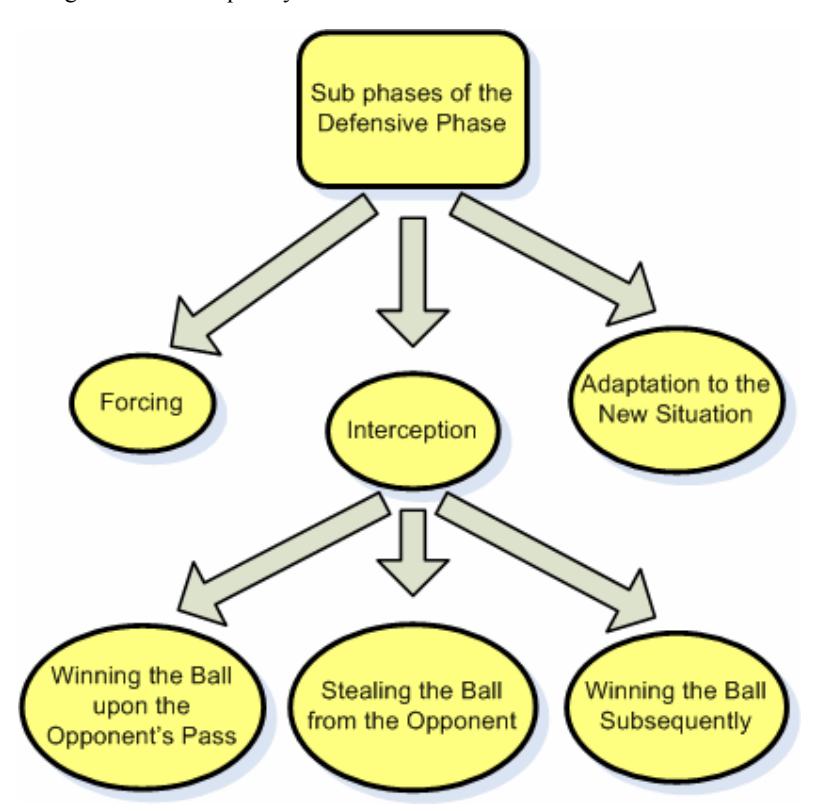
The necessary steps to winning control of the ball are:
- Forcing the opponent's action towards certain zones of the field.
- Winning the ball upon the opponent's pass.
- Stealing the ball from the opponent.
- Winning the ball subsequently.
Definition and objectives of the defensive sub phases:
Forcing: this refers to a movement which, by attacking the ball, aims at forcing the opponent either to play in a certain zone of the field, or to pass it at a certain time, that is, when the team is ready to intercept the ball. An example of forcing movement is when the forward attacks the opposing back, who has the ball on the inside, so as to force the back to play the ball on the wings, where it is easier to double-team him (with subsequent creation of a "weak side" on the other side). Other examples of forcing movements are when the defender plays for time while waiting for a teammate to double-team the opponent with the ball, and when the only space the defender leaves the opposing forward to dribble or pass is an unfavorable one.
Interception: after forcing the opponent's action, the team and the individual player must be ready to steal the ball by intercepting it either after a mistake by one of the opponents or in one of the following ways: Intercepting the ball while it is being passed. After forcing the opponents into certain zone of the field, the team places one or more players in the position called "watcher". The objective of the "watcher" is to intercept the pass independent of the movement of the offensive player. Stealing the ball from the opponent – immediately: this refers to stealing the ball from the opponent by anticipating him or by a tackle. Stealing the ball from the opponent – subsequently: this refers to when the defense wins control of a loose ball after a partially successful attempt to intercept the ball.
Adaptation: after the defense intercepts the opponent's action, there is the adaptation phase, with a counterattack if the control of the ball is won, or a return to one of the previous phases if the control of the ball has not been won yet.
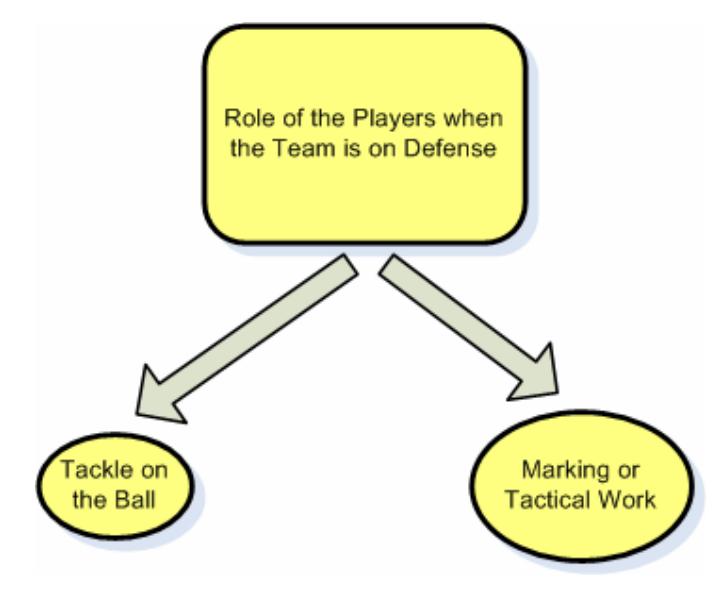
Role of the player involved in the defensive phase:
When the team is on defense, one or two players are involved in tackling the opponent with the ball, while the rest of the team is involved in intercepting the opponent's possible pass.
2.1 The Player Facing an Opponent Who Has the Ball
How to tackle the opponent:
The player (or the players, in case of double-teaming) involved in tackling the opponent with the ball has a very demanding technical and tactical task. He must optimize the technique and the time of the tackle, while applying great pressure on the opponent and closing off the space in order to make the opponent's development of the play more difficult. In order to apply pressure as soon as possible on the opponent receiving the ball, the defender should quickly get closer to him while the ball is still on its way. Once the defender is close to the offensive player who is in control of the ball, he should slow down his run in order not to be out placed, making his last steps shorter, so that he can correctly position himself. The defender should place himself between the opponent dribbling the ball and the goal itself, keeping a diagonal position. This enables him to force the opponent towards the zones that are less risky. The defender should not react to the movement of the opponent player (feints) but to the movement of the ball. His main objective is to win control of the ball. In most cases, it is advisable to force the opponent's action towards the wings. Once the opponent's action has been slowed down, the defender should try to take the initiative in order to complete the defensive intervention by directly stealing the ball or by interrupting the opponent's offensive action.
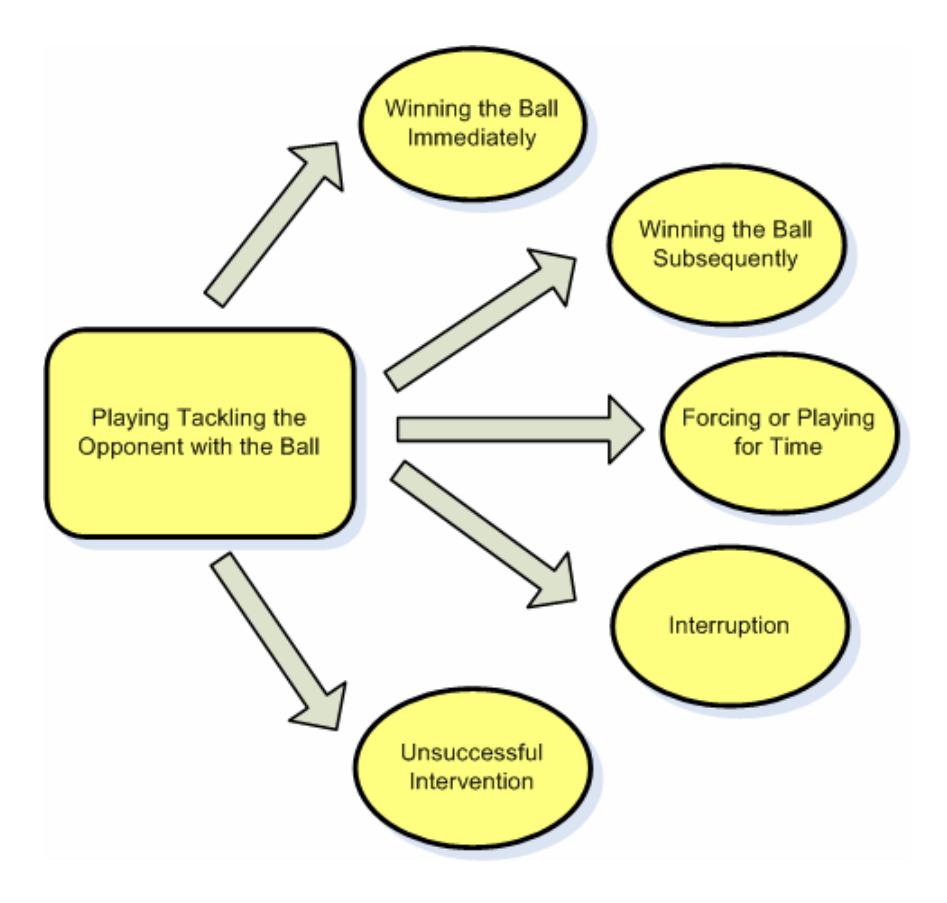
Possible options when tackling the opponent who has the ball:
The objective of the player tackling the opponent who has the ball is to win control of it by a successful intervention. He may win the ball directly: this occurs when his intervention immediately enables him to win the ball. He may win the ball indirectly: this occurs when the defender's intervention enables one of his teammates to win the ball. The defender's action can also force the opponent's play. This too can be instrumental in winning the ball. In many circumstances, the ability to force the opponent to certain tactical choices favoring the defenders is an important step towards winning the ball. Another objective of the defender can be the temporary interruption of the opponent's action. This happens when the defender deflects the ball out of bounds, or clears it. This delay of the offensive action may be tactically helpful to the defense, despite the fact that the offense retains control of the ball. If the defender is beaten by the opponent, it is difficult for the defense to adapt to the new situation, so the defender must do his best not to be beaten. Just like it is fundamental to win the ball, it is extremely important not to be beaten.
When to give space:
Let's consider the typical situations in which it can be better to give space instead of tackling. In situations of inferiority in numbers it is important to be able to "float" between the two opponents so as to slow them down as they move towards the goal, relying on the teammate's recovery of their positions. The defender must be ready to take advantage of any possible mistake made by the opponents while the offense is passing the ball, dribbling or controlling it. An example would be a slow or wide pass. Another situation in which it is better for a defender to give space in order to slow down the opponent's action is when he faces an opponent type that is quicker that the defender is. By giving space, the defender can play for time while waiting for a teammate to double-team the opponent.
2.2 The Defensive Player Not Facing the Opponent with the Ball
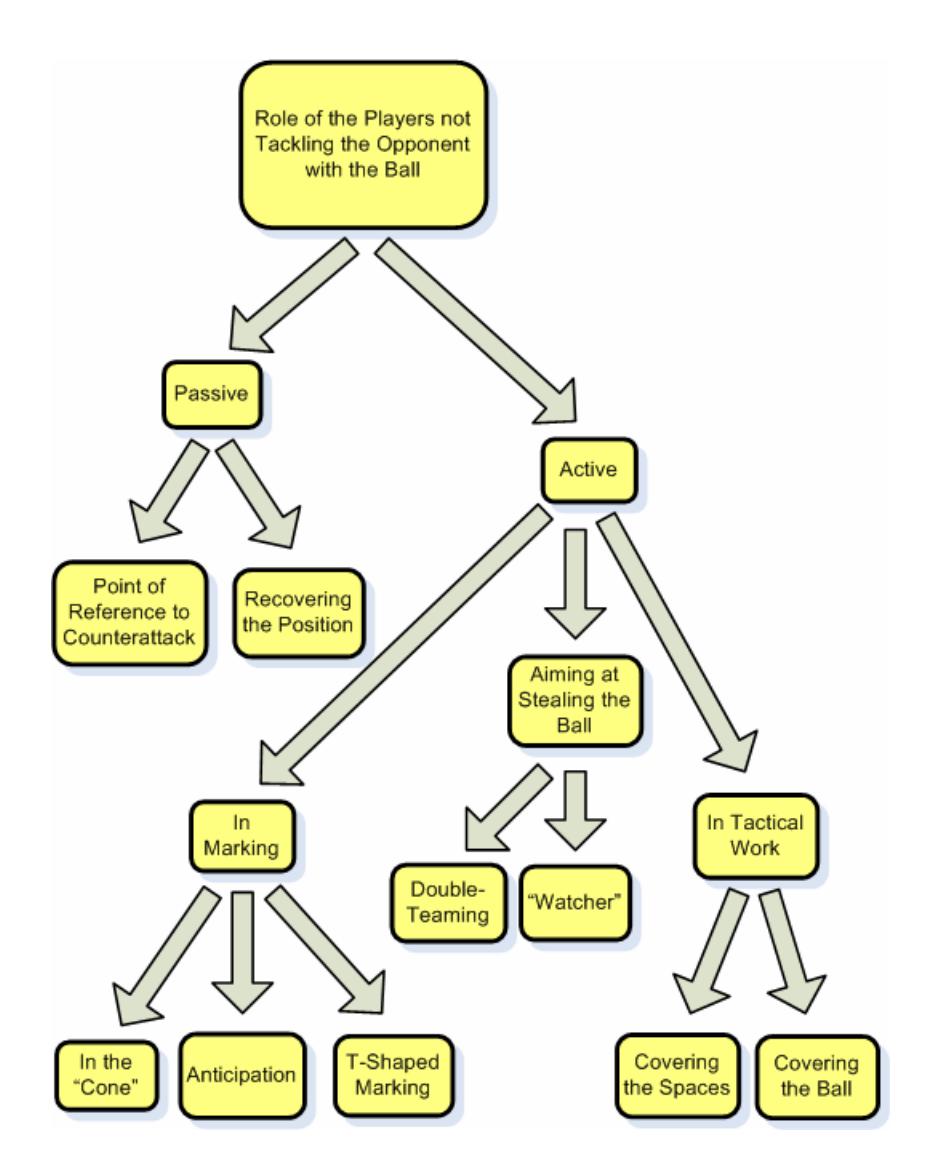
The passive player:
Just as on offense, it is very important for the defense to be able to move without the ball. It is the organized movement of all the players involved on defense that enables the team to gain possession of the ball and start a decisive counterattack. On defense, the player not tackling the player with the ball can be termed either "active" or "passive". He is "active" when he participates in the attempt to gain possession of the ball; he is "passive" when he does not. As a general rule, on defense we can term "active" any player who is in the area between the line of the ball and his own goal ("under the line of the ball"), while we can term "passive" any player beyond the line of the ball ("over the line of the ball"). However, there are some exceptions. The player over the ball line can also be active when he closes down on the possible back pass. When the development of the play places the player in a passive position, he should quickly recover to a more useful position which will help his team to gain possession of the ball. The "points of reference to counterattack" are those players who remain over the line of the ball in the defensive phase, ready to receive a pass and start counterattack if their team gains possession of the ball. The "active" player may be involved in marking, stealing the ball or in tactical work. With regard to his direct opponent, the marker can position himself in anticipation, in the cone, or in a T-shaped position. The marker is said to be in anticipation when he is between the offensive player with the ball and the offensive player he is marking. The marker is said to be in cone when he is inside the triangle whose base is the goal line and whose top is the offensive player he is marking. The marker is in a T-shaped position when, on the side opposite to where the ball is (weak side), he shifts towards the inner side of the field.
3 Future work
For the next year we want to pay more attention to the coach. Already we use some information from coach, but we feel that we can use it more efficient, in order to give some tactical advices during the game.
As the coach has the privilege to receive full visual information without noise, we can use it to make an opponent modeling. In fact, we believe that is more important to adapt the strategy during the game, instead before it.
So, we can use a neural network that will try to find, a typical pattern for each opponent team, in both of these defensive and offensive phases. Than the coach can decide, if something goes wrong, to send some advices to change things.
We think that importance of the coach is not speculated very well right now, and maybe it will be a good point for research, not only for our team but for all teams involved in soccer simulation.
References
- Peter S. Layered Learning in Multi-agent System [D]. Pittsburgh: school of computer science, Carnegie Mellon University, 1998.
- Jinyi Yao, Jiang Chen, Zengqi Sun. An application in RoboCup combining Q-learning with Adversarial Planning. Available in http://robocup.lits.tsinghua.edu.cn/download/document/tsinghuaeolus_kick.zip.
- M. Riedmiller and Artur Merke, "Using machine learning techniques in complex multiagent domains," In I. Stamatescu, W. Menzel, M. Richter and U. Ratsch, editors, Perspectiveson Adaptivity and Learning, LNCS, Springer, 2002.
- Itsuki Noda et al, Soccer Server Manual, RoboCupFederation. http://www.robocup.org.
- Y. Jinyi, C. Jiang, and S. Zengqi. An application in RoboCup combining Q-learning with Adversarial Planning. In the 4th World Congress on Intelligent Control and Automation (WCICA'02), Shanghai, China, June 2002.
- Peter Stone and David McAllester. An Architecture for Action Selection in Robotic Soccer. In Proceedings of the Fifth International Conference on Autonomous Agents, pages Pages: 316–323, 2001.
- Takashi Suzuki. Team YowAI Description. RoboCup 99: Robot Soccer World Cup III, 2000.
- Soccer Tactics. An analysis o attack and defense, by Lucchesi Massimo, originally printed in Italy – 1999 by Edizioni Nuova Prhomos Via O.Bettaccini.
- Coaching the 4-4-2. Zone Play, The Flat Back Four Defense, Attacking Schemes, by Floriano Marziali and Vincenzo Mora, originally published in Italy by Edizioni Nuova Prhomos.