RoboSampad Simulation 2D Team Description Paper
Hosein Mobasher, Behnam Amani
Shahid Beheshti High School; Farhikhtegane Montazer Scientific Institute
Abstract In RoboSampad, we continue to research based on Knights simulation team. RoboSampad has participated in Iranopen2008, 2d league student's competition, Khwarizmi 2d league. In this paper, we present the agents' skills and all future work. RoboSampad methodology that is the fuzzy logic and all action of an agent in soccer simulation 2D environment are used with this logic and in continue, we presented it.
1 Introduction
The RoboSampad team was established in 2008, starting with only the simulation team. In 2d students competition, we got 5 th place and 10 th place in iranopen2008 competition. Agents send/receive the message that got the harmonizing team aims. So, teams' coach try to analyze the opponent team behavior that considering team between weak or strange. Finally, appoints the team strategy in filed and by knowing the agents, send the suitable message to them. After sending message by coach, agents try to do them well. Since now, a large part of this structure has dismount successfully and remains complete in future.
2 Team Systems
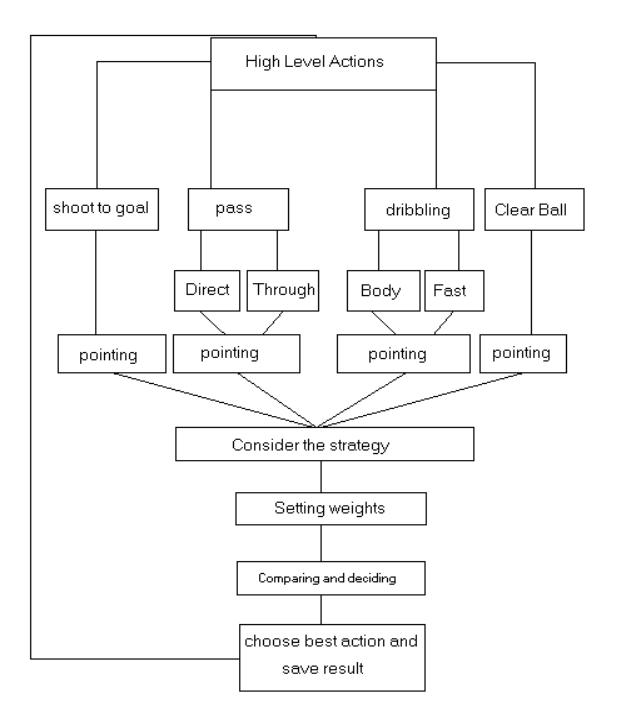
Team methodology is based on fuzzy logic. Below graph show that all actions are sending to server after fuzzy deciding. In team, filed has divided to 12 parts and set weights for all of part. After pointing the actions (below will present), weights are effected to points after considering the position or strategy.
This graph show team coordinates structure:
2.1 Actions with ball
Any agents that owner the ball to achieve the end should has best skills. RoboSampad team skills divide to 4 parts:
2.1.1 Shoot to goal
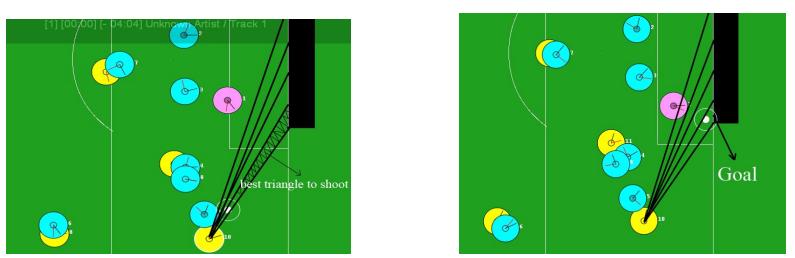
In this part, any agent tries to get a goal for team by using this skill. RoboSampad agent divides the goal line to 6 parts and creates a point and risk for any part. Finally, select the best part with terms and shoot ball to it.
2.1.1.1 Shoot to goal terms
- Distance to goal, 2. Distance to goalie and 6part of the goal line, 3. Goalie catchable area, 4. Opponent strategic and agent's position
2.1.2 Pass
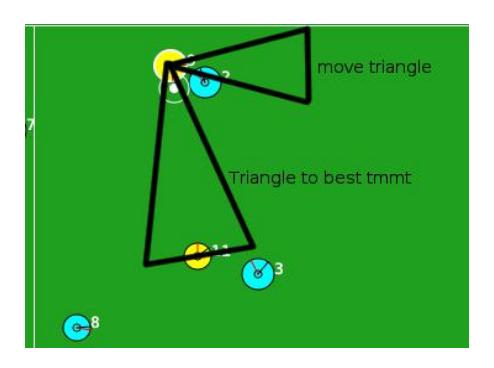
This skill is important to relate the agents together. In this part, agent chooses the points for all of the teammates and calculates the point by using the pass terms and finally chooses the best teammate for pass to it.
Team pass is dividing to 2 part: 1 direct 2 through
2.1.2.1 Direct pass
If agent can pass ball to teammate directly, try to direct pass when the opponent isn't in pass route, direct pass is suitable or distance to teammate are low, using direct pass is good and useful.
2.1.2.2 Through pass
If agent can't to pass directly, use through pass. In this part, pass to secure position is important. Team is using the pointingmode to select position. position usually front of the agent to be selected for pass.
2.1.2.3 Passing terms
- Distance to agents, 2. Strategic position and type of the players, 3. Agent position and teammate, 4. Number of opponents and teammates on pass route, 5. Visible and confidence, 6. Offside line and agent situation fromit
2.1.3 Dribble
Dribble of team is dividing to 2 parts: 1 Body, 2 Fast
2.1.3.1 Body dribble
This dribble is action when around of the agent isn't secure, and this dribble with low speed and dash to save the ball.
2.1.3.2 Fast dribble
This dribble is action when the around of the agent is secure and in this dribble agent use long dribble, and kick the ball frontier than body dribble.
2.1.3.3 Dribble terms
- Agent position, 2. Agent type, 3. Strategic part, 4. Goal difference, 5. Opponent position
2.1.4 Clear ball
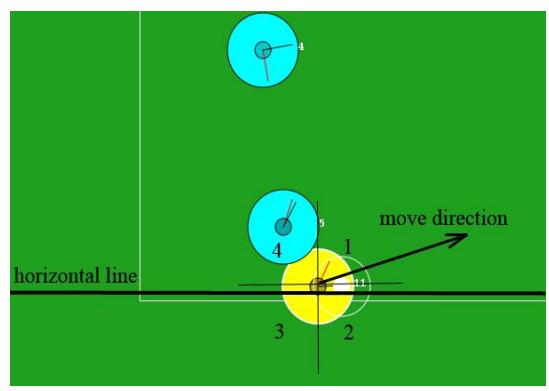
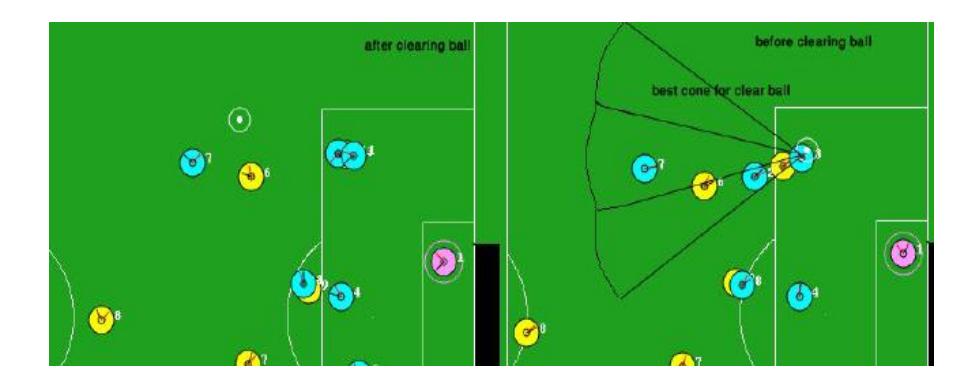
Clearing ball in all teams is important for goalie and agents. In our team, 3 triangles have created in front of the agent and calculated the points for any one and select best and secure to kick ball to it.
2.1.4.1 Clearing ball terms
- Agent type, 2. Agent position and strategic area, 3.Teammates and Opponents positions, 4. Kick route and number of player in it.
2.2 Actions without ball
These skills make agents to be arranged in positions so that they would have the most chance to create opportunities for team or to get the opponents opportunities.
2.2.1 Mark
Mark skill approaches two purposes:
- Not to let the ball reaches the opponents (mark player).
- Not to let the opponents shoot to their desired position (mark ball). According to the purpose the player gets near to the opponent up to the MarkSecureDistance and marks him.
2.2.2 Objectfinding skill
The agent uses this skill to find an object and/or to update his world model.
3 Goalie
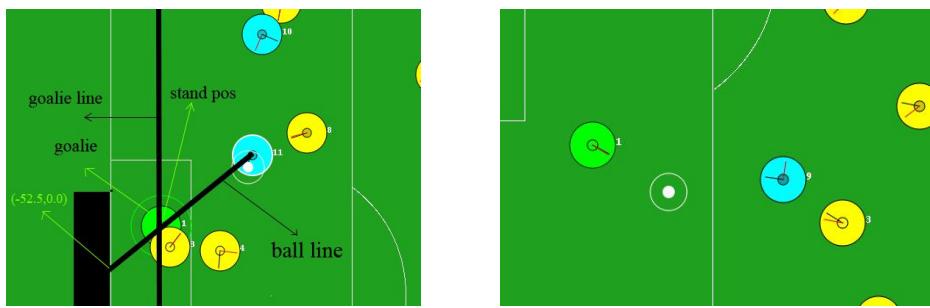
RoboSampad try to improve the goalie action by using the best conditions. In this part, first check the catching ball action, if goalie fastest to ball then tries to catch ball or kick it out of filed. Goalie standing position calculate with creating parallel line with goalie line and intersect it with ball line(Fig. 6 ) and got the position that move it.
4 The Coach
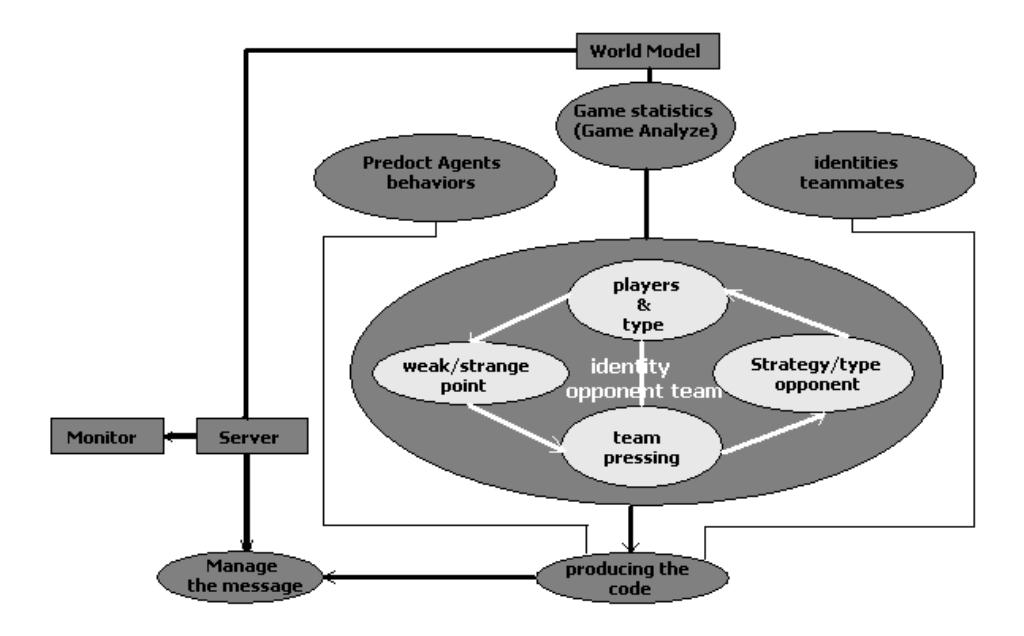
RoboSampad coach level has divided to 2 parts: first analyze the game and second choose the best strategy by using this analyze result.
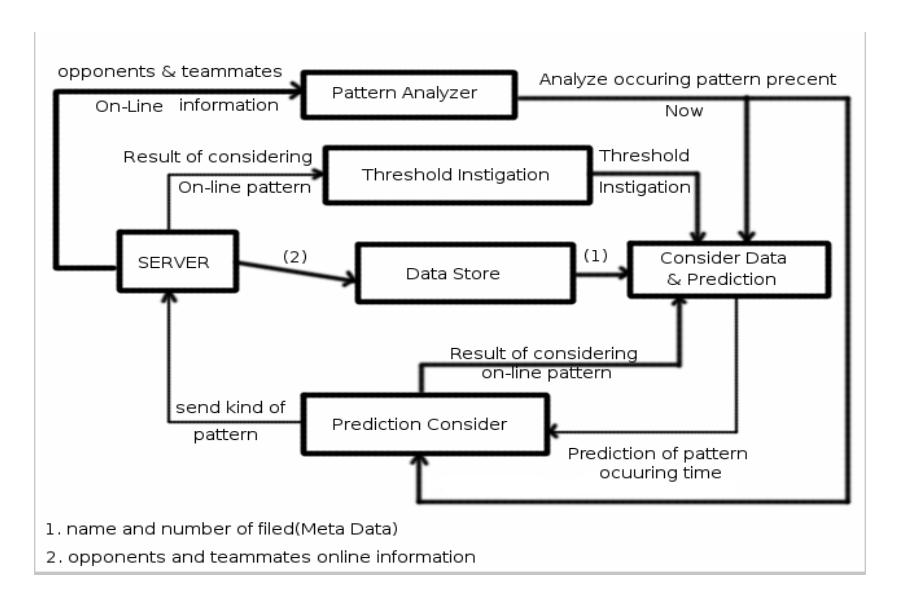
In analyze part agent's behavior has a pattern that has repeated in game and by using the fuzzy system and artifitual intelligence, the time of run actions would predict that deciding the suitable behavior.
4.1 Analyze system and internal structure
When coach has started the work in first cycle, in any time receive information from server. Moreover, server sends the other information to clear the game mode. In this part try to analyze the game with information of server and other information that coach got them.
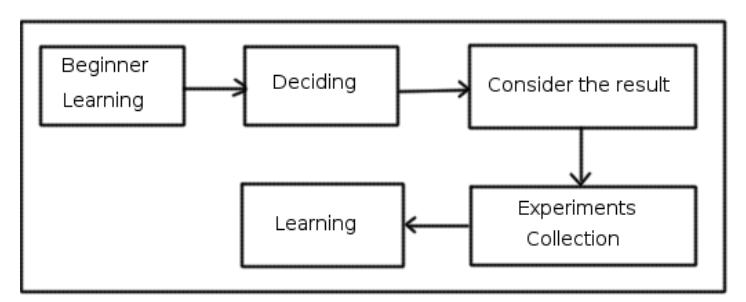
4.2 Learning and deciding
After the coach analyzing and getting suitable information about environment, now should decide for teammates and use the experiment to suitable deciding.
5 Conclusion
In this paper we showed an overview of the RoboSampad soccer 2D agents design. We can to dismount our algorithm well. We use fuzzylogic and neural system in high level skills to improve them and got the best result that arrange agents. We separate agents with type of them and create role for them to run command rapidly. Finally, team achieves the end and decreases the dangerous of the lost ball.
References
[1] M. Veloso, E. Pagello, and H. Kitano, editors. RoboCup99: Robot Soccer World Cup III, SpringerVerlag, Berlin, 2000. [2] Alireza F. Naeeni, "Advanced MultyAgent Fuzzy Reinforcement Learning," DEGREE PROJECT Computer Engineering, Hogskolan Dalama University Press, 2004 [3] Kh. N. Maleki1, M. H. Valipour, R. Y. Ashrafi, S. Mokari, S. A. Zahiri and M. R. Jamali, "Scorpios Team Description Paper Soccer Simulation 2D league, Iran Open 2008" [4] H. Mobasher, N. Alamati, A. Manzoori, "Knights Team Description Paper Soccer Simulation 2D League, IranOpen 2008" [5] 5. V. Salmani, A. Milani Fard, M. Naghibzadeh. A Fuzzy TwoPhase Decision Making Approach for Simulated Soccer Agent, IEEE International Conference on Engineering of Intelligent Systems, pp. 134 139, Islamabad, Pakistan, April 2223 2006.