APOLLO2D 2010 Team Description
Zhongbao Jin, Weimin Wu, Lizhen Hu, Zhiyong Zhang
Department of Automatization Science, Nanjing University of Posts and Telecommunications, Nanjing, 210003, P.R.China
Abstract This paper describes the main features of Apollo2010 2D Soccer Simulation. Apollo 2D has won the first prize in China RoboCup 2008 and 2009 2D Simulation League. Although Apollo2D has got good results in his previous matches, there are many deficiencies and shortcomings. To solve these problems, we have been concentrating on updating the worldmodel of Apollo2D 2008, as well as adjusting and improving the upper mechanism used by previous years in large-scale.
Introduction
Apollo is a robot soccer team of 2D Simulation League. It comes from Nanjing University of Posts and Telecommunications, and we have taken part in RoboCup since 2004.
Apollo2010 inherits from Apollo08 but has a great improvement. Rewriting the Apollo's goal is to fix up the deficiencies and shortcomings in team, make it sync with the latest Rcssserver, verify the collaborative programs which are brought forward in recent years, and promote our artificial intelligence and multi-agent system (MAS) learning and understanding.
In the latest team, considering to the differences of roles and missions, we divide team members into a number of groups. The collaboration among team members is divided into real-time collaboration within the group and inter-group cooperation through online coach. The coach's using will be the sign of distinguishing from a low version of the Apollo team. In next paper, we will introduce the differences in Apollo2010 2D.
Dribbling Skills
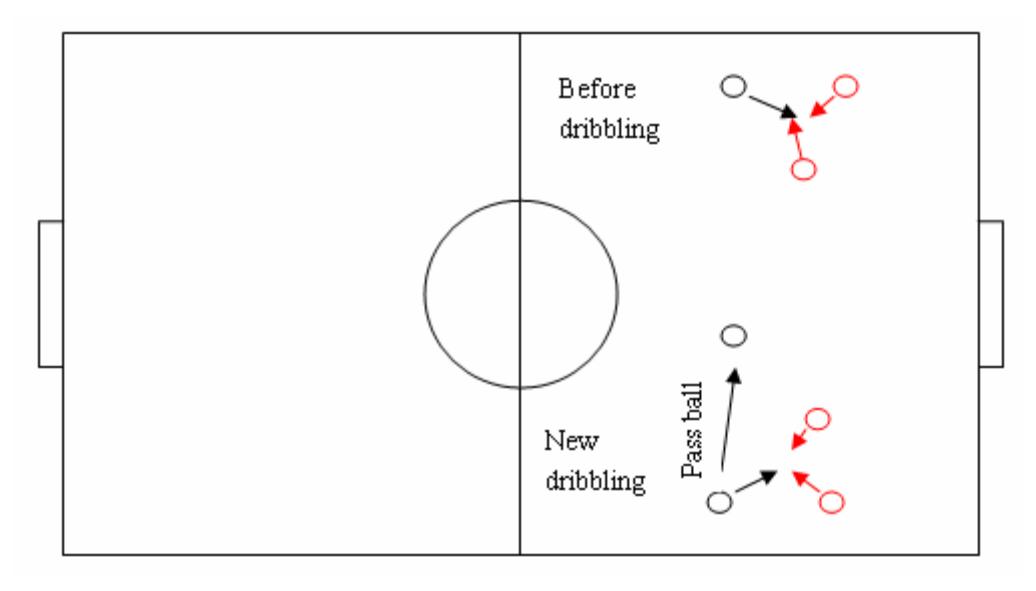
In the previous team, our dribbling system will easily lead to a lone dribbling ball to opponent areas and result in losing ball directly, which has been proved in China RoboCup 2008 and 2009. To solve this problem, we change the dribbling mechanism of aggression to cooperative aggression by a number of players and a way by pass ball to teammate to break through opponent's defense (Fig 2.1).
Of course, choosing the cooperative aggression strategy need to consume the valuable time, therefore, we have specially developed the action of dribbling ball to attack. The low-level decision-making have been included in the action, and the upper tactic is responsible for adjusting the more complex strategies.
Saving Stamina Mechanism
We find that some of our players lose their stamina in games and easily lead to the dead situation. Functions in worldmodel can help players perceiving stamina, but players can not accurately measure the stamina information about other teammates. This will reduce the effectivity of cooperation.
We believe that the stamina needs to play the best results through collaboration, and get the maximum savings. Therefore, in the upper tactic, we collect the stamina information of teammates and calculate a best mechanism to save players' stamina, which is one improvement of Apollo2D 2010.
Formation
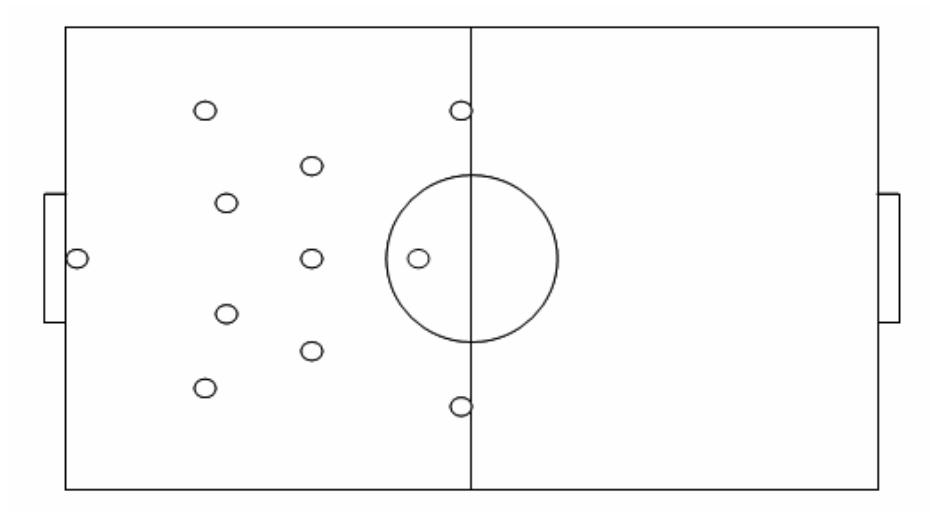
In Apollo2010 2D, our offensive and defensive formation use the 4-3-3 formation (Fig 4.1). Due to no specific testing, the locations of formation may be adjusted in the future. We also design other formations for backup.
We use a Situation Based Strategic Positioning (SBSP) method [1] to adjust the location of players on the field every cycle, which was proposed by a world champion team, the FC Portual 2000 [3]. And based on the differences between defensive and offensive, different SBSP points sets are supplied.
Scheme
In soccer match, it is very important to understand the opponent's approach of offensive and defensive. When attacking, we need to infer the opponent's defensive approach, and use the appropriate plan of aggression. Similarly, when defending, you need to guess the form of opponent's attack. Thus, in the process of attack and defense, players near the ball must infer the opponents' moves information based on the opponents' information, and adjust the team's cooperative strategy based on these information.
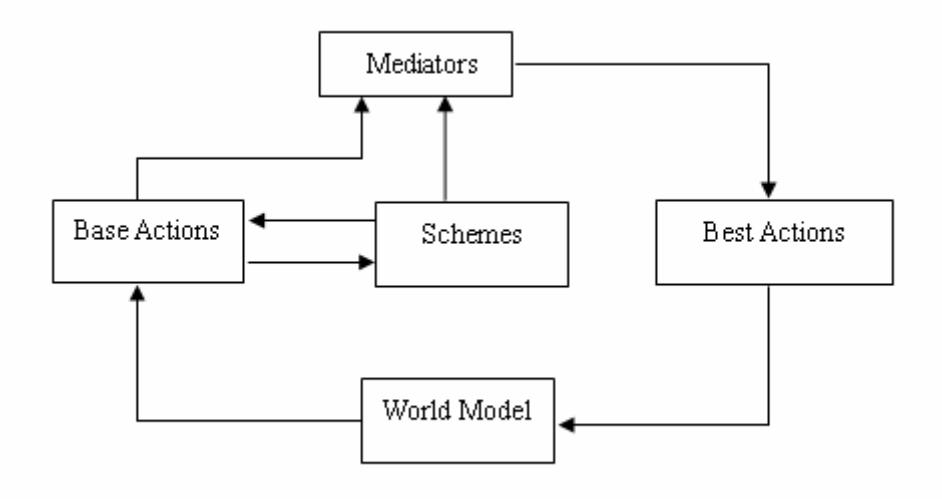
In Apollo2010 2D, our proposed mechanism is divided into a variety of strategies, such as the stamina conservation mechanism for the players, the positioning proposed mechanism, the visual proposed mechanism and so on. At the same time, we use evaluation mechanism associated with every mechanism to manage these strategies, and select the optimal strategy to implement, so as to achieve the best collaboration among multi-agents. In fig 5.1, it shows the schemes mechanism calling of the Apollo2010 2D.
In addition, in Apollo2010 2D, we have also designed a series of tactics. In the implementation of a series of actions will be to determine whether the input condition of tactics is met. When met, the appropriate tactics will be implemented to complete the coordination among multi-agent, for example, two cooperative players breaking through one opponent's defense is a good tactic in previous Apollo2D.
Conclusion and Future Directions
In this paper, we introduce the Apollo2010 2D simply and exhibit our work. Because some improvements of the program are put forward comparatively late, and the rate of improvements are subject to the development team, we don't test the effect of the latest changes by the numbers.
The current log files and debug outputs show that, our worldmodel is so imprecise that leads to many inaccuracy information and wrong judges in match. While improve on the upper-level models, we are trying to refactorying our team using librcsc-3.1.2, which has a nice performance in communicating with server and is released by Akiyama [2].
Campared with SBSP, the Delaunay Triangulation Positioning Algorithm which is proposed by Akiyama [3] has some distinctive advantages. Therefore, Delaunay Triangulation can be a substitution of SBSP to position our players' location.
In the next time, we need to perfect the above-mentioned mechanisms, develop good offensive and defensive opponent matching method, adjust the team strategy function modules in accordance with the characteristics of opponents and keep balance among decision-making, information exchange and action.
For future directions, we are interested in researching different structures and cooperative strategies of Multi-agent system, and how to improve agents act intelligently.
References
- Luis Paulo Reis, N.L.: Fc portugal team description: Robocup 2000 simulation league champion. Robocup 2000: Robot Soccer World Cup IV (2000)
- Download open source address: http://sourceforge.jp/projects/rctools/
- Akiyama, H., Noda, I.: Multi-agent positioning mechanism in the dynamic environment. InVisser, U., Ribeiro, F., Ohashi, T., Dellaert, F., eds. : RoboCup 2007: Robot Soccer World Cup XI, Lecture Notes in Artificial Intelligence. Volume5001., Springer(2008) 377-C384.
- Yao, J., Lao, N., Yang F., Cai, Y., Sun, Z.: Technical solutions of TsinghuAeolus. In: RoboCup Symposium 2003, Padova, Italy (2003)
- Ma, J.: Distributed Intelligent Decision and Optimized Learning in RoboCup Simulation. Bachelor Degree Thesis. Nanjing University of Posts and Telecommunications. First prize awarded in Jiangsu thesis competition, China. (2006)