FC PARS 2010 2D Soccer Simulation Team Description
Farzin Hosein Borujerdi, Mahdi Hamdarsi, Saideh Hossein Borujerdi
Facuty Of Computer, Kowsar University Of Technology, Qazvin, Iran; Facuty Of Computer, Shahid Beheshti University, Tehran, Iran; Facuty Of Computer, Tehran University, Theran, Iran
Abstract This paper describes the architecture and scientific goals of the FC PARS soccer simulation team. This team is built by three students from the Kowsar, Shahid Beheshti and Tehran universities for robotics and AI research purposes. FC PARS was started as a school research project in 2002 and now is participating for the first time in international robotic competitions. The team was previously built on the well known UvA Base code, but now is using the release base code of Helios 2008 team. The research focus is to alter the behavior of soccer players to think and act like professional human soccer players. For this we have used experiences and advices of Mr. Majid Jalali (AFC approved soccer coach) and tried to implement his ideas to take artificial soccer intelligence to a higher level. Our efforts are distributed in two major areas which will be discussed in the following sections. Much attention has also been paid to the software engineering aspects of the project for its comprehensibility and to facilitate future revisions.
Introduction
FC PARS team has participated in past competitions, mainly in IranOpen and other national competitions. Although not much successful, the team continued its research in artificial intelligence. Our primary focus is to take soccer AI one step forward to clone human emotions, mainly anxiety and excitement. This subject came in mind after a deep discussion with Mr. Jalali who is a professional soccer coach and is a AFC approved soccer coach. We analyzed his ideas and tried to implement them in soccer simulation league.
With the fundamental changes of the 2D simulator and simulation, much time seemed to be needed to update our previous base code (UvA) to comply with the huge changes that RoboCup soccer simulator has gone through and to utilize its newly added features.
For this we found out it's better to use a newer and up to date base code which matches our needs. We selected Helios 2008 released source code (Which is released under GNU license) and tried to improve upon it. In order to implement new emotional models of soccer players, we have gone through changing almost all of decision process which is implemented in Helios source code. The some changes include decisions for all defenders, wing offenders and middle offenders, attackers, game play and huge changes in marking and pass implementation. Some basic skills were also altered to match our decision process including dribble and shooting method.
During the implementation we have also paid much attention to the software engineering aspects of the project (modular design, documentation, etc.)
Current Implementation
This section describes the current implementation of the FC PARS team.
Excitement and overall team behavior
Daniel Golman is a behaviorist psychology professor. In his book "Working by excitement sense" he introduced excitement as a deep reason for a lot of actions done by humans. He believed that excitement intelligence is a type of intelligence, skill or ability that deeply surrounds human actions [1].
When a player sees that the current game situation is prominent and can lead to a goal with a good probability, he will go into a state of excitement. If the excitement is considered with a reasonable discipline and coordination, the team's chance of scoring will be improved significantly.
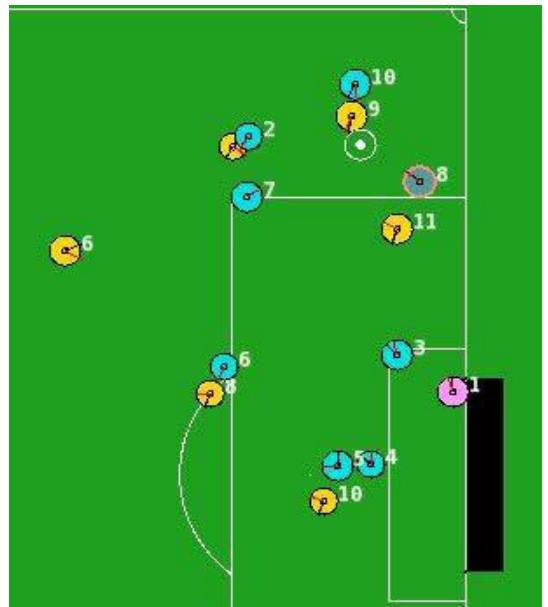
Consider the following scenario: The ball is in our team's procession and it is located in the forward one third of opponents half. In this situation the player only sees the situation good for scoring and only thinks of the best way to score. The type of excitement in this repetitive situation differs for teams which are more powerful than their opponents or just are losing with one goal advantage of their opponent.
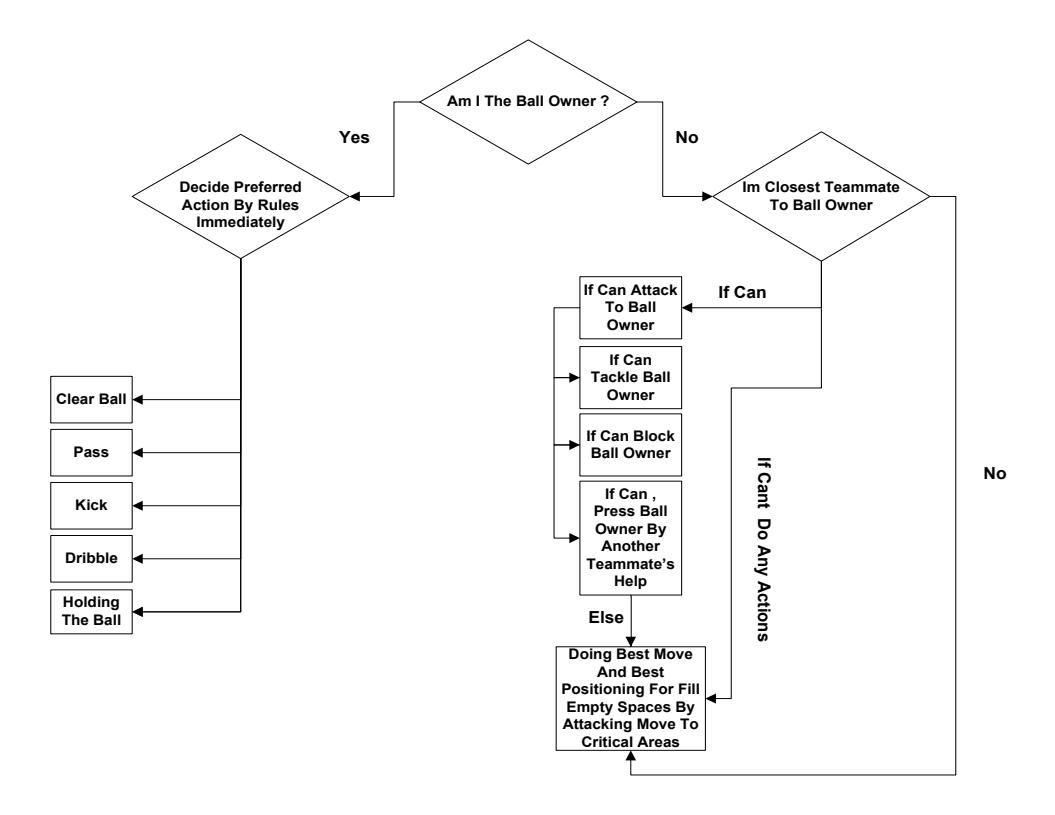
"If this emotion is handled with a coordinated plan, it will benefit the whole team to get to better result." This is one of the best advices of Mr. Jalali and we tried to implement it to see how it results. We created a decision tree and tried to improve it step by step. Briefly it is presented in Fig. 1. The coordination plan is to move fast into opponent's area and try to penetrate opponent's small count of defenders with the help of flank offenders.
Anxiety and overall team behavior
Fear is natural reaction of humans when encountering dangers with the aims to defend human from possible harmful effects of the danger. When a human is in a dangerous situation, adrenaline is flown into blood vessels which increases heart beat rate and blood pump rate in muscles which prepares body for faster and more accurate reactions. So, in dangerous situations fear is natural and even helpful [2].
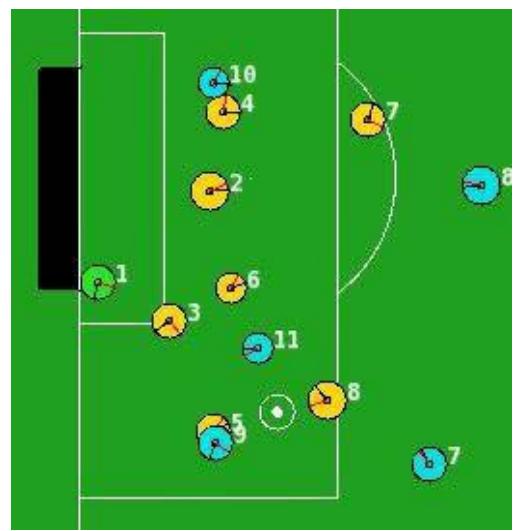
In the other hand, anxiety is an unreasonable extreme amount of fear which makes human to lose control of his actions in a fearful environment. In a soccer match this happens typically in situations where players find the opponent team with a chance of scoring a goal. In these situations the normal reaction of players is to gather fast in the front of their own goal and defend.
If this emotion is controlled coordinated between team's players, there will be a good chance of recovering the situation and using it as a counter attack. This is one of the other advices of Mr. Jalali. In his opinion putting a team in anxiety makes easier for the opponent to score, because in the state of anxiety players act more chaotic and with no coordinated plans.
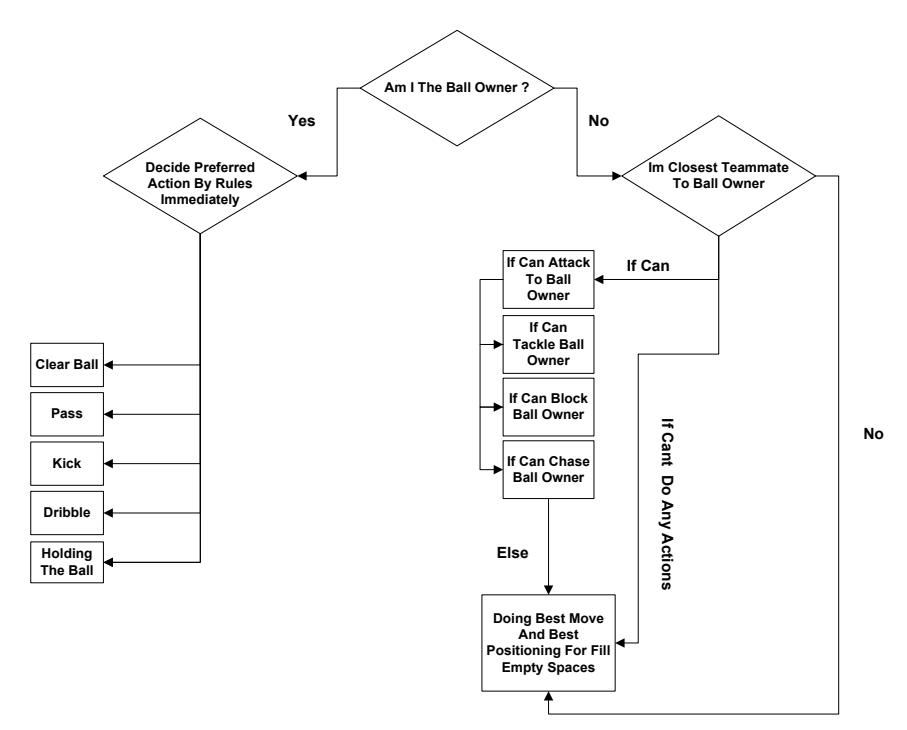
In order to handle these situations, we evaluate a value for the anxiety of current situation, and based on that will defend our goal. The more anxiety calculated, the more players will act densely and closer to their goal. This is also done with a decision tree which is shown on Fig. 3.
Software engineering
In order to make it easy to maintain and append new features to a project concerning a multi-agent system much attention during implementation has been focused on software engineering issues. We have followed an object oriented design leading to a logical program flow and highly modular code. We use a multi-level log system for debugging purposes, which uses the basic idea of layered disclosure [3] which enables the programmer to specify the issue subject so that all log reports would be organized for a speedy log rotating. Much time has also been spent on documenting our code to facilitate future reuse. For this we have used the documentation system Doxygen.
Conclusion and Future Work
In this paper we have discussed the current implementation and future plans of the FC PARS soccer simulation team. Until now most attention has been paid to humanoid emotions in soccer and their implementation on Helios source code, software engineering issues. As of the future plans we presented our idea to use the BPN with online training and memory of the match to mimic the human emotions more accurately.
Excite and anxiety emotion modeling has proven successful in modeling and controlling situations which put pressure on players. Our current implementation is using decision trees. We seek to improve the functionality of this behavior with using back propagation neural networks (BPN). Our ultimate focus of using BPNs with online training of emotions is to mimic human emotions completely. For this the players shall behave not only from the current game situation, they shall consider past situations in the game or even past game records with their opponents. This is done by using saved data of the match and using them as memory reserves for the agent. These reserves will be considered in the neural network.
References
- Wikipedia, Free Encyclopedia, Daniel Golman: Working by excitement sense. http://fa.wikipedia.org/wiki/%D9%87%D9%88%D8%B4_%D9%87%DB%8C%D8%AC%25%0b%20%20%20%20%20%D8%A7%D9%86%DB%8C/
- Wikipedia, Free Encyclopedia, An introduction to Anxiety. http://fa.wikipedia.org/wiki/%D9%87%D8%B1%D8%A7%D8%B3/
- Patrick Riley, Peter Stone and Manuela Veloso, Layered Disclosure: Revealing Agents' Internals, Computer Science Department, Carnegie Mellon University, PA 15213 -3891 Pittsburgh, PA