RoboCupSoccer 2010 - 2DSoccer Simulation League - Team Description Ri-one (Japan)
Akira Yoshimura, Kosuke Miyawaki, Takayuki Ikegami, Yukio Kuwa, Yuki Takao, Katsuari Kamei
Ritsumeikan University, Japan
http://spice.ci.ritsumei.ac.jp/~robocup/public/index.php
Abstract Ri-one is 2D soccer simulation team based on UvA Trilearn[1] base team. Our main goal is "To construct strong AI for soccer", and We think that "strong AI" equals to "Agents have a consistent intention or role". In this paper, we will mainly introduce team features, and techniques included in Ri-one.
1 Abstract
Ri-one is 2D soccer simulation team based on UvA Trilearn[1] base team. Our main goal is "To construct strong AI for soccer", and We think that "strong AI" equals to "Agents have a consistent intention or role". In this paper, we will mainly introduce team features, and techniques included in Ri-one.
2 Introduction
2.1 OutLine of TDP
This TDP has 4 sections. In these sections, we will describe the following things. 1st section : We will show outline of this TDP and introduce our project team. 2nd section : We will describe our team policy and explain about each ideas which achieve our policy.
3rd section : We will introduce about our tool for team developing and our new team.
4th section : We will summarize our ideas, describe future directions and references.
2.2 Group Introduction
Ri-one is a project team founded by Ritsumeikan University College of information science and engineering. We have started participating RoboCup 2D soccer simulation league in the same year, In our first participation RoboCup 2006, we won the 3rd place. In next RoboCup 2007, we won the 12th place. And in RoboCup 2008, we won the 9th place. Now, our project team participate in both 2D soccer and Rescue simulation leagues.
3 About Team Policies and Approaches
3.1 About Team Ri-one
Team Ri-one places more emphasis on offensive ability and less on defensive one. Its policy is aiming to get score with quick attacking by using counter and breach the opponent's defense line by using through pass. Recent years in 2D soccer simulation, the importance of collaboration between midfielders and other positions is becoming bigger and bigger. For instance, when the team enter an advantageous phase, some their midfielders work as temporary forward and participate in attacking with forwards. Also in another situation, when the team enter a dangerous phase, midfielders quickly return to their field and work as a temporary defender. Therefore, there are many teams that have flexible midfielders. However, the team needs all member's collaboration and high quality stamina control model of midfielders to realize this plan. Ri-one remarks this point and set its main attacking model as hereinafter. First, our defender steal the ball from an opponent in our field. After that they quickly pass the ball to the front like a counter attack. By using this way, we can reduce the number of opponents who are in charge of defense line as much as possible. Then, forward run through theopponent's defense line with through pass and get a score. In the following part, we will introduce our skills to realize these ideas.
3.2 Through Pass
First, this TDP use the word "Through Pass" as following definition. The pass enables agents to run through opponent's defense line and make a strong chance of getting score. In the Ri-one's offense style described in above part, this trough pass's success and failure is very important to actively get score. As acting through pass, important points are
1)Keeping the position and assessing situation of through pass receivers.
2)Collaboration between through pass taker and receiver.
3)Make opponent's defense line be minimum scale.In following part, we will discuss these 3 points
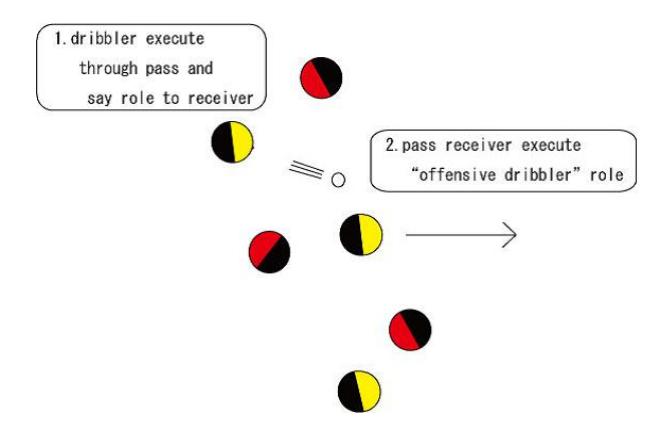
- Keeping the position and assessing situation of through pass receivers. For suitable through pass, the key point is position and body direction of receiver. Specifically, the receiver has to grasp some opponent's defenders position and off side line and turn his body to the opponent's goal.
- Cooperation between through pass taker and receiver. In the above situation, it is too difficult to obtain information of ball and its holder by forward himself. Therefore, Ri-one use say command to make collaboration between ball holder and receiver.
- Make opponent's defense line be minimum scale. The less number of opponent's defenders is important factor for through pass. Thus Ri-one aims to quickly attack by using counter.
3.3 Communications with Say Command
There are some problems to realize the Ri-one's offense style and we are trying to solve them by using say command. Followings are examples of usage of say command.
- a) Supporting other agents to observe ball information.
- b) Decision making by other agents.
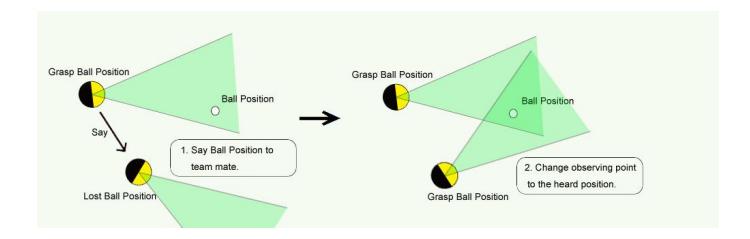
- a : Ri-one takes the ball information as the most important one. Because the accuracy of ball information is quite important to make appropriate judgment on field situations and our formations. Therefore, each agent can demand ball information from other agents when he lost the ball information. Followings are concrete steps.
- An agent who lost ball information demands ball information from other agent by using say command.
- An agent who hear the demand says the ball information if he is the 1st or 2nd closest to the ball and has high confidence of its position.
By using this system, Agents can obtain the ball information in a few cycle and judge the situation with accuracy.
3.4 Usage of many SBSP Formations
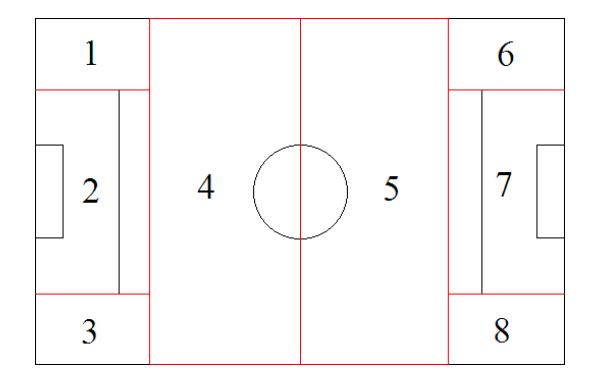
Ri-one uses Situation Based Strategic Positioning(SBSP)[4] for team formations similarly to UvA trilearn. SBSP is developed by team FC Portugal[3] and it enables to make up complicated formations with a few parameter sets. Ri-one realizes flexible agent positioning which correspond to ball position by adopting total 8 formations. In the concrete, we dividesoccer field in 8 areas as follows and each formation are adopted according to current ball position. In addition, we set up each formation without undergoing major changes at the each agent's position when our formation are switching.
4 About team development and tool
4.1 Tool for making Formations
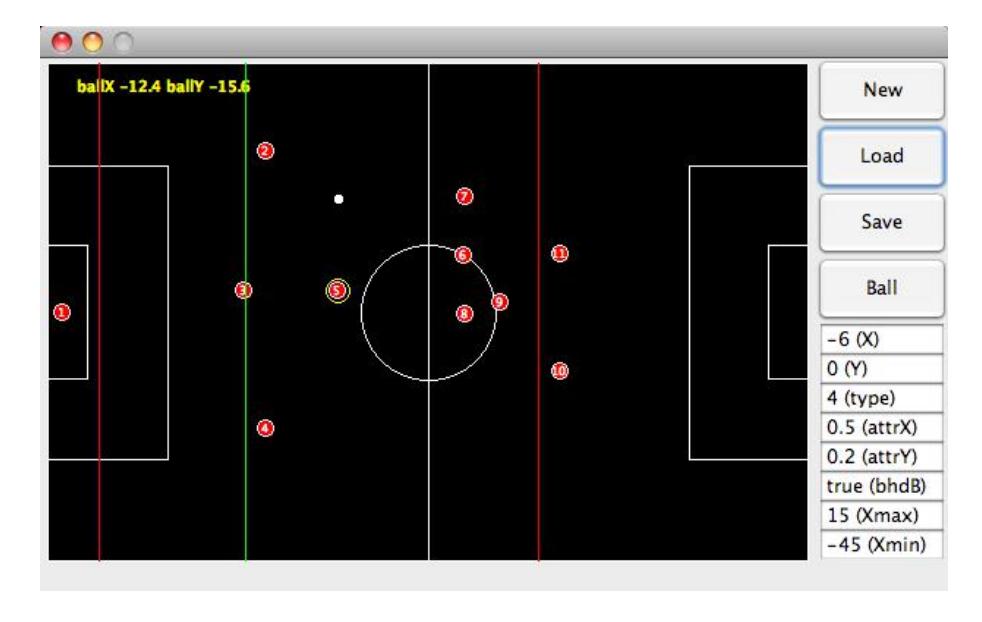
We developed a simple formation editor for easily making many formations. This tool has following functions.
- Making a new formation and output the format.
- Loading a existing formation format and alter it.
- Visualizing the formation and any other information ( e.g : offside line )
4.2 Development new Team
The previous Ri-one Team was based on UvA Trilearn Base. Now, we are developing new Ri-one Team from scratch. Because many black boxes were generated according as the team was developed and the architecture of UvA Trilearn base team is less suitable for the current Ri-one's architecture. Therefore, we decided to develop a new team again without generating black boxes. Ri-one members who not have much programing skill can develop Ri-one team when this new team is completed. Most of Ri-one's new members start studying programing on university at first and they usually belong to Ri-one between freshman and sophomore on university, it's very short time. Thus, we are able to study and do succession smoothly by making this new team.
5 Conclusion
5.1 Summary and Future directions
In this paper, at first we described that our team policy and some skills used in Ri-one. Next, we introduced a tool we developed as a simple formation editor and a new team we are developing now. We think that we able to approach our goal "Agents have a consistent intention or role" by using these method in the agent. The problem with Ri-one today is that it has some waste part in basic skills such as intercepting caused by not accommodation new version Rcssserver(in particular version 14-). Therefore, for the next year we will firstly complete developing the new team and transplant current skills to the new team. After that we will try to brash up basic skills and develop new skills to realize more corporative agents program.
References
- UVATrilearn : http://staff.science.uva.nl/~jellekok/robocup/
- Akiyama Hidehisa, (2006), RoboCup soccer simulation 2D league victory guide, shuwasystem Company,Tokyo.
- FC Portugul : http://www.ieeta.pt/robocup/
- Luis Paulo Reis, Nuno Lau, and Eugenio Oliveira. Situation Based Strategic Positioning for coordinating a simulated robosoccer team. Balancing Reactivity and Social Deliveration in MAS pp. 175-197, 2001.