RaiC11: Examination of One-man Agent Assignment in a Team
Tomomi KAWARABAYASHI-KUBO, Takenori KUBO
Fukui National College of Technology; University of Fukui
Abstract The purpose of our study is to examine "one-man" agent assignment in a team for proposing an effective design of MAS. 6 experimental teams are prepared by assigned one-man agents to all defenders, all defenders and mid-fielders, all players except goalie and center backs, all players except goalie, all mid-fielders and forwards, and all forwards, respectively. The experimental results shows the team assigned one-man agents to all forwards has the largest number of wins against agent2d.
1 Introduction
Our long-term objective is to realize an adaptive behavior selection between "behave by itself" and "behave cooperatively" on MAS and propose a design of MAS by using one-man agents through a series of studies on the "one-man agent". Last year, analyzing the influence and effectiveness of the one-man agent on the team was focused on [1]. The result shows that having one-man agent in forwards position should be effective for its team performance rather than not having it. The one-man agent is defined as an agent which behaves by itself without others' cooperation while the agent shares the team's goal.
In this year, the scientific focus of our team is to examine "one-man" agent assignment in a team as a design of MAS by using one-man agents. 6 experimental teams are prepared by assigned one-man agents to all defenders, all defenders and mid-fielders, all players except goalie and center backs, all players except goalie, all mid-fielders and forwards, and all forwards, respectively. The agent2d-2.0.1 [2] is used as a base code for all experimental teams. Then, each team had 50 games against agent2d. The experimental results were analyzed from the number of wins and losses.
Based on the experimental results, the team RaiC11 consists of 3 one-man agents wearing uniform numbers 9, 10, 11 as forwards and 8 agents from agent2d-2.1.0. (The team is the same as Team9_11 in section 3.1.) The one-man agent's base code is agent2d-2.1.0. The one-man agent and the experimental results are described as below.
2 One-man Agent
In our study, a one-man agent has been developed based on agent2d-2.0.1. The one-man agent is an agent which always takes the one-man approach and simultaneously shares the goal of its team – to win against an opponent team. Then, the one-man approach is realized as the behavior that the agent dribbles the ball toward the opponent goal and then makes a shot without passing to its team mate. Specifically, the one-man agent is implemented by removing "pass" from its behavior rules of the team agent2d.
3 Experimental Result
To examine "one-man" agent assignment in a team, experimentations were performed through simulated soccer games. Then, the experimental results of the teams including one-man agents were compared by the number of wins and losses.
3.1 Experiment Description
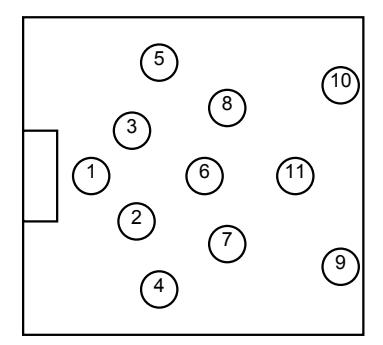
Simulated soccer games (eleven-on-eleven) were done as the experiments to 6 experimental teams below. Each experimental team played 50 times against the team agent2d. One game has 6000 simulation steps. An experimental team is a team that some agents in the team agent2d replaced by some one-man agents. Fig. 1 shows the formation of the experimental teams. Each circle represents an agent. The digit in each circle is an uniform number of agent. The goal keeper wears uniform number 1.
The formation and agents' positions in the experimental teams are defined as follows.
$$\text{Team}_{i-j} = {i, j \mid 2 \le j \le 11}$$
Where i and j are uniform number, Team_{i j} is an experimental team that agents wearing uniform numbers from i to j are one-man agents.
6 experimental teams are Team2_5, Team2_8, Team2_11, Team4_11, Team6_11 and Team9_11. Team2_5 is the team that all defenders are one-man agents. Team2_8 is the team that all defenders and mid-fielders are one-man agents. Team2_11 is the team that all players except goalie are one-man agents. Team4_11 is the team that all players except goalie and center backs are one-man agents. Team6_11 is the team that all mid-fielders and forwards are one-man agents. Team9_11 is the team that all forwards are one-man agents.
3.2 Experimental Results
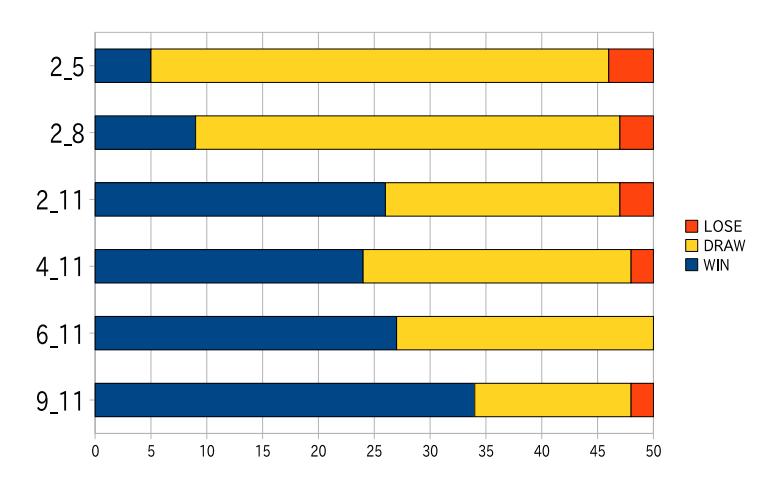
The bar chart in Fig. 2 shows the results of simulated soccer games per 50 games for each experimental team. Team9_11 had 34 wins, 2 losses and 14 draws. The team won better than the others. The results have great advantage of the number of wins. The result shows that adding one-man agents into mid-fielders and defenders are not effective. It is assumed that the number of agents who pass to their team mates are reduced in the team as the number of one-man agents increase.
4 Summary
The team RaiC11 consists of 3 one-man agents wearing uniform numbers 9, 10 and 11 as forwards and 8 agents from agent2d-2.1.0. The one-man agent's base code is agent2d-2.1.0. According to the experimental result, the best number of one-man agents in a team is three and the best positions are in forwards.
References
- Tomomi KAWARABAYASHI-KUBO and Tatsuya YAMADA, Analyzing the Influence and Effectiveness of One-man Agent on its Teams Performance, Proceedings of the International Workshop on Agents in Real-time and Dynamic Environments in AAMAS2010, pp.6-11, 2010
- agent2d source: http://sourceforge.jp/projects/rctools/