2D Soccer Simulation League Team Description Ri-one 2011
Takayuki Ikegami, Yukio Kuwa, Yuki Takao, Kazuma Okada
Ritsumeikan University, Japan
Abstract Ri-one is a 2D soccer simulation team based on UvA Trilearn[1]. Our main goal is "establishing strong soccer team for defeating team which consists of human by future, 2050". We focus on influence of agents' capacities on winning percentage. In this paper, we will describe team features and experiments.
1 Introduction
Ri-one is in project organization of department of Information Science and Engineering at Ritsumeikan University. This team was established in 2005, and has been developing agents of 2D soccer simulation league now. Ever since same year, we have participated in RoboCup's 2D soccer simulation league four times. In RoboCup 2006 in Bremen, we won the 3rd place. Now, our project team participates in both 2D soccer and Rescue simulation leagues. This TDP fall into four sections. In the following sections, we will describe the following things:
- 1st section(this section): We will introduce our team and show outline of this TDP
- 2nd section: We will describe our team's strategy and roles each position
- 3rd section: We will explain experiments we did
- 4th section: We will summarize our ideas, describe future directions
- 5th section: We will present original formation editor
2 Agents' roles
Today, many strategies and formations are used in 2d soccer simulation league. Agents' roles depend on strategies and formations. We have added strategy that include concepts of full members' attack and full members' defense. The role of every position is as follows:
- FW move better position for receiving through pass when MF have the ball.
- MF pass the ball to FW quickly in order to counter attack.
- DF prevent opponent's attack and make a chance to snatch ball by full members' defense when team are counter attacked.
2.1 Required skills
We supposed that the following skills or abilities to be required for implementing our strategy:
- FW need abilities enabling themselves to move quickly.
- MF need better kick skills in order to pass the ball accurately.
- DF need abilities to take the ball from opponent and pass to properly teammate.
2.2 Heterogeneous Player
As described above, kinds of skills and abilities required of each agent depend on its role. This means it is essential for succeeding each agent's strategic action that each agent has skills and abilities required. Therefore, we guessed heterogeneous players which define agents' parameters are important. However, heterogeneous players' parameters in one game are different from that in every other game. This fact shows some agents may not get required parameters. We must find the way to choose the best combination in any situations. Our former team adopted strategies placing the heterogeneous players which have high speed parameters FW mainly. We found it was necessary for choosing best combinations of heterogeneous players that considering the ways to choose heterogeneous players. That is why we did the following experiment.
3 Experiment
(Section preamble before subsections)
3.1 Settings
Rcss server generates 18 heterogeneous players from random number which is called seed. We did an experiment in the following processes.
- Choose 10 heterogeneous players randomly in 18 heterogeneous players server generated.
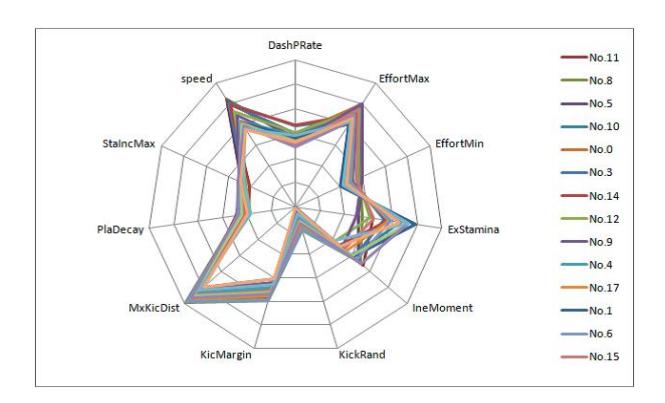
- Fig.1 is graphs of parameters of heterogeneous players. Each graph shows each heterogeneous player.
- Record 20 games.
- Repeat first and second process the regulation. The datasets we handled include:
- Fixed lists of heterogeneous players and parameters of each player.
- Score of both teams and our winning percentage in every 20 game.
- A table which shows the division of heterogeneous players.
Next, we analyzed the data in the following processes.
- Sort datasets in descending order of winning percentage.
- Making sorted data of every agent.
We adopted agent2d¹ as the opponent team.
3.2 Result
We collected more than 10,000 games' data.
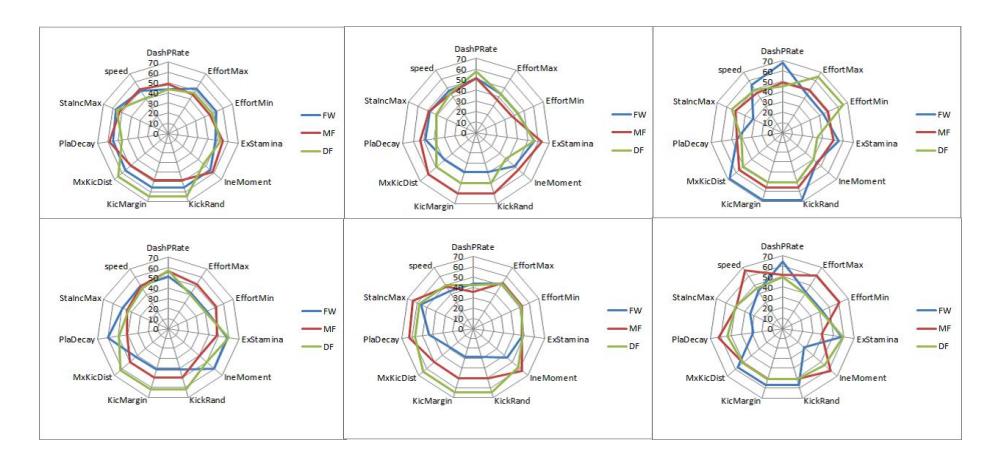
Therefore, we made Fig.2 focusing on winning percentage and average speed of FW. Fig.2 is radar chart of 11 parameters of each position. The chart is divided into three blocks of the upper and lower pair. Each radar chart sequentially are lined with descending in order of winning percentage from the left data set of pair of upper and lower are randomly selected from the same winning percentage.
¹ Helios-based team
Each graph corresponds with each position. Next, we extracted two sets of a standard deviation and an average of every parameter in every winning percentage. Using these data, we found a deviation of every parameter and make graphs. As the result, we found correlation between the each winning percentage and deflections of each heterogeneous player's parameter of each agent.
4 Conclusion
For the reasons stated above, the expriments showed our teams' winning percentage depended on heterogeneous playes' parameters. In these experiments, we analyzed datas focusing on heterogeneous agents' speed. Therefore, we hope to more finding by improving the ways of experiments as follows:
- Collecting more datas
- Trying approach datas from more-side.
In addition, we can collect datas constantly by these processes of experiments. We will refine our team's strategy based on collected datas.
5 Formation Editor
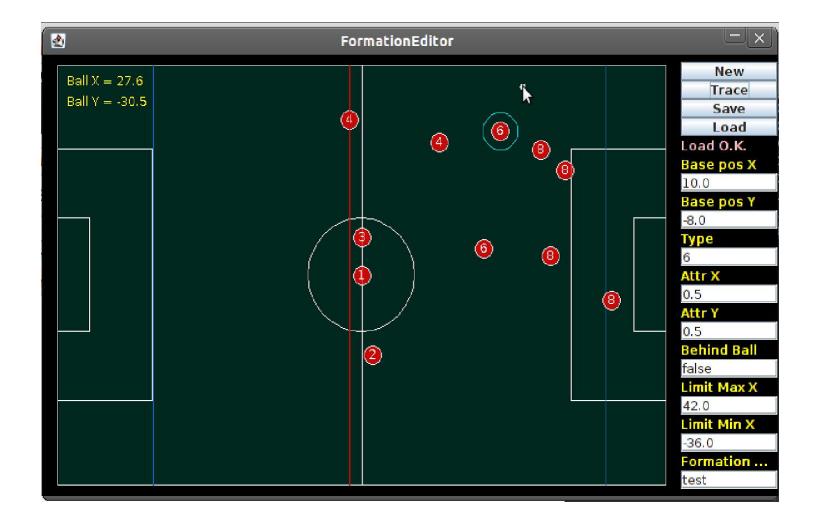
We developed a simple formation editor for easily making many formations. This tool's code is written by Java.
Fig.3 is the screen shot of this tool. The functions of This tool is as follows:
- Making a new formation and output the format.
- Loading a existing formation format and alter it.
- Visualizing the formation and any other information ( e.g : offside line )
The changes since the last tool is as follow:
- Bag fix
- Changing UI.
- Enabling to assigning formation's position to each roles
This tool supports the format which is originally used by UvA Trilearn.
6 Acknowledgment
We are deeply indebted to Mr. Akiyama[2] for his advices. We thank to Mr. Gspandl for his kindness.
References
- UVATrilearn : http://staff.science.uva.nl/ jellekok/robocup/
- Akiyama Hidehisa, (2006), RoboCup soccer simulation 2D league victory guide, shuwasystem Company,Tokyo.
- Shigeki Sugiyama, (2008), 4-2-3-1 Analyzing soccer by strategies, Kobunsha, Tokyo
- Soccer Simulation wiki, http://rctools.sourceforge.jp/pukiwiki/index.php?FrontPage
- Luis Paulo Reis, Nuno Lau, and Eugenio Olivero. Situation Based Strategic Positioning for coordinating a simulated robosoccer team. Balancing Reactivity and Social Deliberation in MAS pp. 175-19