WrightEagle 2D Soccer Simulation Team Description 2011
Aijun Bai, Guanghui Lu, Haochong Zhang, Xiaoping Chen
Multi-Agent Systems Lab., School of Computer Science and Technology, University of Science and Technology of China, Hefei, Anhui Province, China
Abstract WrightEagle 2D Soccer Simulation Team is a 2D soccer simulation team which has been participating in the RoboCup competition since 1999 and won 2 champion and 4 runner-ups in the past 6 years. In this paper, we briefly present our current research effort and some newly introduced techniques for improvment since the last competition.
1 Introduction
WrightEagle 2D Soccer Simulation Team, which was established in 1998 as the first branch of WrightEagle RoboCup Team developed by Multi-Agent Systems Lab. of USTC, has been participating in annual competition of RoboCup since 1999. Recent years, we have won the Champion of RoboCup 2009 and 2006, the runner-up of RoboCup 2010, 2008, 2007 and 2005.
We take RoboCup soccer simulation 2D as a typical problem of multi-agent systems, and our long-term goal is to do research in decision-making and other challenging projects in artificial intelligence. This year, we have developed some new techniques for both the low level skills and the high level decision-making model in our new team WE2011, based on our research effort. In this paper, we present a brief description of some of our progress mentioned above.
We have released the newest version (2.1.0) of our team's base code WrightEagle-BASE to the public as an open source software which can be freely accessed from our website. We hope that our released software will be helpful to a new team who wants to participate in the RoboCup event and/or start a research of multi-agent systems.
2 Dynamic Formation System
Formation is a way to decompose task and to economize the cost of developing agents. In previous WrightEagle, we used a fixed formation system to bundle tactics to specific groups of agents. Since the number of players may not remain a constant in recent years' match and substitution becomes a regular tactic to overcome the shortage of stamina capacity, we believe that a fixed formation system will not be able to cover our needs in the near future.
In preparation for starting a long-term study on this case we implemented a dynamic formation system. In current version of this system, we split all formation related parameters and tactics into configuration files and the program will load them as plug-ins based on the agents online decisions or direct orders from the coach agent. The direct order from coach also provides a synchronizing service on recognition to current formation between agents.
Based on this new dynamic formation system, we developed several different formations including 433, 442, 4231, etc. The team can also change its formation on the fly flexibly while the game is running.
3 Online Role Changing Mechanism
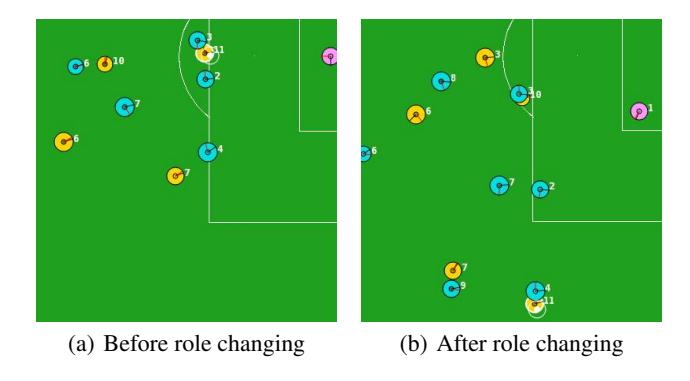
No matter which concrete formation the team use, the function of the formation system remains the similar: avoiding the disorder of entire team. But on the other hand, predefined formation also limits the moving scope of each player. Sometimes the team will get better performance if some of the players run beyond their pre-defined formation scope. For example, when a dribbling midfield player is going to be out of its formation scope while all the other forward players are being strongly marked by the opponents, it should keep on dribbling even if it is likely beyond its own formation scope violating the rules of formation. We developed an online role changing mechanism to overcome this problem, by telling the midfield player that it is now "new" a forward player indeed.
In our current implementation, the decision is made distributedly, mainly depending on the relative positions among players and the global situation. Most of the time, the focus point of the role changing decision is the player who is holding the ball. The other players just adjust their formation role to adapt the ball holding player to encouraging offense when in our team's offensive situation or defense when in our team's defensive situation. A typical long-term effect of online role changing is shown in figure 1.
4 Substitute Strategy
A new stamina model was introduced in rcssserver 13.0.0. The variable stamina capacity defines the real-time maximum recovery capacity for each player. When player's stamina is recovered during the game, its stamina capacity is also consumed. If the player's stamina capacity becomes zero, its stamina is never recovered and it can use only its extra stamina. We found that this will always happen to some of the players when the half game is going to be end. We developed a substitute strategy to deal with this problem.
In our current implementation, the coach agent keeps monitoring all the players' state change, and maintaining their real-time stamina capacity. After the game lasting for a enough time, a player p can be substituted if it's stamina capacity meets the following requirement:
$$\frac{Capacity(p) + Stamina(p)}{cycles_left} < \frac{Capacity_{total} - Capacity(p)}{cycles_passed}$$
If there are multiple substitute candidates during the same time, an additional partial ordering is considered for the judgement. The partial ordering of player p mainly depends on:
- How long p is considered to be substituted.
- How important the role of p is.
5 Conclusion
This paper described our soccer simulation team, WrightEagle, and related programs. We also described our current research effort and some newly introduced techniques from last competition. We developed a dynamic formation system allowing more flexible formations to be used by the team. We also use a online role changing mechanism to extend the limits of pre-defined formations. And we are trying to deal with the lowstamina problem by using stamina capacity based substitute strategy. According to our test results, it can be seen that the composite performance of our team has been improved in both low-level and high-level way.
References
- J. Anderson, B. Tanner and J. Baltes. Dynamic Coalition Formation in Robotic Soccer. Proceedings of the AAAI 2004, 111, 2004.
- Xiaoping Chen, et al, Challenges in Research on Autonomous Robots. Communications of CCF, Vol. 3, No. 12, December 2007.
- Changjie Fan and Xiaoping Chen. Bounded Incremental Real-Time Dynamic Programming. IEEE Proceedings of FBIT 2007. Jeju Island, Korea, 2007.
- Feng Wu and Xiaoping Chen. Solving Large-Scale and Sparse-Reward DEC-POMDPs with Correlation-MDPs, Proceedings of RoboCup Symposium 2007, Atlanta, America, July 2007.
- Feng Wu, Shlomo Zilberstein, and XiaoPing Chen. Multi-Agent Online Planning with Communication. Proceedings of ICAPS-09. Thessaloniki, Greece. Sep. 2009.
- Feng Wu, Shlomo Zilberstein and Xiaoping Chen. Online Planning for Multi-Agent Systems with Bounded Communication. Artificial Intelligence (AIJ), Volume 175, Issue 2, Page 487- 511, February 2011.
- Feng Wu, Shlomo Zilberstein and Xiaoping Chen. Point-Based Policy Generation for Decentralized POMDPs. In: Proc. of 9th Int. Conf. on Autonomous Agents and Multi-agent Systems (AAMAS 2010). Toronto, Canada, May 2010.
- Ke Shi and Xiaoping Chen, Action-Driven Markov Decision Process and the Application in RoboCup, Journal of Chinese Computer Systems, 2009.
- Peter Stone and Manuela M. Veloso. Task Decomposition, Dynamic Role Assignment, and Low-Bandwidth Communication for Real-Time Strategic Teamwork. Artificial Intelligence, 1999.
- Zongzhang Zhang and Xiaoping Chen. Accelerating Point-Based POMDP Algorithms via Greedy Strategies. Proc. of the 2nd International Conference on Simulation, Modeling, and Programming for Autonomous Robots (SIMPAR 2010), Darmstadt, Germany. November 15-18, 2010.