AUA2D Soccer Simulation Team DescriptionPaper for RoboCup 2012
Junhai Zhang, Yanan Li, Wangfei Zhang, Runmei Zhang
School of Electronics and Information of Engineering, Anhui University of Architecture, China
Abstract This paper briefly describes our new techniques both in high level and low level, which we apply to AUA2D 2012. Our new shoot model and strategy based on the improvement of the effective algorithm. We also strengthen the passing strategy to avoid the opponent intercepting the ball, and make an improvement of interception strategy to improve the the initiative of agents. Many improvements and innovations apply to AUA2012.
1 Introduction
The AUA RoboCup Team was established in 2003, starting from the 2D soccer simulation team only. In the following years, the 3D soccer simulation team, MSRS team and Rescue simulation team have joined the AUA team. AUA2D is highly active in the RoboCup, we have participated actively in RoboCup China Open from 2003 to now and obtained good result. AUA2D took the 7th place in RoboCup China Open 2008. AUA2D is also promoting RoboCup in China successfully. We held the 2nd RoboCup Open 2010 in Anhui Province, China. More than 200 members of 74 teams from 21 universities took part in the competition. We are the TC president in Anhui Province since 2011 and will be one of the TC members in China Open 2012.
In 2010, we have developed a new team structure based on the BP algorithm. In 2011, we studied the learning ability of agents which has been significant improvement to the team strength. And we have participated the WorldCup 2010 in Singapore and the WorldCup 2011 in Istanbul. Of course, we scored better year after year.
This year some new ideas were added into shoot, passing, interception mainly comparing with the past. The paper describes our new technology that was used in high level and low level, which apply to AUA2D 2012. We hope to obtain a good grade in World RobCup 2012. We also want to study RoboCup deeply with anyone interested in it.
2 Shoot Model and Strategy
Most problems in competition are drove by dynamic object while shoot is different. For that goal is fixed in the field, shoot is a question drove by static object. In order to offering a exact measurement of a better shoot time, we formalize each factor related with shoot, constructing a function whose range is in [0,1] to measure success rate accurately and take it as decision dependent for shoot or finding better chances for dribbling or passing.
2.1 Factors that Affect Success Rate of Shoot
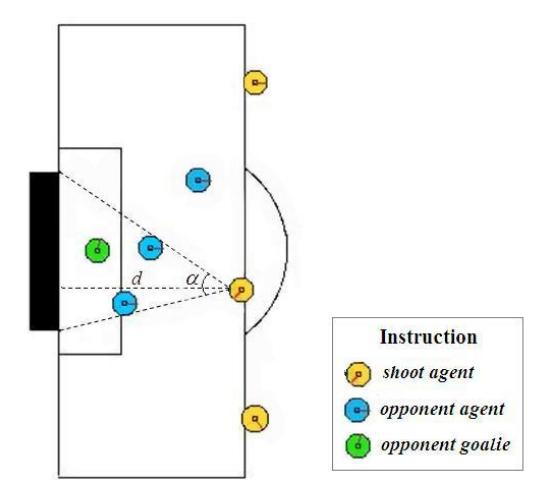
By watching many competition logs, we think that the main factors that affect the success rate of shoot are as the following Fig. 1 shows.
- The vertical distance between shoot agent and opponents goal d;
- The vision angle between shoot agent and opponents goal α;
- The ability score of shoot agent f;
- The annoyance value from opponents agent to shoot agent i.
2.2 Several Basic Hypothesis
- When the ball is at the goal line and without any opponent interference, that is d = 0, α = π, i = 0, it is bound to score;
- When the ball is at the goalpost's extension, that is d = 0, α = 0, it can't be scored;
- The success rate of shoot is in proportion to α and f;
- The success rate of shoot is in contrast with the square d of and the annoyance from opponent agent.
2.3 Mathematical Model of Shoot
Definition of shoot function is:
$$shoot(d, \alpha, f, i) = \left(\frac{1}{(1+d)^2} \frac{\alpha}{\pi} + \frac{f\alpha}{f_{max}(1+d)\pi} \left[1 - \frac{1}{(1+d)^2} \frac{\alpha}{\pi}\right]\right) \frac{1}{1+i}$$
We can work out following formulas by property of function
- shoot(0, 0, f, 0) ≡ 1(Satisfy basic hypothesis (1))
- shoot(0, 0, f, i) ≡ 0(Satisfy basic hypothesis (2))
We can also prove out that function shoot satisfy hypothesis (3) and (4). But we won't show out the total prove-process for article limited. The parameter value of andcan be figured out directly from the function offered by soccerserver. Valuecan be worked out from the following formula:
$$\alpha = \arccos \frac{(x_1 - 1)(x_2 - x) + (y_1 - y)(y_2 - y)}{\sqrt{(x_1 - x)^2 + (y_1 - y)^2} \sqrt{(x_2 - x)^2 + (y_2 - y)^2}}$$
2.4 The Arithmetic of Shoot Strategy
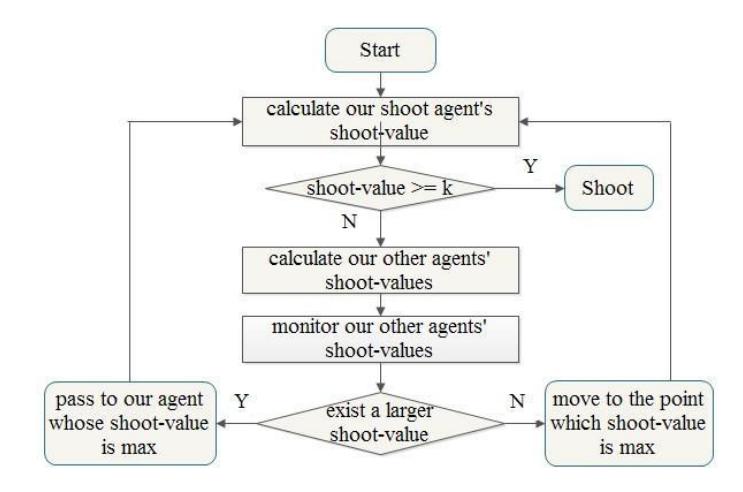
The arithmetic as following Fig. 2 We make shoot agent calculate its own shoot-value in each cycle. When the value is larger or equal to the shoot critical value set in advance, it shoots. Or it will monitor our no-ball agent passing there own shoot-value with command say served by soccerserver. Then shoot agent chooses a largest shoot-value to pass. If no such one teammate, shoot agent will move to a point near itself whose shoot-value is larger and repeat the process until shoot or its ball is steal.
3 Team Passing Strategy
Passing is the one of the most important parts. It is the basis of attacking and the kernel of the competition. We consider that the key of passing is the choice of path, therefore we establish our new passing strategy which is based on three different modes as following the Fig. 3 shows.
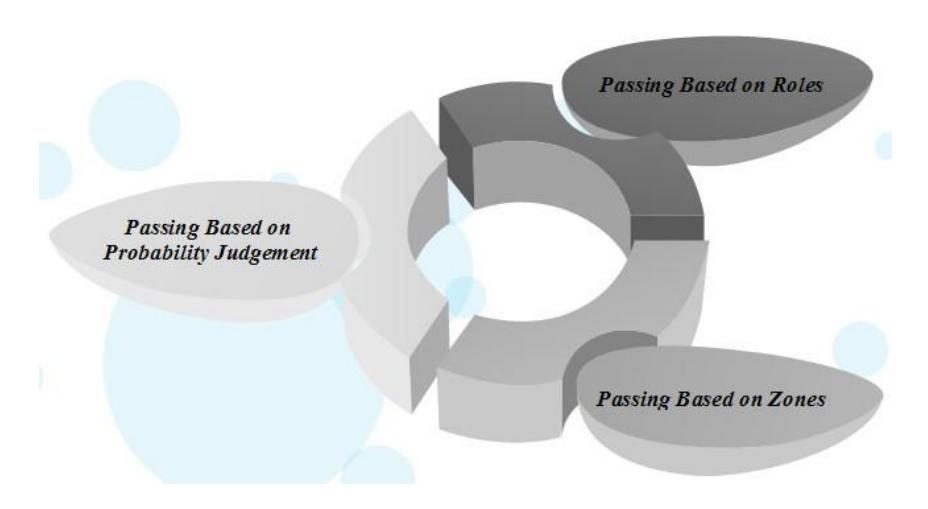
3.1 Passing Based on Role
We passing the ball to the agent whose priority is highest. If our agent satisfy passing condition, it can pass the ball as quickly as it can. So this passing mode is efficient enough. In the offend area, we adopt passing based on role for the purpose to attack fast as finding the most prior agent who can take the pass.
3.2 Passing Based on Zone
We divided the entire field into seven zones, in different zones agents have different strategy act. When shoot agent decides to pass, it chooses the best objective teammate. It achieves the idea choosing the best pass teammate. It contains problems to work out the maximum and minimum value. Success rate of this strategy can be improved. In the defense area, we adopt passing based on zones, for the purpose of trying to find out the optimal agent and reducing passing fault.
3.3 Passing Based on Probability Judgment
Processing the shoot act by randomization, for any agent, there are 9 teammates besides goalkeeper. Making the passing probability multiply by q0, q1, q2, q3, q4, q5, q6, q7, q8, q9, these refer to the original values before the ball passing and make it 1. When the agent calculates his passing probability, it should also confirm value q and the probability of the influence that the agent passing to different teammates. After the pass command the best passing object will be formed. And for the existence of formation ,a proper attack path is created. We can mix all the probability values with a weight to make the probability values adjust automatic. Then , we can not only get the best proportion but also saving much time wasted on adjusting data by hand. In the shoot area, we adopt passing based on probability judgment, in order that we can guarantee passing accuracy.
4 Interception Strategy
Interception merely based on individual technology is not always reliable. Therefore we consider interception based on cooperation among multi-agent will be better. When making a strategic decision, we can calculate our agents' queue of interception, then we make use of the strategy of interception based on cooperation to supply the interception based on individual.
5 Conclusion and Future Work
In this paper, we introduced our AUA2D 2012 simply and described our current research effort and some newly introduced techniques from last competition. We developed an accurate shoot model and various passing strategy in our team.
Future work is concerned with creating a robust robocup simulation 2D team using online learning strategies of competitors, collaboration between agents and some other new skills based on our previous source code.In the coming time we will work hard to make a good result in the World RoboCup.
References
- Runmei ZHANG, Hongliang YAO. Separators Introduced BK Inference Algorithm and its Application in RoboCup. Computer Science.Vol.36(6).June,2009.
- Baofu Fang,Hao Wang ,ect.The Survey of HfutEngine2005 Robot Simulation Soccer Team Design, Journal of Hefei University of Technology. Vol.29(9). Sep, 2006.
- Bachelor thesis, Central South University, About Defense system, part of the algorithm,2008.
- Xiaoping Chen, et al, Challenges in Research on Autonomous Robots, Communications of CCF,Vol.3,No.12,Dec,2007.
- Gang WANG, Mubin CHEN, Fuhong LIANG, Shumei ZHENG. A Study of the Passing Strategy on the RoboCup Simulation Game. Computer Engineering and Science.Vol.29(10).Oct,2007.
- Satje A. Reintbmement Learning of Player Agents in RoboCupSoccer Simulation[A]. Proc of the 4th IntI Conf on Hybrid Intelligent Sys-tem[C].2004.