GDUT_TiJi 2D Soccer Simulation Team Description 2012
Jing Guo, Haohui Huang, Jiyao Li, Wei Chen
Faculty of Automation, Guangdong University of Technology, Guangzhou, Guangdong Province, China
Abstract GDUT_Tiji team is a 2D simulation team which has participated into RoboCup China Open since 2006. In 2010, Jing Guo took in charge of GDUT_TiJi 2D team and enrolled several undergraduate students to work together on this project. In RoboCup China Open 2011, GUDT_TiJi got first prize (the 4th place) and was voted as technical committee members of RoboCup China Open 2D simulation league. In this paper, we will describe the main idea on our team, roughly on the improvement since last year and future research; meanwhile we will analysis the structure of agent 2D-3.1.0 base source and which might be helpful for new developer of 2D simulation.
1. Introduction
GDUT_TiJI 2D team was established in 2006, before 2010, we had not made huge improvement because lack of labor and experience. When Guo Jing led GDUT_TiJi, he spent lots of time on analysis of the whole structure on 2D soccer simulation team and read countless literature on research and development of 2D simulation. In 2011, he directed the team work on HELIOS base and got the first prize in RoboCup China Open 2011, which was the best achievement of GDUT_TiJi; and we were voted as technical committee members of RoboCup China Open 2D Soccer Simulation league.
Agent2d-3.1.0 is still the base code of our team for RoboCup 2012. After RoboCup China Open 2011, we re-analyzed the whole structure of agent2d, and carried out new methods on defense system which avoid of its unstable performance. The important issue in the past several months is the analysis of offensive system, especially on online planning. It is believed that new developer on agent2d-3.1.0 will not make great progress on offensive system in only half a year. So we will also submit a detailed analysis on structure of agent2d-3.1.0 and its excellent idea on online planning in Appendix B.
In this paper, we will give a brief analysis on agent2d; then introduce some methods and ideas on goalie, defensive and offensive position will also be described; field-evaluator is the main factor which would affect offensive, we also made great improvement on this part. All our effort on improvement are tested and verified efficiently by experiments. In the end we will propose the main research topics and further work plan of GDUT_TiJi.
2. Analysis of agent2d
Agent2d is a sample team program which implement on the base library of librcsc-4.1.0. Librcsc includes lots of definition of simulation soccer team, such as the connection of server, model of simple players and actions, basic calculation of pitch. Agent2d plays high-level role of soccer team which focuses on the decision-making layer, structure of agent2d will be shown in Appendix B.
Basic point defined in formation file is the key factor in agent2d. Hidehisa Akiyam made great contribution on basic point for each player utilizing Constrained Delaunay Triangulation method, paired with other methods, player could figure out proper target point. According to our test and simulate, we found that any modification violating basic point might exacerbate the decision of players which have also been proved during RoboCup China Open 2011. So before our work, plentiful experiments and technical analysis have been executed.
Chain action is the essential issue of agent2d, which is described as online planning in [2]. It is definitely key point which provides relatively excellent cooperation on kick action. Details on analysis of chain action are shown in Appendix B.
3. Primary Improvement
After lots of experiments and tests, we concluded the rules above and the major improvement of GDUT_TiJi 2012 comprises some detail of defensive system, such as mark and intercept; positive position which could enhance the whole cooperation of players; avoid mark which will create more chance for player; goalie strategy, which was also fixed by some new measure methods on positioning. What's more, we re-analyzed the online planning system, which was absolutely key point in agent2d, some improvement of field evaluator was proved to be useful during competitions. Last but not least, some modification in online planning have also been made, which was simple but truly improved cooperative decision.
3.1 Mark and Intercept
Defensive system is easy-see unsolved part in agent2d, which only simply designed move and tackle action with basic point. In GDUT_TiJi 2011, we developed several methods on intercept, mark, block and move strategy which was proved not stable and perfect enough. Due to its unstable performance, we re-analyzed the structure and found ambiguous modification on defense would be in a dilemma. In normal formation, basic point is pre-designed for each player according to the position of ball, so each player might not deviate largely from it, otherwise, all strategies will be destroyed. In our defensive system, we exploited mark action by ball position for defensive players, which would help each player to find mark opponents. The idea is simply described below:
If the ball is in self side
If not exist nearest teammate and not far from basic point
Go to ball position and mark ball holder or intercept;
Else if exist nearest opponent and not far from basic point
Go to nearest opponent position and mark;
3.2 Positioning
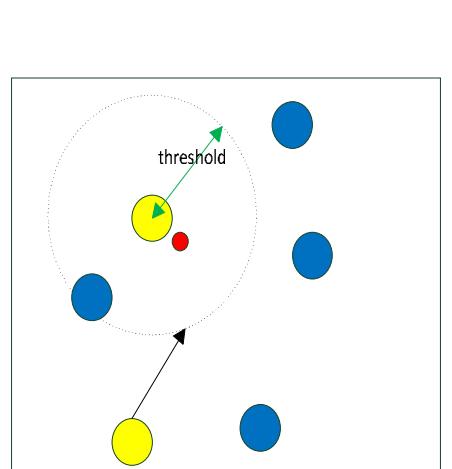
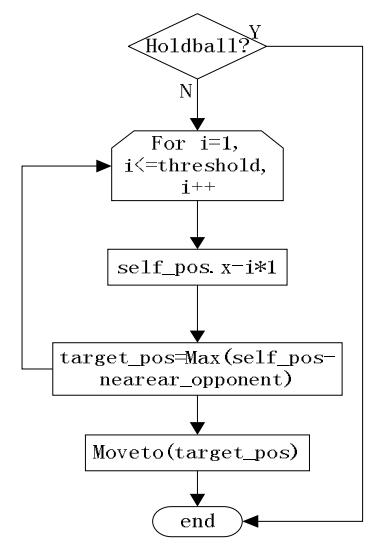
No matter in defense or offense, better positioning will benefit cooperation during game; disorder planning without theory will not only waste stamina but affect behavior of other players. There are quite lot of effort on positioning, situation based strategic positioning was quite famous and applied by several teams. However, in GDUT_TiJi we improved positioning of offensive player by distance of self and teammate who holds ball, which we think could be easy-realized and would also perform well. First, define threshold value which draw up an advantage region of ball holder; then find the best position player to reach. The idea is shown in Fig. 1.
3.3 Avoid Mark
When be marked, player could not do any decision and lose controlling of ball. Avoid mark is essential skill for player to enhance the opportunity of offense. Paired with other decision skill, avoid mark could improve the whole performance of team. In our team, we concentrate on the avoid mark during play on mode. As mentioned above, any decision of player should not deviate from basic point, so our avoid mark will help player to move in sufferable extent. Fig.2 depicts the main idea of avoid mark.
3.4 Goalie
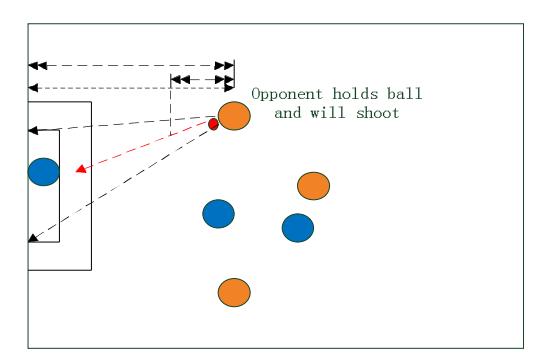
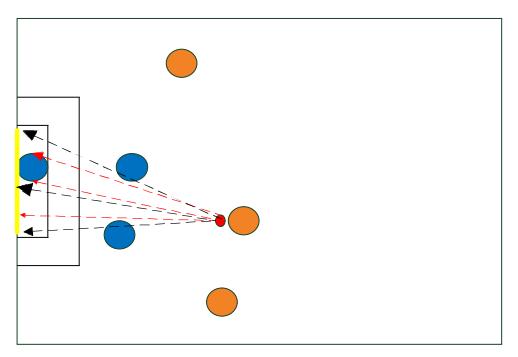
Agent2d provided basic strategy for goalie, which was simple but useful. However, the performance of goalie will largely depend upon actions of defensive players. When play game with mighty offensive opponent, it is hard for goalie to get proper position to prevent opponent. So we designed new goalie methods based on agent2d. Our idea was focus on the position of goalie in special situation. When opponent hold ball is close to break through our defense line and enter self penalty area, it is wisdom for goalie to catch ball initiatively, as fig. 3 depicts, goalie should know the best point to catch ball. At the same time, when goalie runs towards player who holds ball, opponent will have narrow angle to shoot. So, in GDUT_TiJi, we assume the path of ball moves on the angular bisector of opponent's shoot angle, the y value of target point will be calculated by the parameter and y value of opponent. Another situation is when there are self defensive players who standing between goalie and opponent players; normally, in fig 4, the yellow line is the main decision for goalie of agent2d, which neglects the consideration of defensive player. In GDUT_TiJi, we developed new method intake the affection of teammate which will largely help goalie find the best position to get the ball, just like red line shows in Fig 6. However, the real all our effort on goalie has not yet completely reflected through games. This part will still under test.
3.5 Online Planning
Online planning gives a model of kick action such as pass, shoot, dribble, etc. The solving method should be critical during game. There are two major component of online planning which mention in [2]: action generator and field evaluator.
3.5.1 Field Evaluator
In former agent2d base, field evaluator was designed by the x value of ball position with proper calculation. According to geometric analysis and testing, we re-structured field evaluator by particular method which could help player measure the situation of pitch more accurately and properly. But there are several key points we would emphasize first:
- Whatever method is used in field evaluator, positive evaluator value should never be changed for negative on the same orientation. Otherwise, player will get stuck at this point (such as agent2d-3.0.0).
- When define the evaluator calculation, all returned value must be continuous, unexpected alteration also result in bad estimation.
- When consider player position during field evaluator, it is urgent to be aware of the relationship of teammates. If not, the whole online planning will be ruined.
In GDUT_TiJi, we take full advantage of y axis of ball position, and which is backup solution of figure out the shortcoming of simply estimation by x value of ball position. The important point is weight the x and y value in evaluation. We did effort on this point and made some significant progress.
3.5.2 Improvement on Online Planning
Online planning is a complex system which has complicated relationship between each design. In Appendix B we will introduce the structure of online planning in detail. In GDUT_TiJi, we have some improvement on online planning especially on some conditional test. We also designed a simpletacklegenerator which we assumed to execute tackle action which aimed at fixing up the offensive players' interception, however which seems not perform well during game.
On the other hand, GDUT_TiJi removed some first-actions (defined in chain action), and fixed some conditions by experience and theory analysis, which somehow enhanced the performance of whole team. At the same time, some modification on dribble, pass have also been investigated and adjusted. Which also shows better performance.
4. Experiment
To estimate our effort on agent2d, we designed several groups' experiments: group 1 is the game between agent2d-3.1.0 with WrightEagle 2011; group 2 is the game of GDUT_TiJi with WrightEagle 2011; group 3 is the game of GDUT_TiJi with agent2d-3.1.0, and the last group is GDUT_TiJi with gdut2011 (which was 4th place during RoboCup China Open 2011). All games were operated under Ubuntu 10.04, with soccerserver 15.0.1, and processor is AMD Athlon P360 dual-core processor with 2.30GHz.
We have performed 100 games of each group to reduce the error which definitely exist during 2D simulation. All the scores of each group have been collected and analyzed separately in following figures.
According to fig.5, WE won 92% of the game compared with agent2d, and the average goal of WE per game is 5.88, in contrary with 1.54 of agent2d; While, GDUT_TiJi won 11% of the games with WE and the average goal of GDUT_TiJi increased to 2.49 with WE fell to 5.17.
From fig 7 and 8, it is shown that GDUT_TiJi have already successfully won most of the games with agent2d and gdut2011. Although there might be some unstable factor during games, after some adaptation, GDUT_TiJi still perform well during these games.
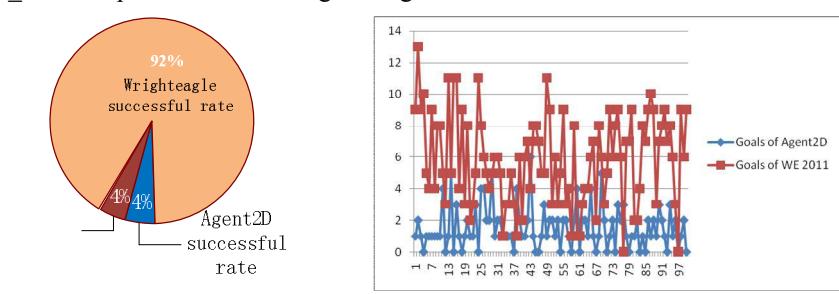
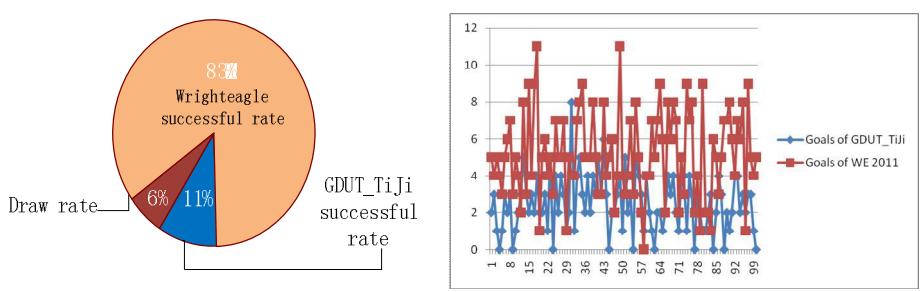
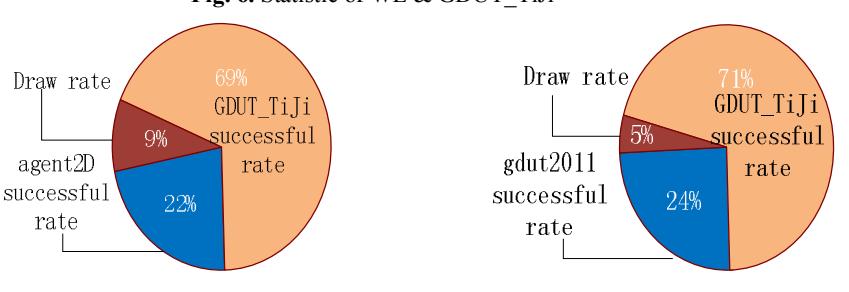
In our experiment, we implemented several group games between different teams, all the results were shown in figures above. As there were too many uncertain factors in 2D simulation, there might exists some mistakes and error during our statistic analysis, and different hardware would also affect the result, while on the whole, all the results would be reasonable and have a sufferable error range.
5. Conclusion
In this paper, we described our work on agent2d during the last competition we participated in RoboCup China Open 2011. To fix up the unstable performance, we re-analyzed the structure of agent2d-3.1.0, and improved the mark and intercept, positioning, avoid mark and field evaluator according to the analysis. To estimate our effort efficient, we implemented several groups' games which were shown in section 4. According to the statistic analysis, it is shown that our team has been improved in certain extent. However, it is not enough for research; as 2D simulation is a platform for decision-making research with huge state space, every action and decision would have unexpected interference, it is quite an intractable problem to figure out global decision for each player. Although, agent2d gives us the direction on online planning for local or partly decision-making; to make great progress on this issue will cost more effort for every team. Our team spent more than half a year on settle the whole structure and idea of agent2d, by now, it is clear for us to use this base team for more research, later we will focus on the online planning structure, positioning skill will be mentioned as chief task, meanwhile, new methods on solving online planning will also be used into GDUT_TiJi in future.
6. Further Research and Plan
Previous work on analysis of agent2d structure provided us direction on high-level decision-making especially about online planning. In future, GDUT_TiJi will enroll one Ph.D. candidate, three postgraduate students and several undergraduate members, working on new algorithms of online planning; new model of decision-making(MDP, POMDP); and optimize of behavior of players separately. There are several issues we will try to figure out in less than one year:
- POMDP (MDP) model used into goalie;
- Fast algorithms for solving decision-making online;
- Positioning for online planning system;
- Optimize basic actions.
References
- Hidehisa Akiyam, et al. HELIOS2010 Team Description. 2010 RoboCup: 2D Soccer Simulation League.
- Hidehisa Akiyam, et al. HELIOS2011 Team Description. 2011 RoboCup: 2D Soccer Simulation League.
- Luís Paulo Reis and Nuno Lau, FC Portugal Team Description: RoboCup 2000 Simulation League Champion, RoboCup-2000: Robot Soccer World Cup IV, Springer LNAI, Vol. 2019, pp.29-40, Berlin, 2001.
- Luis Paulo Reis, Nuno Lau and Eugénio C. Oliveira, Situation Based Strategic Positioning for Coordinating a Team of Homogeneous Agents in Balancing Reactivity and Social Deliberation in Multi-Agent system – From RoboCup to Real-World Applications, Springer LNAI, Vol. 2103, pp. 175-197, Berlin, 2001.