AUA2D Soccer Simulation Team Description Paper for RoboCup 2013
Jie Chen, Runmei Zhang
School of Electronics and Information of Engineering, Anhui University of Architecture, China
Abstract This paper briefly describes our new techniques both in high level and low level, which we apply to AUA2D 2013. Our shoot strategy and interception strategy are continue to be studied. Based on some disadvantages of the last game we found, the new dribbling skills and formation system are applied to our team, those are the greatest achivements for AUA2D. Many improvements and innovations were applied to AUA2D, looking forward to be able to participate in this race to test our new research.
1 Introduction
The AUA RoboCup Team was established in 2003, starting from the 2D soccer simulation team only. In the following years, the 3D soccer simulation team, MSRS team and Rescue simulation team have joined the AUA team. AUA2D is highly active in the RoboCup, we have participated actively in RoboCup China Open from 2003 to now and obtained good result. AUA2D took the 7th place in RoboCup China Open 2008 and took the 6th place in RoboCup China Open 2012, we had a new breakthrough . AUA2D is also promoting RoboCup in China successfully. We held the 2nd RoboCup Open 2010 in Anhui Province, China. More than 200 members of 74 teams from 21 universities took part in the competition. We are the TC president in Anhui Province since 2011.
In 2010, we have developed a new team structure based on the BP algorithm. In 2011, we studied the learning ability of agents which has been significant improvement to the team strength. And we have participated the WorldCup 2010 in Singapore and the WorldCup 2011 in Istanbul. Of course, we scored better year after year.
This year some new ideas were added into shoot, passing, interception, dribbling, formation system mainly comparing with the past. The paper describes our new technology that was used in high level and low level, which apply to AUA2D 2013. We hope to obtain a good grade in World RobCup 2013. We also want to study RoboCup deeply with anyone interested in it.
2 Shoot Strategy and Interception Strategy
Based on some thinking in last year,we continue studied in-depth .
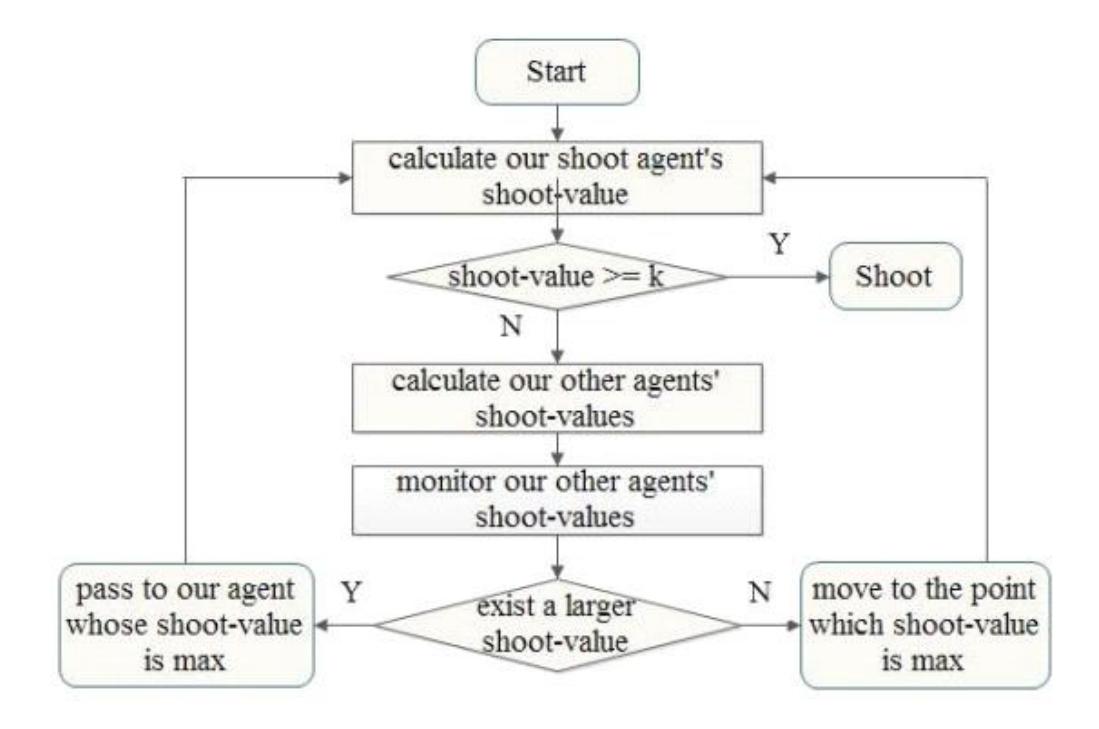
The arithmetic as following (Fig 1).We make shoot agent calculate its own shoot-value in each cycle. When the value is larger or equal to the shoot critical value set in advance, it shoots. Or it will monitor our no-ball agent passing there own shoot-value with command say served by soccerserver. Then shoot agent chooses a largest shoot-value to pass. If no such one teammate, shoot agent will move to a point near itself whose shoot-value is larger and repeat the process until shoot or its ball is steal.
Interception merely based on individual technology is not always reliable. Therefore we consider interception based on cooperation among multi-agent will be better. When making a strategic decision, we can calculate our agents' queue of interception, then we make use of the strategy of interception based on cooperation to supply the interception based on individual.
3 Dribbling DribblingDribblingSkills
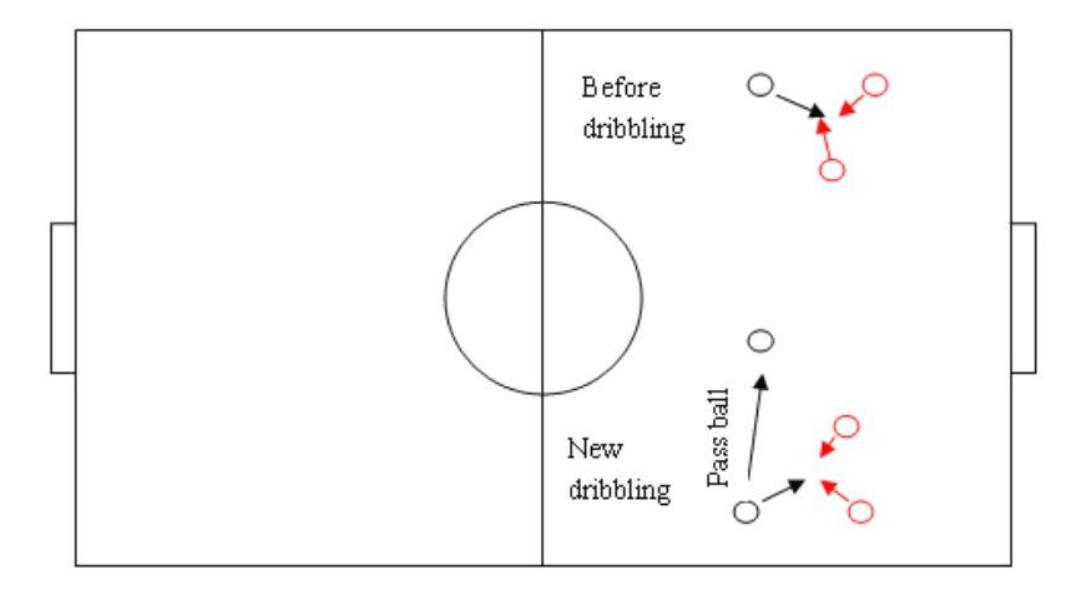
In the previous team, our dribbling system will easily lead to a lone dribbling ball to opponent areas and result in losing ball directly, which has been proved in RoboCup China Open 2012. To solve this problem,we change the dribbling mechanism of aggression to cooperative aggression by a number of players and a way by pass ball to teammate to break through opponent's defense (Fig 2).
4 Formation Formation System
In this year,from our study and research,we also learn from the other teams' somegood methods and strategies are applied to our team.We use the method of Computational Geometry to analyze the CDT (Constrained Delaunay Triangulation) and the TIN (Triangulated Irregular Network),and we study the generation and maintenance of the formation. In this way, we have had an intensive comprehension on the formation of Agent2D.We designed our offensive and defensive formations for our own characteristics, and we also designed No_PlayOn formations for AUA2D.
5 Conclusion Conclusion and Future Work
In this paper, we introduced our AUA2D 2012 simply and described our current research effort and some newly introduced techniques from last competition. Because some improvements of the program are put forward comparatively late, and the rate of improvements are subject to the development team, we don't test theeffect of the latest changes by the numbers.
Future work is concerned with creating a robust robocup simulation 2D team using online learning strategies of competitors, collaboration between agents and some other new skills based on our previous source code.In the coming time we will work hard to make a good result in the World RoboCup.
References
- Runmei ZHANG, Hongliang YAO. Separators Introduced BK Inference Algorithm and its Application in RoboCup. Computer Science.Vol.36(6).June,2009.
- Baofu Fang,Hao Wang ,ect.The Survey of HfutEngine2005 Robot Simulation Soccer Team Design, Journal of Hefei University of Technology. Vol.29(9). Sep, 2006.
- Bachelor thesis, Central South University, About Defense system, part of the algorithm,2008.
- Xiaoping Chen, et al, Challenges in Research on Autonomous Robots, Communications of CCF,Vol.3,No.12,Dec,2007.
- http://www.socsim.robocup.org/files/2D/tdp/RoboCup2012/