OXSY 2013 Team Description
Sebastian Marian, Dorin Luca, Bogdan Sarac, Ovidiu Cotarlea
OXygen-SYstems laboratory, Str. Constantin Noica, Bl.5, Sc.C, Ap.36, C.P. 550169, Sibiu, ROMANIA
Abstract Oxsy team was founded in July 2002 for a graduation project of one student, Sebastian Marian, in the field of Multi-Agent Systems, at the Department of Computer Science of Lucian Blaga University (Sibiu - Romania). After graduation he continued the work on this project and so was born Oxsy team. As we started from scratch, our ideas, concepts and beliefs, was implemented year by year and today, we are happy to see that we gone on the right way, as our team was growing in these years, more than we expected from the beginning. If we'll qualify to the competition, this year we'll reach at the 11th consecutive participation in RoboCup Soccer Simulation League.
Introduction
In July 2003 at RoboCup competition, which was held in Padua - Italy, we won the first round and for us it was a good surprise for first year of participation. Then, next year, we participated in Lisbon - Portugal for the second time and, again, we obtained a good result (the 11th place). In 2005 in Osaka – Japan, we participated for the third time and finally we entered in the first 8 teams in the world, of soccer simulation league, as we won (the 8th place). In 2006 the competition was held in Bremen – Germany and we won (the 7th place). In 2007 we went to Atlanta – Georgia (U.S.A), where we obtained (the 5th place), the same result which we achieved in 2008 in Suzhou - China. Finally, in 2009 in Graz we entered in the first 3 teams in the soccer simulation league, as we won (the 3rd place), the same result which we achieved in 2010 in Singapore. In 2011 we came back from Istanbul - Turkey with 4th place in this amazing competition. Last year we were in Mexico City and we had a bad experience, as we made some major changes in our defensive system, and also many others overall our team strategy, changes which was not very well integrated at that time, with all others characteristics of our team, as we didn't qualified for finals, from the second round groups. This year the competition will be held in Eindhoven - Netherlands. As we already have a very good experience in 2D Soccer Simulation league, we hope that our new ideas and improvements for this year will be reflected in the competition, where we will also test other tactical elements developed.
Importance of the coach agent
2010 was the first year when we involved the coach in our team strategy, beside of his classical attributions, as change player types or recognize opponent player types, which already were implemented, we felt that we can use it more efficiently, in order to gives some tactical advices during the game. As the coach has the privilege to receive full visual information, without noise, we can use it to make an opponent modeling. In fact, we believe that is more important to adapt the strategy during the game, instead before it. We think that importance of the coach is not speculated very well right now, and maybe it will be a good point for research, not only for our team but for all teams involved in soccer simulation.
So, in one hand, based on some typical neural networks that we developed since 2010, just to be used by the coach in some specific ways, and in the other hand based on the power of the coach, which has a full view of the whole field without any kind of noise, today our coach is the most important agent in our team. Here is a review of most important things that our coach performs today:
- Creating more spaces behind the opponent defense line, by recognizing the pattern of opponent's defending style and also by finding theirs weak points, in this way our offense clearly advised by the coach, should creates more chances to score goals.
- Obtaining a good world model, for the opponent's players positioning, in both phases of the game, depending of the game phase and the position of the ball, which will be useful in offensive phase for the pass decision, when the world model of the opponent's players, generated by sensor information is incomplete, and in defensive phase for the defending strategy, in the same situation of incomplete world model information of our opponent.
- Choosing the best position of our offenders, in spaces created between or behind the opponent's defenders, when the ball is controlled by a player from our team, depending of the position of the ball.
- Deciding if we should use offside trap with current opponent.
- Changing our team shape in the field, to achieve some tasks which can not be performed, with opponent that we are facing, using actual formation positioning.
Creating more spaces behind the opponent defense line
As we replayed many games from the last competitions we clearly observed that we can group opponent's defensive in three types of pattern. First group of teams are defending using pressing (marking one at one) in certainly zone, specially in theirs own third, the second group are defending in zone without very strictly marking and the last group of teams are defending using pressing (marking one at one) almost all the time on the whole field. As we are interested how to create more spaces in theirs own third, our coach must identify what kind of pattern of these explained above, is used by our opponent and than, to give some advices especially to our midfielders and offenders how to move, in some generally patterns, to create some spaces behind the opponent defense line. We refer here to the players which does not have the ball.
The roles of the players without the ball are as follows in figure 1.
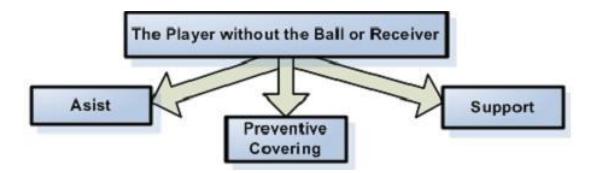
Analysis of the player's functions when not in possession
Preventive Covering.
The offensive players who remain positioned between the opponent's offensive section and the offense's own goal, so as to become an obstacle to the opponent's action if they gain possession of the ball and start an attack, are said to be in preventive covering. All the players on offense, who remain positioned behind the line of the ball, are considered to be in "preventive covering".
Support.
An offensive player who makes himself available for a back pass or a horizontal pass is referred to as a "supporting player". The supporting player can be termed as "back support" when he is behind the teammate with the ball. When the supporting player is along the same line as the teammate who has the ball, his support is referred as "encompassing" because he can receive the ball either some steps forward or some steps backward, depending on the game situation.
Assist.
An offensive player, who helps to take the ball towards the opposing goal by making himself available for a pass forward, is referred to as an "assisting player". He can receive the ball in two ways: either with the opponent at his back or by unmarking himself. He has the opponent at his back when he comes towards the ball or when he cuts towards the corner flag. He tries to receive the ball unmarked when he cuts towards the opposing goal or when he penetrates to receive the pass from his teammate.
Movements of the player without the ball
We will now consider how to organize the movement of two offensive teammates, one belonging to the "attack" line and the other a neighboring "attack" player or belonging to the "midfield" line. These types of movements will be of course decided by the coach, after he'll analyze the defensive pattern of our opponent.
Possible combinations of movements of two forwards:
- Both forwards go towards the teammate with the ball.
- Both forwards move forward in depth.
- One forward goes towards the ball while the other attacks in depth.
Obtaining a good world model
We believe that obtaining a good world model of your opponent is most important then any other "mill metrical" calculation that we are hag-ridden to do for every action in every cycle of the simulation. Our belief is that if you have a better world model, you have more powerful in any kind of decision that you have to take, indifferently of the current phase of the game, defensive or offensive. So, for this scope we developed a neural network which tries to find, a typical pattern for each opponent team, in both of these defensive and offensive phases. The input of our neural network is the type of the current phase (defensive or offensive) and the position of the ball. The result should be the positions of the opponent team players regarding to the current input. The achievement of data will be taken and also used only in normal conditions of play (play on mode).
Choosing the best position
As we are interested how to create more spaces in opponents own third, our coach must identify first, which kind of defensive pattern (explained at 2.1) is used by our opponent. Then we predefined some types of movements for each of this style of defending. First time, the coach will try to recognize it and then he will communicate to his players, which type of defending is used by the opponent that we are facing. Our players involved in these kinds of actions (especially midfielders and offenders), will start to apply these movements depending of theirs roles and also depending of the position of the ball. If the player (midfielder or offender) which is ready to receive a ball, will recognize that the positions of the players (teammates and opponents) regarding to his own position, is adequate for applying one of the predefined type of movement, he will announce this by saying command, and all the players involved in this schema (generally no more than two), will react with the movements of theirs new roles, exactly as we predefined them from the beginning. The most important role in this equation will be on the coach shoulders, because he must analyze the result of this action, as he clearly knows the moment where the action was starting, because he also received the say command from his player which announced this, and finally he must evaluate the spaces created between or behind the opponent's defense, generated by these movements. He also must qualify this schema, as he should decide if this will be maintained or it will be changed with another.
Using offside trap
In the general strategy of the team, the offside trap could be defined as all these actions aiming at regaining possession of the ball, which can take place in two specific ways:
- By receiving an indirect free kick;
- Taking the ball away from the opponent thanks to the application of pressure.
As we observed that already many teams have excellent skills of avoiding classical offside trap, we involved the coach in this problem. Because of the accurate information which is received by the coach, he must analyze the movement of the opponent's offenders, when our team applying such an action of offside trap. Practically our goalie coordinates the movement of the offside trap, as he almost all the time is facing towards the opponent goal, and also due to our strategy used, in which he receives visual information every cycle. So, finally he has a good view of the pitch and also a good position, to decide the moment when our defenders can execute this type of action. Of course that his decision will be based on some analysis functions, with some predefined risking parameters. If based on these functions, the goalie decides that right now is the moment to execute an offside trap, he will announce this through say command, so the defenders which should received this message, could synchronize in executing it. This is the crucial moment of this action, because of the heterogeneous players type, ours defenders have different speed, different inertia moment and others different parameters, that could have a bad influence in what we call a perfect execution of the offside trap. If only one defender can not keep this line of synchronization, this action could return against us. So, here is the point where the coach must be involved. As we said before, he must analyze the movement of the opponent's offenders, but also of ours defenders, and finally, to decide which of the risking parameters should be modified, for a better execution of the offside trap. He also can decide, to definitely stop the execution of the offside trap with this opponent, because of some evaluated risks or because of any other reasons.
Changing our team shape in the field
This year we extended the coach attribution with the following functionality. As we are facing during one game, with many different situations in both phases, defensive and offensive, we must handle them correctly. This can be done if we will dynamically change our team strategy during the game. Changing our team shape is an important element of the team strategy. Depending of the situation, defensive or offensive, changing the shape it helps us to obtain better results than those which were obtained before changing it.
For example if you are facing one team with a great ability of defending, or maybe one that is defending with many players, you probably should come with many players in theirs own third in case you want to be sure, that you will be able to score against it. In the same way, if you are facing with a good attacking team, maybe you must reconsider your defense, and probably you have to reshape your team if you want to face up of theirs many attacking situations. The answer for which is the best shape for some phases of the game, must come from the coach, who must analyze the game, and of course, he must find the best solution, for any dangerous situation created by our opponent, which could reappear.
Future work
For the next future, we'll involve our coach in many others issues, where the team really needs his help. Even if the free form messages, are limited by count and periods of sending, the power of the coach remain very important, as he can receive free noises information. In this way, he can analyze many important aspects of the games and if he'll deliberates based on these information, he can give valuable advices to his own team.
We must accept that right now, many teams involved in this competition, adapt theirs strategy before the game is started instead of while it running. A team will be more powerful, when it can adapt correctly his strategy depending of the opponent behaviors and not by the opponent's name, and also during the game and not only before it starts. In this way, we tried to adapt our team to some unexpected situations, which are generated by different playing style of our opponents. In the real soccer, the role of the coach during the game is very important, and this is not only because of the players that he's changing, but because of many good advices that he gives to his team. In the same way we must think more and more to the power of the coach and how we can use it in our simulator.
References
- Peter S. Layered Learning in Multi-agent System [D]. Pittsburgh: school of computer science, Carnegie Mellon University, 1998.
- Jinyi Yao, Jiang Chen, Zengqi Sun. An application in RoboCup combining Q-learning with Adversarial Planning. Available in http://robocup.lits.tsinghua.edu.cn/download/document/tsinghuaeolus_kick.zip.
- M. Riedmiller and Artur Merke, " Using machine learning techniques in complex multiagent domains," In I. Stamatescu, W. Menzel, M. Richter and U. Ratsch, editors, Perspectiveson Adaptivity and Learning, LNCS, Springer, 2002.
- Itsuki Noda et al, Soccer Server Manual, RoboCupFederation. http://www.robocup.org.
- Y. Jinyi, C. Jiang, and S. Zengqi. An application in RoboCup combining Q-learning with Adversarial Planning. In the 4th World Congress on Intelligent Control and Automation (WCICA'02), Shanghai, China, June 2002.
- Peter Stone and David McAllester. An Architecture for Action Selection in Robotic Soccer. In Proceedings of the Fifth International Conference on Autonomous Agents, pages Pages: 316–323, 2001.
- Takashi Suzuki. Team YowAI Description. RoboCup 99: Robot Soccer World Cup III, 2000.
- Soccer Tactics. An analysis o attack and defense, by Lucchesi Massimo, originally printed in Italy – 1999 by Edizioni Nuova Prhomos Via O.Bettaccini.