OXSY 2014 Team Description
Sebastian Marian, Dorin Luca, Bogdan Sarac, Ovidiu Cotarlea
OXygen-SYstems laboratory, Str. Constantin Noica, Bl.5, Sc.C, Ap.36, C.P. 550169, Sibiu, ROMANIA
Abstract Oxsy team was founded in July 2002 for a graduation project of one student, Sebastian Marian, in the field of Multi-Agent Systems, at the Department of Computer Science of Lucian Blaga University (Sibiu - Romania). After graduation he continued the work on this project and so was born Oxsy team. As we started from scratch, our ideas, concepts and beliefs, was implemented year by year and today, we are happy to see that we are on the right way, as our team was growing in these years, more than we expected from the beginning. If we'll qualify to the competition, this year we'll reach at the 12th consecutive participation, in RoboCup Soccer Simulation League.
1 Introduction
In July 2003 at RoboCup competition, which was held in Padua - Italy, we won the first round and for us it was a good surprise for first year of participation. Then, in the next year, we participated in Lisboa - Portugal for the second time, and again we obtained a good result (the 11th place). In 2005 in Osaka – Japan, we participated for the third time and finally we entered in the first 8 teams of soccer simulation league, as we won (the 8th place). In 2006 the competition was held in Bremen – Germany and we won (the 7th place). In 2007 we went to Atlanta – Georgia (U.S.A), where we obtained (the 5th place), the same result which we achieved in 2008 in Suzhou – China. Finally, in 2009 in Graz, we entered in the first 3 teams in the soccer simulation league, as we won (the 3rd place), the same result which we achieved in 2010 in Singapore. In 2011 we came back from Istanbul - Turkey with 4th place. In 2012 we were in Mexico City, where we had a bad experience as we made some major changes in our defensive system, and also many others overall our team strategy, changes which was not very well balanced at that time, with all others characteristics of our team, as we didn't qualified for finals, from the second round groups. Last year we came back in top, as we won the 6th place, in Eindhoven – Netherlands. This year the competition will be held in Joao Pessoa - Brazil. As we already have a very good experience in 2D Soccer Simulation league, we hope that our new ideas and improvements will be reflected in the competition where we will also test other tactical elements developed.
2 Pressing: An essential tactical element in the defense phase. Pressing in the defense zone.
In order to get the best results and, in any case, to make our team as strong as possible, we must take care of every little detail, even those things that may look marginal. In fact, when the technical ability of two teams is more or less on the same level, it is the details that often make the differences.
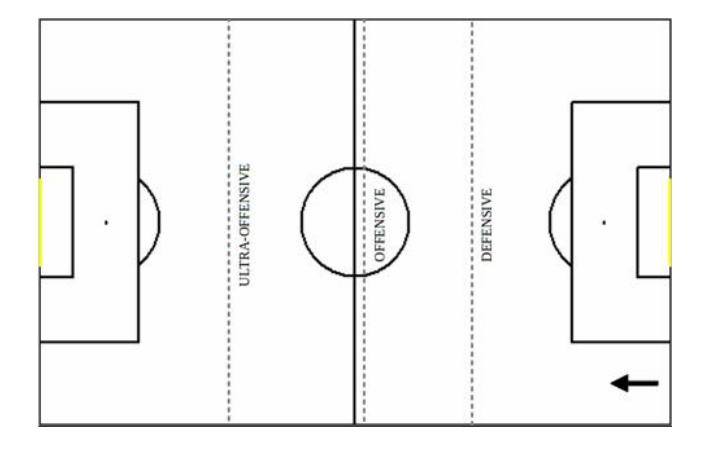
This year, we prepared our team defense phase with careful attention of this tactical action named pressing. In fact, pressing is a collective tactical action, carried out by more than one player, and performed in situations of non-possession. We should make a distinction between putting a player under pressure and pressing a player. Putting a player under pressure is an individual action, carried out in order to take away playing space and time from the opponent in possession. Instead, pressing means that a number of players are cooperating simultaneously so as to reach a common aim. The purpose of pressing is to close up the spaces and playing time for the team that is in possession, making it difficult for them to develop their attacking moves and easier for us to regain the ball. We also classified the types of pressing, depending to the part of the field where these collective actions are applied in the most systematic way (Fig. 1.):
- ultra-offensive pressing;
- offensive pressing;
- defensive pressing.
In the above image, we just have seen that applying pressing in the defense zone means waiting for the opponents to arrive up to certain part of the field before beginning to put the prepared strategy into real effect. Defense pressing is usually based more on covering the spaces rather than on aggressive play, on the ability to tighten marking at the right moment rather than marking risky shifting moves. We have to use this type of defense strategy when we have numerical superiority in the defense line over the opposing strikers. Following on from this, the most important techniques for carrying our effective defense pressing are these:
- individual marking (both on the player in possession and on his teammates in support);
- contrasting;
- doubling up;
- covering.
2.1 Individual marking
Marking is the control of an attacking player carried out by a defender. He must place himself so that he can see both the ball and his direct opponent, making sure that the striker cannot receive the ball in depth. This is a defender's first essential target. Another important objective is to place himself is such a position that he can attempt to anticipate and regain the possession in case when the ball has been passed to his direct adversary. We make a classification of the ways in which marking can be carried out:
- "T" marking;
- marking in the cone;
- marking in anticipation.
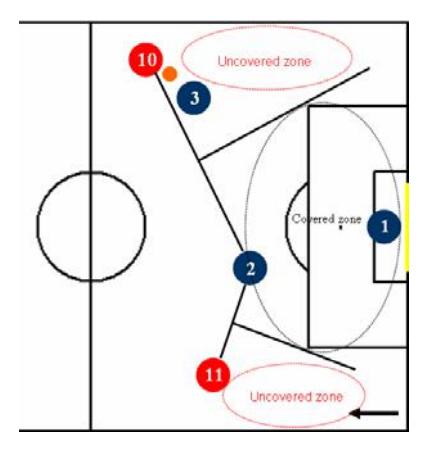
"T" marking. In "T" marking the control is fairly elastic. This type of marking is carried out on the weak side, on the player far away from his team mate in possession. The "T" is a useful way of subdividing the part of the playing field that separates the defender from the striker, so as to make a theoretical distinction between the area nearest to the defender and that nearest to the striker. Theoretically speaking the "T" can help us understand in what part of the field the striker might receive the ball and where the defender will be able to contrast him. (Fig. 2.)
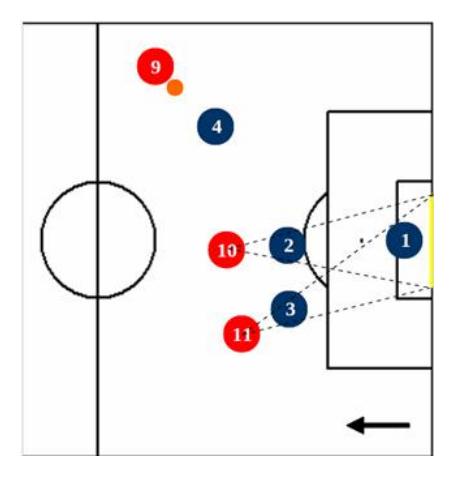
Marking in the cone. This type of marking refers to the position taken up by a defender who is placed inside an imaginary triangle (or cone), which has as its base the goal line and its summit the striker who is to be controlled. This position allows the defender to stand between the striker and the goal he is defending, so that the striker cannot receive the ball in depth, but the defender can try to anticipate the ball if it is passed to his direct opponent. In any case, this placement will allow the back to block the striker's way, even if he has received the ball. (Fig. 3.)
Marking in anticipation. This type of marking refers to the position taken up by a defender who is placed between the striker who is to be controlled and his teammate who has the ball. In this way he can anticipate a directly pass to the striker, but he must be sure that the striker can not receive the pass in depth.
2.2 Contrasting
When a defender faces an adversary in possession, we can say that he "contrasting the ball". We must also note that the defender doing the contrasting can:
- bide his time without putting too much pressure on the player in possession;
- making sure that the player in possession does not carry out certain plays;
- try to regain the possession.
When the player in possession entered in the zone of contrast, the defender must accompany the striker for a while, so as to 'tune in' on his forward speed. It is very important for the defender to follow the striker's movements briefly. At the same time, however, he must take the initiative.
2.3 Doubling up
Doubling up is an intervention made to help a teammate, which already is occupied in contrasting a player in possession. Doubling up is not a movement made by two players attacking in the same time an adversary in possession, but is the movement of one player who goes to contrast an opponent in possession, who is already under pressure controlled by a teammate, to creates a two against one situation. The minimum aim of doubling up is to make it difficult for the opponent in possession to move forwards. The principle aim of doubling up, however, is to regain the possession of the ball. It is important that one of the two defenders should be trying to stop the opponent's forward movement towards the goal, while the other should be contrasting on the ball in order to get it back.
2.4 Covering
Tactically speaking, covering is a very important task. The defender can cover an opponent in possession or one without the ball. Covering can be carried out by a defender who is marking his adversary at the same time (Fig. 2.), or by a defender who is not marking. Covering a player in possession serves a double purpose. A defender in coverage can, as necessary, regain possession from a forward pass made by the opponent, or intervene in cases where the striker has got past a defender who was contrasting the ball.
3 Future work
For the next year we want to apply this tactical element named 'pressing', also in the attacking zone. We have to decide whether pressing in the attacking zone should be carried out all through the match or only in certain cases. In the first case, it is the coach's job which must determine this strategy depending of the opponent we are facing, while in the second the team is merely aligning its tactical behavior to certain accidental factors (we are losing, the team is in numerical superiority and wants to win, there is not much time left and we have to unlock the result and so on), which will condition and modify our original strategy. Before to make a closer analysis of the tactics and the characteristics of pressing in the attacking zone, we must make an elementary point: there are, of course, enormous differences between offensive and defensive pressing.
References
- Peter Stone Layered Learning in Multi-agent System [D]. Pittsburgh: school of computer science, Carnegie Mellon University, 1998.
- Jinyi Yao, Jiang Chen, Zengqi Sun. An application in RoboCup combining Q-learning with Adversarial Planning. Available in http://robocup.lits.tsinghua.edu.cn/download/document/tsinghuaeolus_kick.zip.
- M. Riedmiller and Artur Merke, " Using machine learning techniques in complex multiagent domains," In I. Stamatescu, W. Menzel, M. Richter and U. Ratsch, editors, Perspectiveson Adaptivity and Learning, LNCS, Springer, 2002.
- Itsuki Noda et al, Soccer Server Manual, RoboCupFederation. http://www.robocup.org.
- Y. Jinyi, C. Jiang, and S. Zengqi. An application in RoboCup combining Q-learning with Adversarial Planning. In the 4th World Congress on Intelligent Control and Automation (WCICA'02), Shanghai, China, June 2002.
- Peter Stone and David McAllester. An Architecture for Action Selection in Robotic Soccer. In Proceedings of the Fifth International Conference on Autonomous Agents, pages Pages: 316–323, 2001.
- Takashi Suzuki. Team YowAI Description. RoboCup 99: Robot Soccer World Cup III, 2000.
- Pressing, by Lucchesi Massimo, editing Bryan R. Beaver, printed by DATA REPRODUC-TION Auburn, Michigan.