RoboCup 2014 - 2D Soccer Simulation League Team Description Ri-one (Japan)
Mari Hikichi, Yuto Furuta, Reina Wada, Yuki Tada, Syuto Banndou, Kosei Yamaguchi
Ritsumeikan University, Japan
Abstract This paper describes the features that Ri-one have developed for the Robocup 2D Soccer Simulation in 2014. In the 2D Soccer Simulation League, there is an online coach that watches the game as well as agents playing on the field. The online coach has the capacity to know the exact location of all the agents on the field. By taking advantage of this, pass trajectories can be calculated between the agents by the online coach communicating the information it has to all agents on the team coordinating their movements in a more effective manner. Several algorithms were tested in order to compare results and, by doing so, the success rate of the passes within the team could be improved.
1 Introduction
Ri-one is a student organisation from the Information Science and Engineering Department at the University of Ritsumeikan. The organisation has previously participated in the 2D Soccer Simulation Leage and Rescue Simulation League last year and have continued developing the program using the UvA Trilearn 2003 Base (Trilearn) [1] as our base team. This year, we decided to change the base code to agent2d [2]. In RoboCup 2006 in Bremen, our team finished in the third place. In RoboCup Japan Open, we won the third place in 2009 and the champoinship in 2012. This paper will include the following sections:
- Introduction : We will introduce our team and show the outline of this paper
- Examining methods : We will make a suggestion about three new methods
- Experiments : We will explain experiments carried out
- Conclusion : We will summarize our ideas, describe future directions
2 Examining methods
In order to determine where improvements could be made with the creation of the new team for this year's league, many matches were carried out with the following teams: heliose2012; AUA2012 and fiftystorm2010. From these matches, many data sets were analysed and, as a result, it was noted that the team had a higher failure rate per game in making passes in comparison to other teams. Methods for improving the probability of successful passes became a critical research point for Ri-one's program development. Making successful passes also means the team will have possession of the ball for a higher proportion of the game, resulting in creating more opportunities for the agents to score a goal. Consequently, this reduces the opportunities for the opposing team to score a goal. To ammend the original defect, a strategy program was implemented to focus on passes which enable agents to cooperate with each other in order to execute successful passes and score more points. Upon implementation, two hypotheses as to why passes between agents were not successful were deduced when the current methods for passing were examined: the first is a situation where there is an agent in the opposing team obstructing the course of the ball; the second is a case where an agent on our side has not recognised the agent kicking the ball towards it, or the ball itself.
2.1 Passes within set play
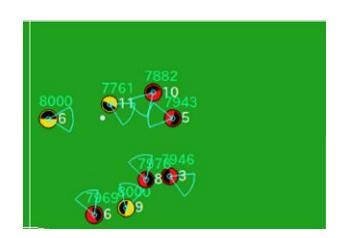
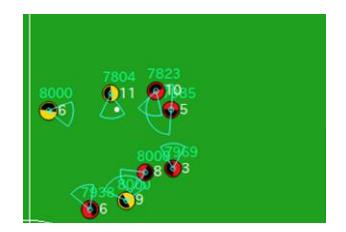
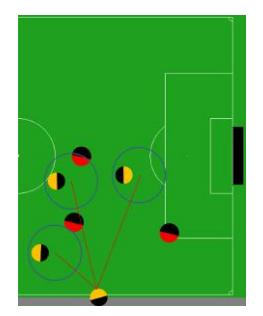
For this paper, a pass during a set play is defined as being the sequence of one agent kicking a ball within the field and another agent recieving it. Furthermore, a set play is defined as any sequence of two kicks when a game is in action. There are two possible situations in which a pass may fail during set play: Figure 2.1 shows the case where an agent on the team, yellow, is kicking the ball onto the field. These passes fail due to the fact that this agent cannot recognize that there is an agent of the opposing team, red, in the way of the course of the ball. In order to prevent such misses, the agent with the ball must know exact locations of all friendly agents in the field as well as securing a course for the ball to travel through.
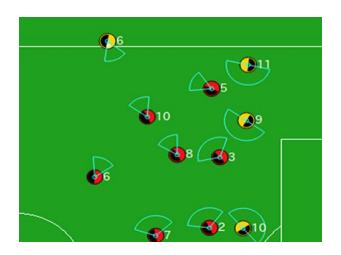
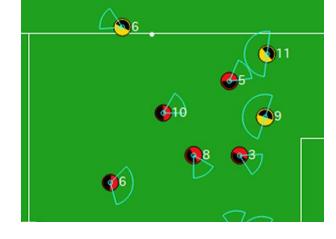
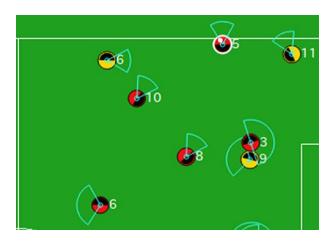
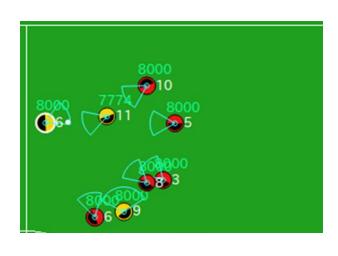
Figure 2.1 shows a miss on behalf of one of our agents receiving the ball within the field. Even when there is no obstruction between the agent kicking the ball in and the receiving agent, there are cases where the agent in the field does not receive the pass successfully. This is due to the fact that our agents do not have complete information on the positions of all agents, and they do not recognise that a ball is coming towards them.
2.2 Method proposed
In order to ensure that the situations written above do not occur, a new strategy to solve this problem was employed. By using the online coach, it was possible to let the kicker know which agents on the team were available to recieve the ball and to send coordinates of the point to which the ball should be kicked to. Using the online coach allows the problem to be addresed as the online coach is aware of the positions of all the agents on the field. The amount of information on the location of other agents positioned out of an agent 's range of view, will evidently decrease as time passes and players move around throughout the game. Therefore, in the case of set play, obtaining position information from the online coach was the most practical solution. This method was previously seen when team HfutEngine2009 [3] also collected information on the field using the online coach. As cited above, an agent 's scope of view is crucial when making a pass. By taking advantage of the online coach, instructions on exact locations can be sent to agents on the team which will increase the chance of them making a successful pass without being obstructed by the opposition. In order to make this happen, free form messages have been used. In the current rules of the 2D Soccer Simulation League, an online coach has limits to sending free form messages to its team. These consist of two main factors:
- the first is that it cannot send a free form message in Play On mode unless 600 cycles have passed.
- and the second is that there is a limit to the number of messages allowed to be sent per match.
Despite these limits, it can be seen that the team Hara-2D 2009 [4] also used the online coach on Play On mode in order to check the information on the field. With these limits and previous cases in mind, a method has been proposed to obtain paths using the online coach when playing except for Play On.
Generating availablable coordinates In 2009, Bahia2D [5] implemented fuzzy logic in their agents to calculate the probability of successfully making a pass. The method this team proposed was to evaluate distances and angles between agents to determine whether it was possible for them to make a pass and to substitute these figures into the evaluation function. In contrast, Ri-one have devised three methods using the online coach in cases except for Play On mode in order to verify whether an agent is able to make a pass. The methods used are as shown below.
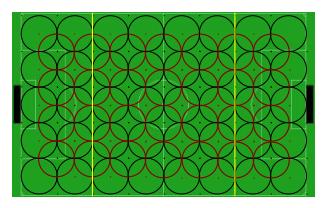
– Field division: When considering methods for the online coach to search available paths for a pass, it seemed reasonable to consider spaces within the field. First, the field is divided into sections as shown in Fig. 9. Looking at the entire field, 40 regular squares are formed by dividing the field into 8 in the x-axis and 5 in the y-axis. The coordinates of the center of these squares are set to be the centre of circles, created with a radius of 6.5. This can be seen in fig. 9 where the black circles are the circles explaine dabove. However, it is evident that a diamond shaped space is left in the middle of four adjacent circles. The red lines show a solution to this, filling in the gaps with circles which also have a radius of 6.5. The field has been divided into circles as there are cases where agents are not able to reach the coordinates appointed by the online coach in time. Nonetheless, if an agent is within close enough reach of the ball, it is still able to recieve the pass. By making this minimum distance the radius of these circles, the agents are able to recieve the pass is they have reached the circle including the appointed coordinates. In 2012, the team NADCO-2D [6] performed a similar method to indicate the movements of agents through management of the stamina of the each agent. Here the same movements are indicated, however circles have been used as the deciding factor in comparison to stamina.
- Personal space: This method is applied by the online coach examining the area included in a 6.5 radius around the agents. The coach creates circles around each agent on our team, and investigates whether there is an agent from the opposing team within this 'personal space'. By doing this, the online coach can decide whether or not it is possible for a specific agent to make the next action.
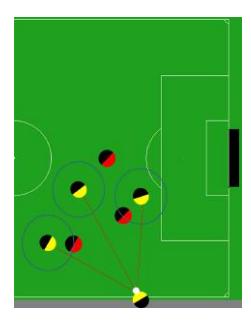
- The lead pass: This method is similar to the Personal Space method used above. However instead of examining the radius around an agent, the online coach investigates the area of a circle, a fixed distance away, by adding a constant to the x-coordinate of the location of the agent. If there is a clear space in front on an agent, this makes it possible to make a successful lead pass.
The evalutation of coordinates Expanding on the Field Division Method, the field can be segmented intoa further 52 overlapping circles. From these circles, the online coach decides the most appropriate circle in which an ally is standing, for the currect kicker to make a pass to. This is done by using the following algorithm:
- First, the circles which do not have any agents standing in them, are selected as options.
- Out of these circles, the closest to the kicking agent is selected.
This circle will always be selected on the basis that there is no opposing agent standing between the kicker and the selected space, called the vacant space, to obstruct the path of the ball. The field is divided into three segments between the x-coordinates ([-52.0, 0.0], [-26.0, 26.0] and [0.0, 52.0] ) as shown by the white and yellow lines in Fig.9. The vacant circle the ball resides in is then determined.
As written above, the personal space technique involves the online coach investigating the circle made around each agent on our team with a radius of 6.5. The online coach determines the course which will be taken by the ball by using the algorithm as shown in Fig. 10. Once the circles have been made, they are examined by the online coach to determine whether or not there is an opposing agent within it. If the circle is clear, then that becomes one of the space options for the ball to go to in the next pass. The next step is to determine whether there are any obstructions between these candidate spaces and the current location of the ball. Having examined both these factors, the agent within the closest circle is selected as the next team member for the ball to be passed to. The online coach will send this information to the kicker through a free form message, letting it know which agent it should pass the ball to next. Figure 11 shows the lead pass technique. This is applied using the same logic as the personal space technique. The only difference being a constant is added to the x-coordinate of the 6.5 radius from the agent.
Communication between the online coach and agent In comparison to agents on the field, the online coach has fewer immediate decisions to make. For this reason, the online coach is able to spend time searching for the most appropriate course for the next pass instead of the agents. Agents move according to messages received from the online coach. This means that by relying on the online coach, agents spend less time making decisions and can make more efficient moves and passes on the field. Quick passes are achieved when the agent that kicked the ball onto the field runs to the ball quickly and kicks it again straight after the set play sequence. By making quick passes, the agents are able to maintain possession of the ball and make another pass before agents on the opposing team obtain information on the ball 's location. Another example of using a coach is seen in the algorithm implemented by team WrightEagle in 2013. They however, used an offline coach trainer in order to manage information concerning the positions of agents in the field. The downfall to this is that it is not possible to use an offline coach in an official match, whereas our online coach proves to be useful real time.
3 Experiment
A method has also been devised for cases using the online coach for situations when the match is not being played in Play On mode. A good strategy was needed to make sure that passes would not be obstructed by opposing agents and that friendly agents would not accidentally let a ball go past it without realizing. In order to see whether implementing these new algorithms have made a difference to the success rate of passes, we set up matches as arranged below and analyzed the data obtained.
3.1 Setting
Having implemented all the new algorithms to the online coach, experiments were carried out with other teams. Our agents played 300 matches against each of heliose2010, AUA2010, and fiftystorms2010, and all the data from these matches were logged. The differences the implementations made on the number of points scored and the number of successful passes for games played not on Play On mode were analyzed. Testing: The number of successful passes per each game played when not on Play On mode
3.2 Results
Table 3.2 provides rate of success before implementing the new algorithms. Table 3.2 provides the rate of success after implementing the new algorithms.
Table 1. Rate of success before implementing the new alogrithms
| vs Team name | before |
|---|---|
| AUA2010 | 26.4% |
| heliose2010 | 65.24% |
| fiftystorms2010 | 37.2% |
Table 2. Rate of success after implementing the new algorithms
| vs Team name | Field division | Personal space | The lead pass |
|---|---|---|---|
| AUA2010 | 26.44% | 23.84% | 24.84% |
| helios2010 | 52.04% | 60.84% | 61.74% |
| fiftystorms2010 | 33.44% | 36.04% | 38.14% |
From the results in these experiments, it can be seen that the success rate of passes has reduced on the whole compared to the figures obtained before implementing the new algorithms. However, not all results decreased. When our team played against fiftystorms2010 using the Lead Pass algorithm, the percentage showed an increase. The three methods which were used can be classified into two different groups. The Personal space and Lead pass techniques are dynamic algorithms which contemplate finding a vacant space during the course of the game. On the other hand, the Field division technique is a static method. When comparing the two different sorts, the results show that using a dynamic algorithm proves to be more efficient in increasing the rate of success for a pass.
4 Conclusion
This paper's research was designed to identify and address the problems with the low rate of successful passes in the previous League. While the results from the experiments do not show a substantial increase in the success rate, the team has learned that an agent's scope of view is critical in making successful passes. The problem can now be identified as a design problem to improve the methods for each agent to obtain information through its field of view. This paper shows that improving the sight of agents by using an online coach is not the most effective method given that the restrictions placed on the online coach prevent major improvements to the success rate of passes. With this in mind, more effective use of the online coach and efficient use of the agent's field of view are the next steps in improving Ri-one's RoboCup 2D Soccer Simulation team.
References
- UVATrilearn. http://sta.science.uva.nl/jellekok/robocup/.
- Hidehisa Akiyama, Tomoharu Nakashima: HELIOS Base: An Open Source Package for the RoboCup Soccer 2D Simulation, Proc. of 2013 RoboCup Symposium, 8 pages (2014)
- Li Shang, Long Li, Hao Wang, Baofu Fang: Hfutengine2009 simulation 2d team description paper. Hefei University of Technology (2009)
- Reihane Kamali, Sepide Rahmatinia, Safoura Sadeghpour: Hara-2d team description paper. Farzanegan High School, Rasht, Iran (2009)
- Marco A.C.Simoes1, Bruno Vinicius Silva1, Alexsandro B.das V. Cerqueira, and Luciana P.das V.Silva: Bahia2d 2009: Team description. Bahia State University (ACSO/UNEB), Salvador, BA, Brazil,Bahia University Center (FIB), Salvador,BA,Brazil (2009)
- Mohammad Ali ,Sadeghi Marasht: Nadco-2d soccer 2d simulation team description paper 2012. Department Of Computer Software Engineering Islamic Azad University - Northern Tehran Branch Department of Artificial Intelligence and Multi-Agent Simulation NAD Educational Robotics Corporation (2012)