GDUT TiJi 2015 2D Soccer Simulation Team Description
Defu Long, Tianli Chang, Daiyuan Liu, Yuepeng Huang, Wei Chen
School of Automation, Guangdong University of Technology Guangzhou, Guangdong Province, P.R.China, 510006
Abstract GDUT TiJi is a 2D soccer simulation team which has been participating in RoboCup since 2006. we had got the first prize in RoboCup China Open 2011, second prize in RoboCup China Open 2012 and the 5th place in RoboCup 2012 in Mexico. In this paper, we will describe the main idea on our team, roughly on the improvement since last year and future research; meanwhile we will analysis the structure of agent 2D base source and which might be helpful for new developer of 2D simulation.
1 Introduction
GDUT_TiJi, a simulation 2D soccer team of Guangdong University of Technology, was founded in 2006 and has been taking part in annual competitions of RoboCup China Open since 2007.In the preliminary stage, we used UvA TriLearn as our team base code but we had not got an ideal achievements. When Guo Jing led GDUT_TiJi, he spent lots of time on analysis of the whole structure on 2D soccer simulation team and read countless literature on research and development of 2D simulation. In 2011, he directed the team work on HELIOS base and got the first prize in RoboCup China Open 2011 and the 5th place in RoboCup 2012 in Mexico .which was the best achievement of GDUT_TiJi, and we were voted as technical committee members of RoboCup China Open 2D Soccer Simulation league. RoboCup simulated soccer has been proved to be an excellent domain for researchers to test their ideas in artificial intelligence [5]. In spite of rigid, our works in the past was mostly focused on the position for both offensive and defensive though some geometric algorithms. In GDUT TiJi2015, with the purpose of making our agents more flexible and dynamic, we have put our effort more on online planning.
This paper is organized as follows. Section 2 introduces the structure of agent2D.Section 3 introduces the design of our team on the offensive strategy. Section 4 briefly presents the changes of the design of the defense system, Section 5 presents the experimental Results. Finally, Section 6 concludes this paper and proposes the future work plan of GDUT_TiJi.
2 .Introduction of agent2D
In agent2d, chain Action is the essential design of agent2d, which search for best action sequence. Kick action sequence has been successfully embodied, and samples of pass, shoot, dribble have also been applied which perform well. Then basic framework of online planning is to find the best sequence of action, which is generated from state to action, it means agent who hold ball should consider the environment of field, and then choose the best action. The ideal form of online planning is to find the best state-action pair. As figure 1 shows:
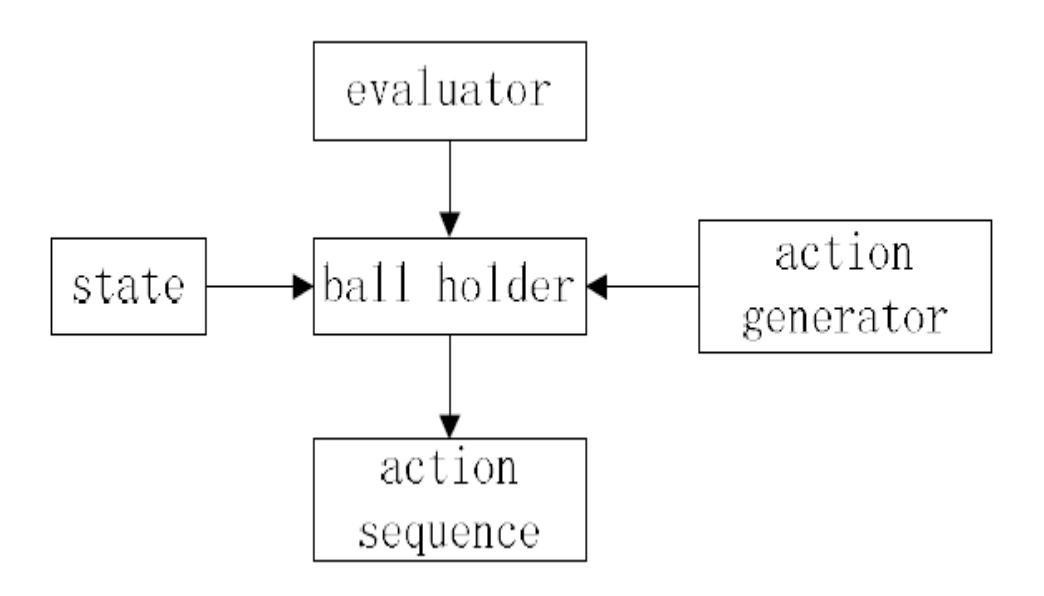
Figure 1 gives the simple frame of online planning under our effort. Although, there might be some misunderstanding about system of online planning, so we would revise this frame sample later. We believe this part could give an overview for new developer and help them to understand how online planning was designed.
2 Offensive
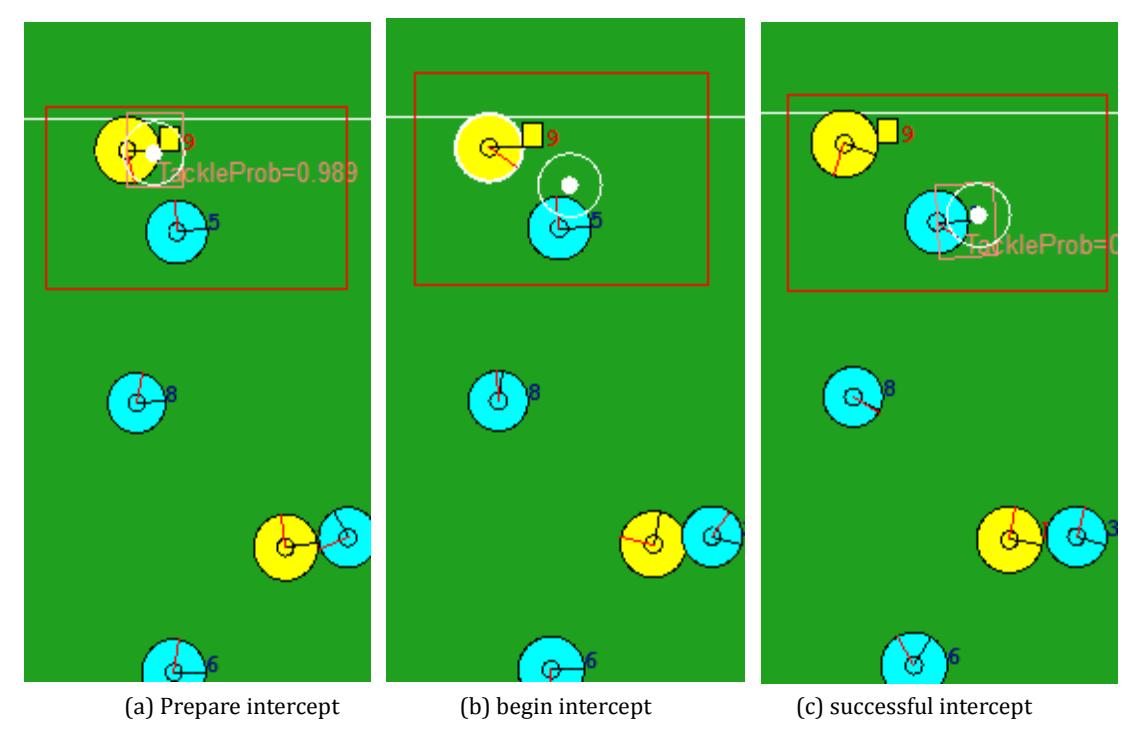
The passing effect of Agnet2D is poorer. It regarding the distance of ball away from the opponent's goal as the only score points of passing and taking into account only defensive player to pass through the point of defense, not considering the defensive player can intercept the pass on the line of the passing . In response to these shortcomings, on the one hand, we added the back-pass in our team. Through the back-passing, it can keep the time of the possession of ball in midfield, and create scoring opportunities when pushing too deep in front of the penalty area of the opponent team. On the other hand, in the TDP of GDUT_TiJi2013, our seniors have built the Anti-Calculation Module. They want to predict the actions that the ball owner will take by this module, and then make the appropriate action to deal with it. They only set up the basic structure of this module, and we further perfect the module on the basis of them. With the aid of Anti-Calculation Module, we will be able to intercept it more accurately while the opponent passes the ball. So it is an efficient way to block the ball owner undoubtedly and also it can improve the performance of defense a lot. As shown in the figure below, we successfully intercept the pass of opponent's offensive (blue represents our players).
3 Defensive Skills Improvement
As of this is obvious, before modifying, the defensive player in agent-2d base does not intercept when the opponent dribbles breakthrough our defensive line until it reaches the penalty area. Based on the Hand-coded defensive policies we used in GDUT_TiJi of RobuCup2013, we optimize the strategies and adopt some new approaches to finding the efficient solution for assignment of opponent's attackers to our defenders.
3.1 Block
The most challenging part in this improvement is determining by two aspects. On one side, firstly, we should realize which defender of us should be assigned to block the opponent's attacker dribble and calculate the point where the agent should move so as to tackle or intercept the ball more accurately and actively according the distance to the goal and opponent's direction.
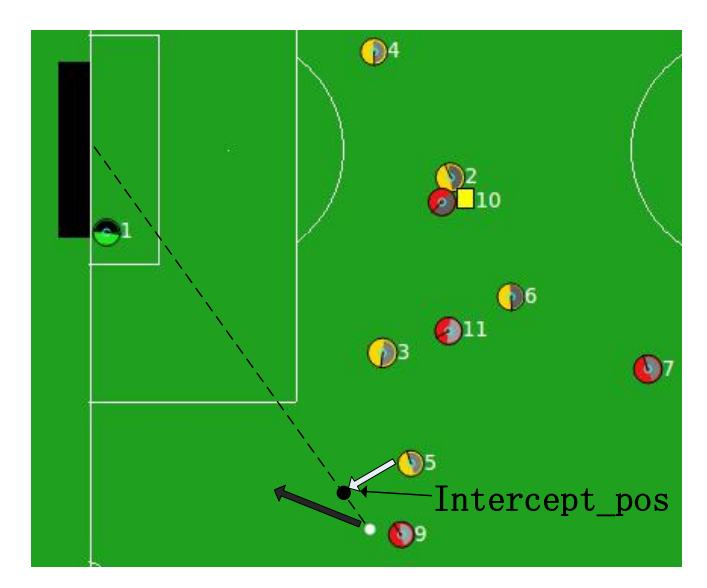
After last competition, we have re-analyzed the structure of agent2d base and on the basis of the teams' performance which was also used the agent2d base in RoboCup 2013, we found that the agents tended to dribble into the bottom line when they were in offensive situation. In GDUT_TiJi2015, therefore, we have strengthened the defensive and intercept ability of the side back players , especially we put more attention into the interception when the opponent has done a through pass. In this aspect, we considered the following parameter to improve the function of the original interception and propose a better interception strategy: the distance between the ball position and the defender position --- ; the distance between the ball position and the goal --- ; the velocity of the ball --- ; the running direction of the ball --- ; the weight for the intercept position according to the ball velocity and direction --- . Then the intercept point calculation function is given as follows:
$$Intercept_pos = ball_pos \times \arctan(\frac{S_1}{S_2} \times k(ball_vel, ball_dir))$$
`Figure.3 depicts an example of procedure of the side back player's interception. Actually, the side back players, instead of running back to the basic point, can provide more protection in case the opponent passes the ball to the center opponent or breaks through. How simple it is, but indeed practical.
3.2 Mark
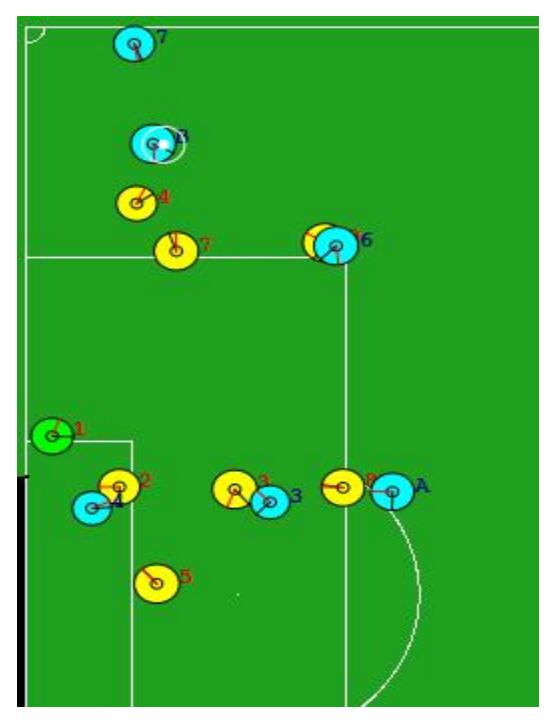
Defensive system is easy-see unsolved part in agent2d, which only simply designed move and tackle action with basic point. In GDUT_TiJi, we developed several methods on intercept, mark, block and move strategy which was proved not stable and perfect enough. Due to its unstable performance, we re-analyzed the structure and found ambiguous modification on defense would be in a dilemma. In normal formation, basic point is pre-designed for each player according to the position of ball, so each player might not deviate largely from it, otherwise, all strategies will be destroyed. In our defensive system, we exploited mark action by ball position for defensive players, which would help each player to find mark opponents .To be specific, our one-by-one marking function is constructed and has been used in practice, as shown below (Yellow represents our players):
4 Experimental Results
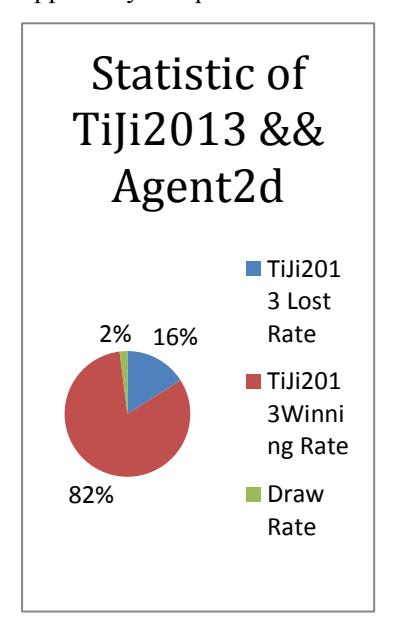
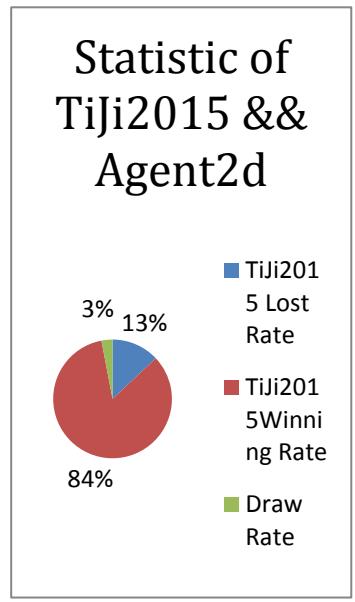
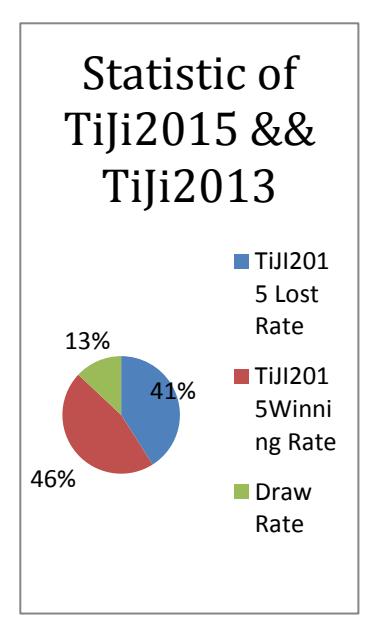
In order to evaluate the effectiveness of our previous efforts we did on GDUT_TiJI2015, vast amount of tests were performed against two different teams and each game had run over100 games to reduce the contingency which definitely exist in 2D simulation. Also we will compare and analyze with GDUT_TiJi2013 both in offensive and defensive. (For some reason GDUT_TiJi did not participate in the RoboCup2014, so compared with GDUT_TiJi2013)
From figure 5, it is shown obviously that, the overall level of GDUT_TiJi2015 had been improved apparently compared with GDUT_TiJi2013.
6 Conclusions and Future Works
In this paper, we have done some improvements on the offensive and defensive systems of GDUT_TiJi, received a certain effect, but still needs to be improved in stability. In some of the details are not yet fully considered, for example, the optimization of dribbles and passes is not yet perfect. So, in order to improve the dribbling ability of individual players, this scoring function of this two actions should be improved. Another key point is chain action graph, which plays the action choosing role during online planning. The important issue which would affect whole performance is action generator and field evaluator. When improve, understand of overall system is essential, because single part in online planning have complex connection with each other. This is also our research topic. Some work have been made, but still under testing.
Despite these efforts, in order to apply the on-line planning in the defensive part, we are improving the anti-calculation system of our team which is used to predict the opponent's action in the next cycle. Even if there are many problems in it, we hope not only can it work on our team in the near future, but also contribute to the defensive strategy. Moreover, we will also consider more abstractly in the low-level skills to let the agents act more like human.
References
[1]Ke Shi: Research on Agent Decision Problems Based on the Theory of MDP, Master's thesis, University of Science and Technology of China, 2010 [2]Zhenyu Li: Research on Multi-Agent System Decision Problems and Application in RoboCup, Master's thesis, University of Science and Technology of China, 2005 [3]Akiyama, H., Shimora, H., Nakashima, T., Narimoto, Y., Yamashita, K.: HELIOS 2D simulation team description 2012. 2012 RoboCup World, Mexico. 2012.06. [4] Kalyanakrishnan, S., Liu, Y., Stone, P.: Half field offense in RoboCup Soccer: A multiagent reinforcement learning case study. RoboCup 2006: Robot Soccer World Cup X pp. 72-85(2007). [5] Luis Paulo Reis, Nuno Lau and Eugénio C. Oliveira.: Situation Based Strategic Positioning for Coordinating a Team of Homogeneous Agents in Balancing Reactivity and Social Deliberation in Multi-Agent system – From RoboCup to Real-World Applications, Springer LNAI, Vol. 2103, pp. 175-197, Berlin, 2001. [6] Jing Guo., Haohui Huang., Wei Chen.: GDUT TiJI 2D soccer simulator team description 2012. 2012 RoboCup World, Mexico. 2012.06. [7] Haohui Huang., Wanlu Yang, Wei Chen.: GDUT TiJI 2D soccer simulator team description2013. 2013 RoboCup World, Netherlands. 2013.06.