HFutEngine2015 Simulation 2D Team Description Paper
Zhiwei-Le, Keting-LU, Guoxing Wang, Hao-Wang, Baofu-Fang
Artificial Intelligence And Data Mining Lab
Abstract This Paper mainly describes the new method of HfutEngine2015 Which aims to deal with the problem of Passing-ball model ,body reorientation model ,the intelligent way to pass balls with considering say-message, the intelligent way to move, and the formation learning about oppoents'.
1 Introduction
Team HfutEngine was founded in 2002 and took partin the RoboCup ChinaOpen2002.In the following years, HfutEngine develops fast and joins many matches. From 2005, the team used UVA BASE 2003 as the base code, and added AI methods to it and updated the code along with the server's upgrade.In RoboCup ChinaOpen 2007, the team gained the 2nd place of soccer simulation 2D. Furthermore, it got the 7th place of soccer simulation 2D in World RoboCup 2008 and 4th place of soccer simulation 2D in RoboCup ChinaOpen 2009. Now we used theHellos Base and We hope to obtain a good grade in World RoboCup 2015. It is the 6th time for us to take part in The World RoboCup. We want to probe into Multi-Agent System and Robocop with anyone interested in them.
2 Body reorientation
Body orientation is closely relevant to the efficiency for passing balls. In order to make the action-chain of passing balls more fluent, as wellas adjust the orientation of body in different areas at the same time to raise the efficiency of catching balls. To realize this, we are exploring how to regulate agents' body orientation through BP neural network algorithm[2~3] based on which area where the agents and the ball in, and the information of where the ball will be next, etc. X1...Xn is the information of input, while w1...wn are the stable weights by change the given values iteratively.
Input: Net= $$x1w1+x2w2+...+xn*wn$$
Output: $$y=f(net)=\frac{1}{1+e^{-net}}$$
3 Classify say-message requesting model
It is necessary for getting and handling information correctly to make a right decision in the real process of passing ball.However, players can just get limited information by means of vision. When predicting the action-chain, the players cannot observe all right information so that we set up a mechanism for that the players far from with the one holding the ball can speak out the request to send the player a direction to pass the ball. This part of decision making is derived from the action-chain of the player who is holding the ball. By calculating the range of a player himself can catch, the player presents the requestfor getting the ball from the one who is holding it then. The requests are given an evaluated weight each based on the area environment where the players are, besides we records the results for whether the action-chain gets succeed or fail finally. Then we can get the the probability of successful implementation of the gain. The weight of requests gets revised further through Bayes every time to make the action-chain extend and progress better. The transition probability from source A to source B can be calculated according to Bayes' theorem[6~7]:
$$P(Bi|A) = \frac{P(Bi)P(A|Bi)}{\sum_{i}^{n} P(Bi)P(A|Bi)}$$
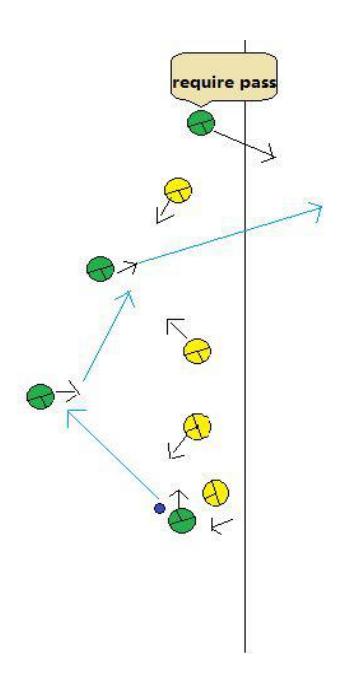
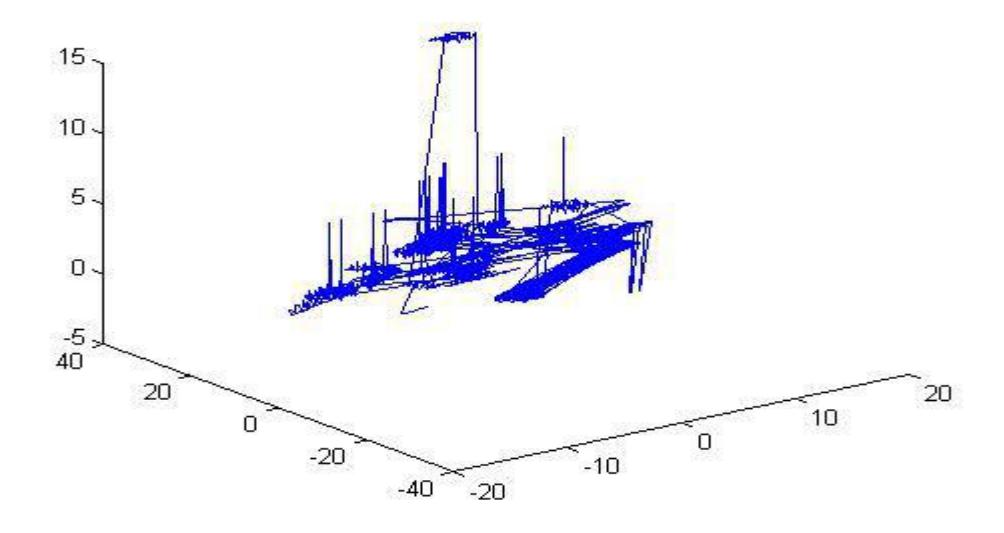
In order to compare with the other teams, we selected Infographics as a training team . Through continuous trainingwith the team to get different weights for effective penetration point. As shown in Figure 2. The X-axis and Y-axis corresponding the pitch. While its height corresponds to the weight of the breakthrough point.
4 Prediction for Formation
First, we separate the football field into many modular zones considering ourselves' formations .When in competition the players can estimate the probability of the enemy players would be in the corresponding zone based on the position where the ball is and then our players could learn the opposite side's lineup continuously and then discover the strategy they are taking and seek the defense leak to make the decision making more reliable. This study method is built on camshift algorithm analysi. As show in Figure 3
First we statistic opponent player movement trajectory by collecting log file location information. Then statistics point probability distribution for each region by camshift algorithm. Then we will get the most likely formation point for the opponent to move. These points can be very important for us to predict the opponents to go when we try to perform the action chain.
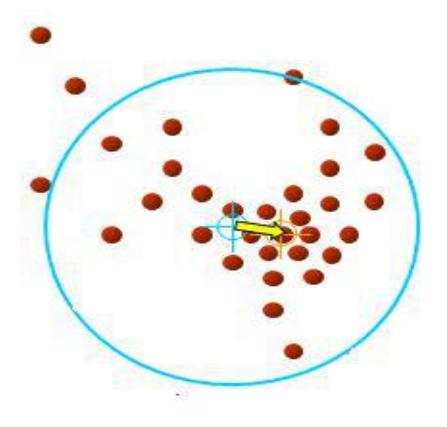
But the best situation is that the enemy's lineup is stable while it can guarantee the prediction is exactly right. To make a little of progress, we are going to build the enemy's lineup dynamically by means of BP neural network algorithm based on the recording information along with the predicting position and where the opposite players actually are. The enhanced method is useful for executing longer action-chain.
5 Prediction for pass-paths
Based on the strategy what the opposite players taking in the process of passing ball when attacking, we are going to make a defensive strategy to fit in the intelligent defensive running system and learn the opposite's paths for passing ball when defending. Coach is going to adopt Aprior algorithm[4~5] to dig out the relevant rules and the potential paths for passing ball by recording the information of the player holding the ball, the player going to catching the ball and the zones where the ball is and the zone for passing the ball, etc. That means to analyze whenever the player gets the ball, what the probabilities could be to take different action-chain by analyzing the zone where the crossing point of all kinds of paths generate. and then adjust the marking objects in the corresponding zones and distribute the spatial defensive resource rationally.
6 Intelligent way to move
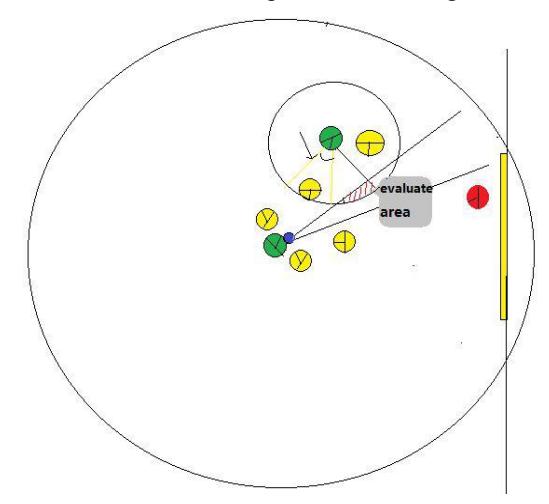
While our teammates holding the ball, the players should make an intelligent running decision to help them , fight the enemy's surrounding and increasing the probability for holding the ball according to the change of enemy's defensive lineup but fitting in our side's lineup as well. On the basis of the opposite's lineup and prediction of their running position, our players can estimate a good catching position in a safe range. The same time when our players helping the one who is holding the ball. He should also make an evaluation to choose the best place for catching and run to that point.
7 Training effect
After a long time of training, the team has receivedvery good e_ects, the passing quality enhanced signi_cantly. The result compared with the passing rate of the Infographics2014 showed as Table 1 and the result against Infographics 2014 is showed as Table 2
Table 1 Passing success rate Confronting with Infographics2014
| Team | Number of successful pass | Probability of successful pass | Sum of pass time |
|---|---|---|---|
| HfutEngine2014 | 1012 | 0.506 | 2000 |
| HfutEngine2015 | 1433 | 0.7165 | 2000 |
Table 2 The result of Confronting with Infographics 2014
| Team | Ave Goals Scored | win | draw | lose |
|---|---|---|---|---|
| HfutEngine2014 | 1.1 | 2 | 3 | 10 |
| HfutEngine2015 | 2.9 | 6 | 5 | 5 |
8 Conclusion
The data above proves that the team's ability can be improved in all aspects by different training. The ratio of ball control and defensive ability get changed. However, we discovered some new problems. That is to say we can just only make a bit difference for predicting the enemy's lineup by means of Bayes method but not good enough for longer action-chain. We have not done some intelligent study yet for improving defensive capacity while predicting enemy's paths to passball. We are looking forward to find a more intelligent way to enhance our team's defensive learning ability.We will try our best to dealing with more issue of the RoboCup Simulation 2D and the research of Multi-Agent System by using the Information Theory in the coming time。
References
- BaoFu Fang, Hao Wang:Robotics[M]HeiFei University of Technology,China
- Zhou Huang-bin;Zhou Yong-hua;ZHU Li-juan: Implementation and Comparison of Improving BP Neural Network Based on MATLAB. University of Guangxi ,Nanning of China
- Huang Li: Improvement and Application of BP neural network algorithm. Normal university of Chongqing (2008).
- Liu Huating Guo Renxiang Jiang Hao: research and improvement of the Apriori association rule mining algorithm. Computer Science and Engineering, Southeast University (2009)
- Wang wei: research and improvement of the Apriori association rule mining algorithm. Ocean University of China (2012)
- Lin Shijie: Comparison and analysis between ID3, Bayes and BP neural network theorem. Inner Mongolia University (2013)
- Li Xin:An improved algorithm analysis for Bayes. Shandong Agricultural Management Cadre Institute.(2011)
- Li Long:Value-based machine learning method and its application in RoboCup simulation of 2D. HeiFei University of Technology,China
- Zhang Huilong: RoboCup 2D simulation of AgentIntelligent Decision System. Anhui University China (2012)
- Zhou Hui: soccer Agent Collaborative Research on RoboCup2D simulation. Nanjing University of Posts and Telecommunications.(2013)
- Zhao Wenyi: Bayes methods Issues. Northwestern University of China (2005).
- Huang Li: Improvement and Application of BP neural network algorithm. Chongqing Normal University China (2008).