MT2015 Robocup Simulation 2D Team Description
Zhongyu Xia, Kaiqiang Cheng, Ke Liu, Haofan Cheng, Xiaofu Niu
Robocup Lab, Department of computer science and technology, Hefei University, Anhui Province, P.R.China, 230601
Abstract The paper presented the main strategy used in MT2015 team. Firstly, we divided field into several regions based on attacking value, and adjusted the key attacking region dynamically according to the opponents, teammates, and the attacking result. Then, we presented the shooting training method based on Ant Colony Optimization, and rhythm control method based on fuzzy logic. The simulation experiments and competition results show that the strategy is feasible and effective. In the last section, conclusion and future work is described.
1. Introduction
MT2015, a simulation 2D soccer team of Hefei University, was founded in Nov. 2011. We have actively taken part in annual competitions of RoboCup China Open since then, and have gotten good performance: won second prize twice in the 2012 and 2013 RoboCup China Open; and won the first prize in the RoboCup China Open 2014. In the process of communication with other teams, we found some deficiencies of our team. According these deficiencies and some new strategies, we improved the code greatly. The simulation experiments results show that the team's capabilities have been enhanced compare to the code of last year. For the reason of testing our new strategy, making new friends, learning new technology, we want to participate in this competition greatly.
2. The underlying of the MT2015
The underlying version t we use is agent2d-3.1.1, which can be gotten from the follow website: http://en.sourceforge.jp/projects/rctools/. Using the librcsc as the underlying library, the underlying realize its function by the method of action chains. Basis on this underlying, we added some classes as follow: bhv_basic_offensive_move, body_offensive_block, fuzzy_logic_rhythm. The bhv_basic_offensive_move class is to realize the actions of attacking and movement when our players are in the opponent's backfield. The body_offensive_block class is to realize the actions of blocking and interception when the opponent get ball. The fuzzy_logic_rhythm class is to realize the rhythm control by fuzzy logic, which controls the attacking rhythm according to the situation of the field.
3. The main strategies of MT2015
According to the need of offensive and defensive strategies, we made some improvements on the underlying code of Agent2D, and added some new technologies. We judges the focus attacking region based on the field division, and determines which attacking method (the side-way, 45-angled, or the middle-way) that we should employ according to the opponent's situation. Meanwhile, shooting training and rhythm control were both studied successful. These will enhance the capability of the MT2015 team greatly.
3.1 Dynamic adjustment of the key attacking region
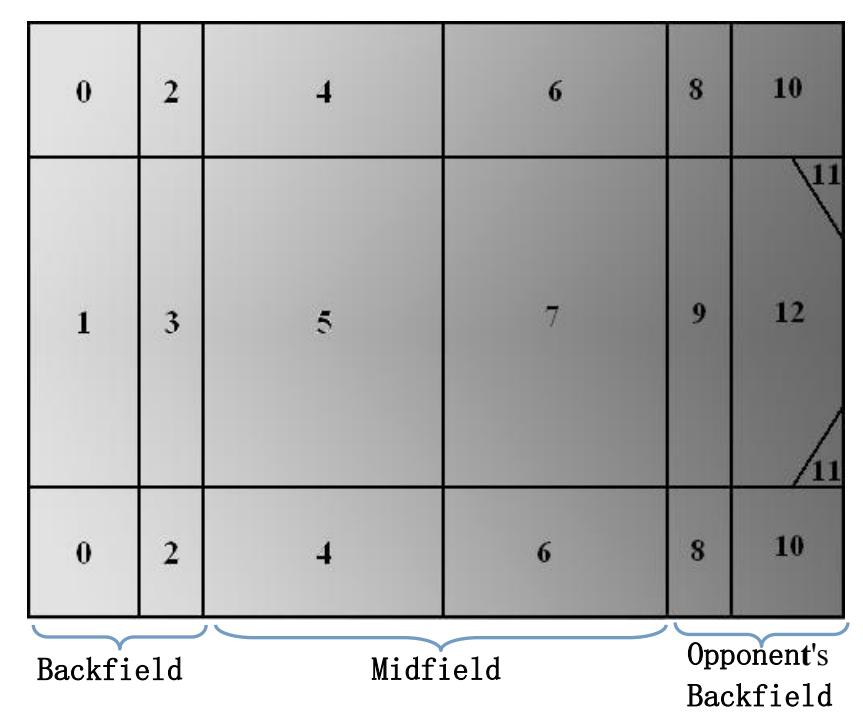
According to the opponents, teammates, and the attacking result, our player manual and the actual effect of the attack, we adjusts the key attacking region dynamically during the competition, and creates the favorable situation for our team locally. We will pass the ball to the other region when there is too many opponents in the local region; We will pass the ball quickly to the region when we estimate that there is few opponents in a region (especially in the penalty region). In keeping with the key attaching region and dynamic adjustment, we have prepared two sets of attack modes: normal mode and quick attack, the second attack patterns are implemented by the regional value. With the front of the venue subdivided into 11 regions, when the need for a regional focus and defense, enhance the value of the region, or in accordance with pre-established good regional value. When the some offensive zone a large number of Enemy, first spread to other regions of the ball, when the agent finds the number of a region (particularly restricted) is below the threshold, the agent will rapidly pass the ball to the region. To cope with dynamic adjustment of the focus of the offensive and defensive zone, we prepared two sets of attack modes: fast attack and normal mode, which sets the value of the use of regional attack mode to achieve both.
With the front of the venue subdivided into 11 regions, when the need for a regional focus and defense, enhance the value of the region, or in accordance with pre-established good regional value.
We regard each region of opponent's backfield as the key attacking region in the first 2000 cycles. Online coach uses statistical methods to assess the competition the temptation to attack mode, statistics show that the pocket defensive vulnerability that, if vulnerabilities are found as a focus for the next 4000 cycles of the attack zone.
3.2 The field division method based on attacking value
The actions selection of the player depends on the operation of the evaluator. A good evaluator is essential to the whole team's decision-making. Thus, we have a second division region divided on the basis of the traditional region division, and performing when the valuation will be considered to the target point around the opponent's case. The whole stadium is divided into 12 regions on the X-axis symmetric, with the upper and lower regions as the same module. And each region after dividing the evaluation value has a different base. Moreover, which region the ball falls, the evaluation value based on the choice of the region as a whole evaluation part of the value. Specifically in the following figure:
3.3 Shooting training based on AC
For the selection of the goal point, we used to calculate the angle bisector intersection of the median line and the goal as the shot point.
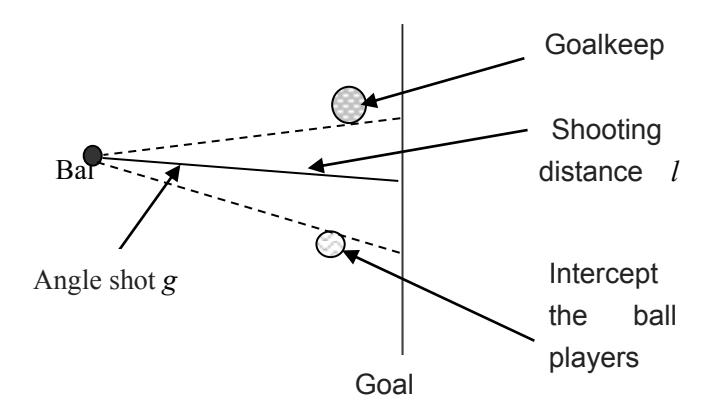
Without considering the dynamic nature of the players and distance from the door, shooting is not very high success rate. To the and, we use ant colony algorithm to train shooting, using distance away from the door to decide when to shoot, determination of scoring points by shooting. First, set a different goalkeeper and defender position, and from the zone would be shot field goal to set a different shoting distances range is divided into 10 equal positions. Specific shown schematically in the figure below:
3.4 Rhythm control based on fuzzy logic
Based on the fuzzy logic, we control the offensive rhythm of MT2015 team. When the defense is intensive, reducing the rhythm of attacking, improves the ball, making team's ability to get a further boost. So, the team's ability can be enhanced greatly.
The decision of which are as follows:
- Ball handlers' defensive intensity value = f (other persons in the region, distance). Below:
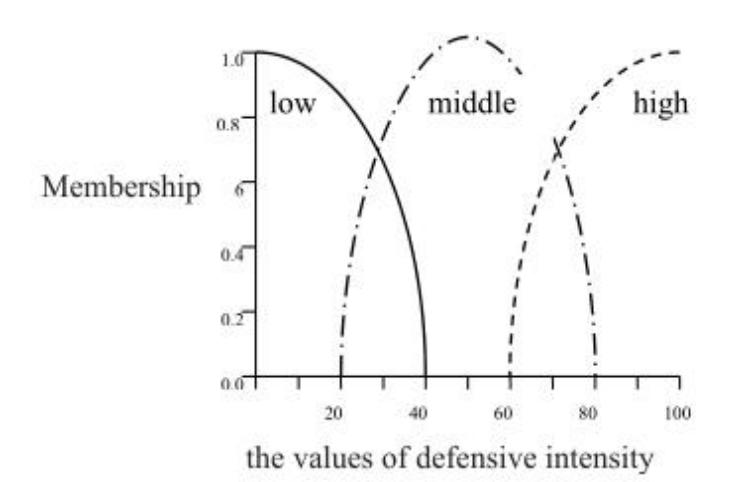
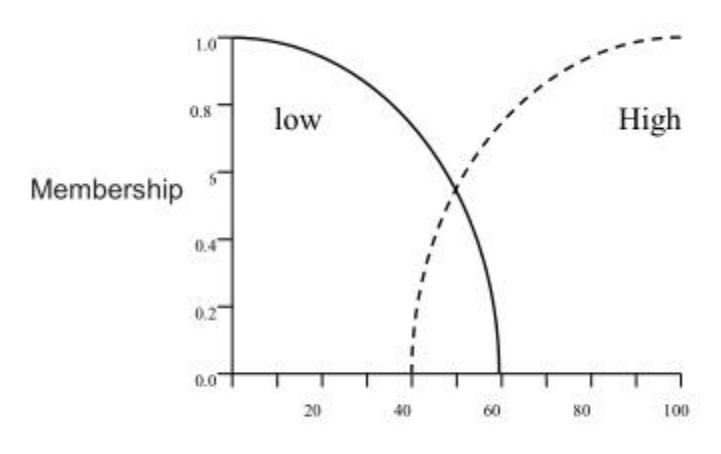
Table 1 The rules of fuzzy control
| Holding Non-ball | low | middle | high |
|---|---|---|---|
| low | Fast-paced | Medium-paced | Slow-paced |
| high | Fast-paced | Slow-paced | Slow-paced |
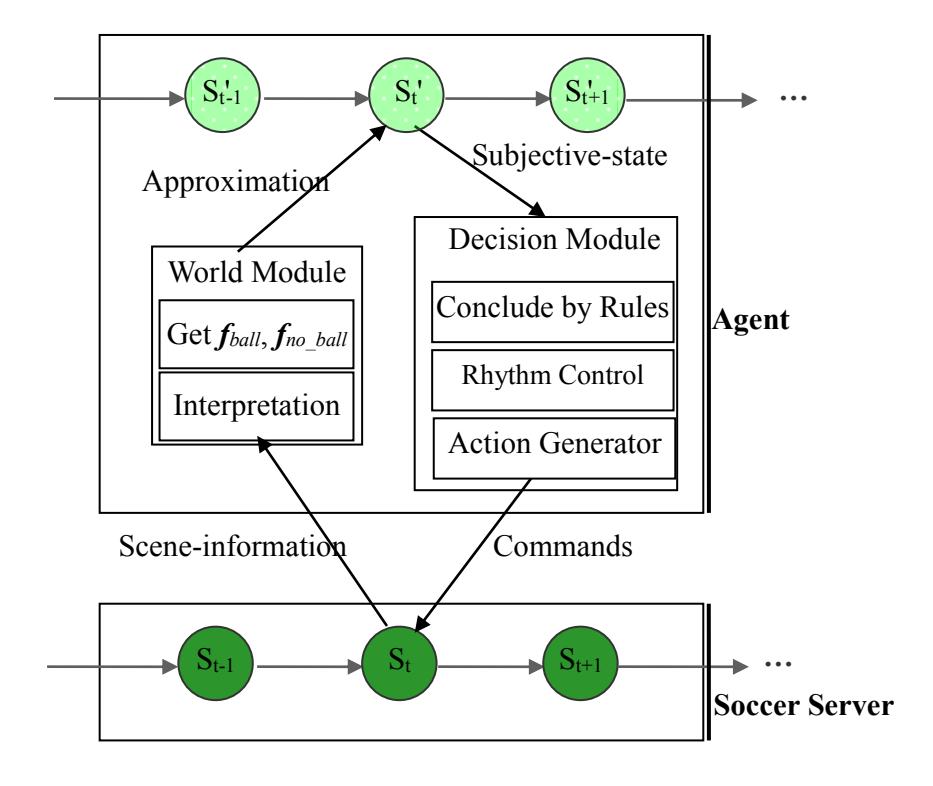
The following are process, as shown in Figure 5:
3.5 The online coach of MT2015
MT2015 has three attack modes: focusing on the sidewalk road, focusing on the middle road, the balancing between sidewalk and middle road. The three attack modes are assessing the value of the region respectively. when focused on the sidewalk road, the assessing values of region 4, 6, and 8 are greater than those of the region 5, 7and 9. And when focused on the middle attack, the assessing values of region 5, 7, and 9 are greater than those of the region 4, 6 and 8. While focused on the balancing between sidewalk and middle road, the region 4, 6, and 8 have the same value with the region 5, 7and 9. Firstly, we have set 2000 periods when the game begins, and to use the three models to have tentative offense. And the online coach will assess the attacking mode for the game by statistical methods, and count the statistics of the return of these three routines respectively, in order to choose the maximum repay as the main attack mode of the game.
The combination use of the MT the regional value and online coaching selects a better offensive repertoire to attack opponents. From the view of real competition, this technology can choose an effective attack quickly, depended on the opponents' mode, which can greatly improve the team offensive and defensive capabilities.
4. Conclusion and future work
Although Agent2d we made many improvements, but the team is young, we still have some deficiencies and shortcomings, many details and ideas are able to achieve. Did not achieve the the desired effect, such as attacking strategy, we need to do the work and effort and lots of more. But we believe that through our continuous efforts to improve learning, experience, and Hefei College MT(light tank) teams will slowly grow up.
References
[1] Kalyanakrishnan, S., Liu, Y., Stone, P.: Half field offense in RoboCup Soccer: A multi-agent reinforcement learning case study. RoboCup 2006: Robot Soccer World Cup X pp.72-85(2007). [2] http://www.wrighteagle.org/2d/ [3] http://sourceforge.jp/projects/rctools/ [4] Robot soccer simulation design and implementation of China University of Science and Technology [5] Akiyama, H., Shimora, H., Nakashima, T., Narimoto, Y., Yamashita, K.:HELIOS 2D simulation team description 2012. 2012 RoboCup World, Mexico. 2012.06. [6] Fan, C., Chen, X.: Bounded incremental real-time dynamic programming. In: Frontiers in the Convergence of Bioscience and Information Technologies, 2007. FBIT2007. pp. 637–644. IEEE (2007) [7] Kaelbling, L.P., Littman, M.L., Cassandra, A.R.: Planning and acting in partially observable stochastic domains. Artificial Intelligence 101(1-2), 99–134 (1998) [8] Shi, K., Chen, X.: Action-driven markov decision process and the application in robocup. Journal of Chinese Computer Systems (2009)