OXSY 2016 Team Description
Sebastian Marian, Dorin Luca, Bogdan Sarac, Ovidiu Cotarlea
OXygen-SYstems laboratory, Str. Constantin Noica, Bl. 5, Sc. C, Ap. 36, C.P. 550169, Sibiu, ROMANIA
Abstract Oxsy team was founded in July 2002 for a graduation project of one student, Sebastian Marian, in the field of Multi-Agent Systems, at the Department of Computer Science of Lucian Blaga University (Sibiu - Romania). After graduation he continued the work on this project and so was born Oxsy team. As we started from scratch, our ideas, concepts and beliefs, was implemented year by year and today, we are happy to see that we are on the right way, as our team was growing in these years, more than we expected from the beginning. If we'll qualify to the competition, this year we'll reach at the 14th consecutive participation, in RoboCup Soccer Simulation League.
Introduction
In July 2003 at RoboCup competition, which was held in Padua - Italy, we won the first round and for us it was a good surprise for first year of participation. Then, in the next year, we participated in Lisbon - Portugal for the second time, and again we obtained a good result (the 11th place). In 2005 in Osaka – Japan, we participated for the third time and finally we entered in the first 8 teams of soccer simulation league, as we won (the 8th place). In 2006 the competition was held in Bremen – Germany and we won (the 7th place). In 2007 we went to Atlanta – Georgia (U.S.A), where we obtained (the 5th place), the same result which we achieved in 2008 in Suzhou – China. Finally, in 2009 in Graz, we entered in the first 3 teams in the soccer simulation league, as we won (the 3rd place), the same result which we achieved in 2010 in Singapore. In 2011 we came back from Istanbul - Turkey with 4th place. In 2012 we were in Mexico City, where we had a bad experience as we made some major changes in our defensive system, and also many others overall our team strategy, changes which was not very well balanced at that time, with all others characteristics of our team, as we didn't qualified for finals, from the second round groups. In 2013 we came back in top, as we won the 6th place, in Eindhoven – Netherlands. In 2014 the competition was held in Joao Pessoa – Brazil, and we entered on the stage for the third time in our participation history, as we won again the 3rd place. Last year we won the 4th place as we played the semifinals in Hefei – China. This year the competition will be held in Leipzig - Germany. As we already have a very good experience in 2D Soccer Simution league, we hope that our new ideas and improvements will be reflected in the competition where we will also test other tactical elements developed.
The Offensive Phase
The objective of the offensive phase is to score. So, the necessary phases which lead to scoring are:
- Refraining from losing the ball (avoid risky moves in the defensive area).
- Tacking the ball forward towards the opponents' goal.
- Getting the ball to a teammate who is free from his opponent's marking.
- Shooting effectively.
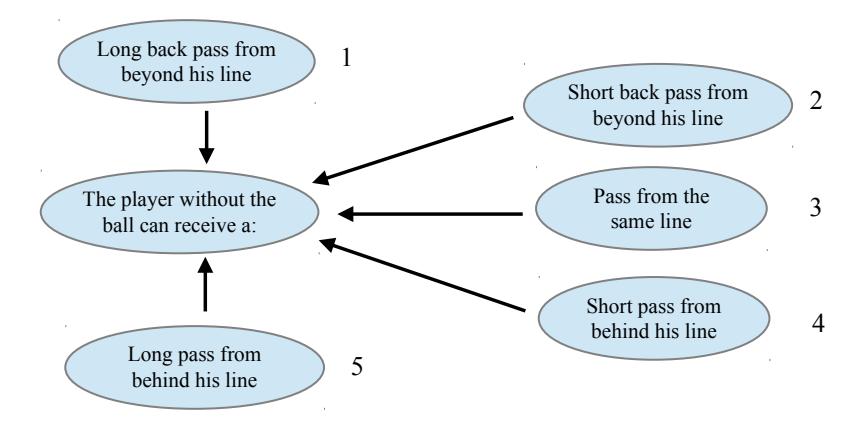
Statistical analysis has determined that 65% of goals are scored in dynamic play, while 35% are scored in, or following, dead ball situations. Analysis of goals which result from dynamic play shows that the fewer the number of passes, and the shorter the duration of the attack, the more likely the chances of scoring. Therefore, the offensive team should optimize its time on offense, taking advantage of its players' movements, and passing, receiving and shooting skills, to take actions in a quick and decisive way. This was our philosophy of playing soccer, from the very first beginning of our participating in soccer simulation league. On offense, the player with the ball can either kick it (pass it or shoot) or dribble it (also dribbling past an opponent), while his teammates are moving without the ball. The roles of the players without the ball are as follows in figure 1.
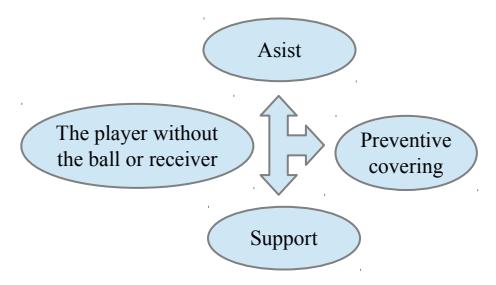
How to receive the ball
Passing the ball is fundamental to taking the ball towards the opponent's goal. Effective passing requires good timing between the player passing the ball and the teammate receiving it. The receiver should make himself available for the pass and get towards the point where he wants to receive the ball with good timing, thus carrying out a movement which makes it difficult for the defense to anticipate him.
With regard to the position of the ball in relation to the opposing goal, the receiver can find himself closer to the goal than the ball is. This may happen, for example, when the forward receives the ball from a midfielder. We say that in this situation the receiver is "over" the ball. When the ball is closer to the goal than the receiver is, we say that the receiver is "under" the ball.
With regard to the opponent's defender, we say the receiver gets the ball "under" when the defender is between the receiver and his own goal. The player gets the ball "over" the defender when the receiver is between the defender and the defender's goal.
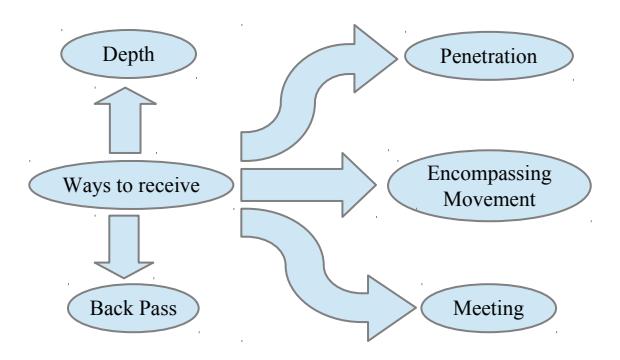
If the offensive player receives the ball:
- "Over" the opponent, and the ball is passed forward, this is referred to as "depth"
- "Over" the opponent, and the ball is passed backward, this is termed "penetration"
- "Under" the opponent, and the ball is passed forward, this is termed "meeting"
- "Under" the opponent, and the ball is passed backward, this is termed "back pass"
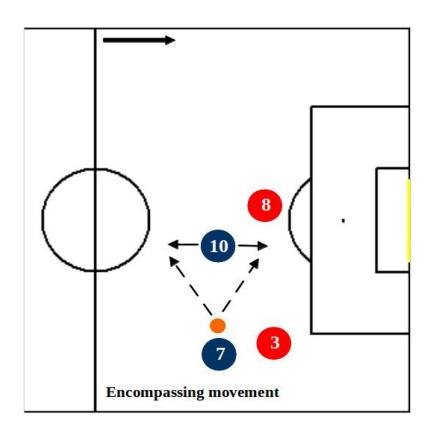
- "Under" the opponent, while passing the ball along the same line, this is termed "encompassing movement". (See figure 3, 4, 5, 6, 7).
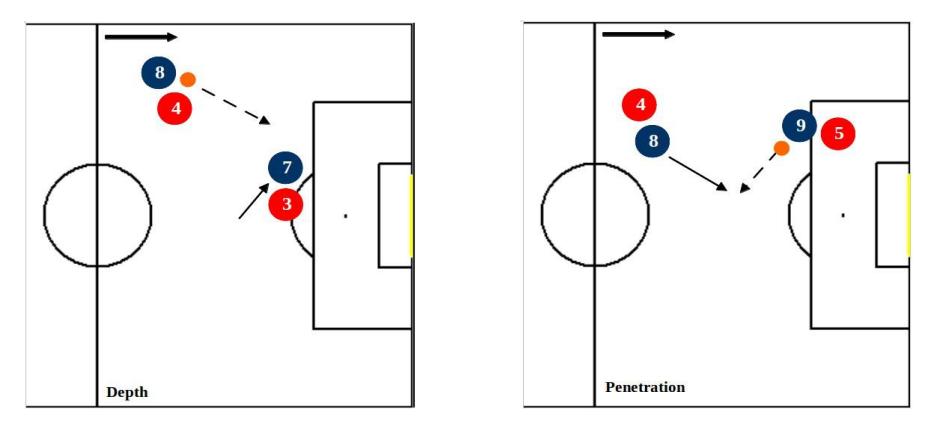
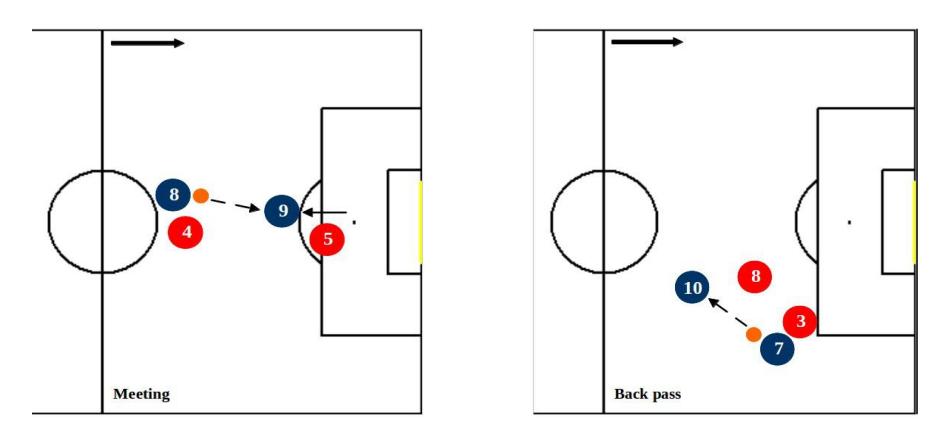
Movements of the player without the ball
Future work
For the next future, we want to continue the improvement of our attacking and to pay more attention to the offensive sub-phases. In this way we will analyze the action of the player who has the ball. If we want to enable each player who is in possession of the ball, to be extremely helpful to the whole team, we must do a specific analysis of his passes and dribbling, as well as of his tactical moves. There are some more elements in the offensive sub-phases, which request some special attention. Here we talk about the: "Movements after gaining possession of the ball", then we must "Building up play", here is very important our "Final touches", and of course at the end we must take good "Shooting". As the time available to the offensive player with the ball to pass, dribble or shoot, is getting shorter when we face up a good defending team, we will try to reconsider the tactical steps necessary to score goals, keeping in mind that individual skills, are enhanced by well-organized team play.
References
- Peter Stone Layered Learning in Multi-agent System [D]. Pittsburgh: school of computer science, Carnegie Mellon University, 1998.
- Jinyi Yao, Jiang Chen, Zengqi Sun. An application in RoboCup combining Q-learning with Adversarial Planning. Available in http://robocup.lits.tsinghua.edu.cn/download/document/tsinghuaeolus_kick.zip.
- M. Riedmiller and Artur Merke, " Using machine learning techniques in complex multiagent domains," In I. Stamatescu, W. Menzel, M. Richter and U. Ratsch, editors, Perspective son Adaptivity and Learning, LNCS, Springer, 2002.
- Itsuki Noda et al, Soccer Server Manual, RoboCup Federation. http://www.robocup.org.
- Y. Jinyi, C. Jiang, and S. Zengqi. An application in RoboCup combining Q-learning with Adversarial Planning. In the 4th World Congress on Intelligent Control and Automation (WCICA'02), Shanghai, China, June 2002.
- Peter Stone and David McAllester. An Architecture for Action Selection in Robotic Soccer. In Proceedings of the Fifth International Conference on Autonomous Agents, pages Pages: 316–323, 2001.
- Takashi Suzuki. Team YowAI Description. RoboCup 99: Robot Soccer World Cup III, 2000.
- Soccer Tactics. An analysis o attack and defense, by Lucchesi Massimo, originally printed in Italy – 1999 by Edizioni Nuova Prhomos Via O.Bettaccini.