RoboCup 2016 - 2D Soccer Simulation League Team Description Ri-one (Japan)
Kota Asai, Yuki Katsumata, Takuro Shibayama, Hiroki Nomura, Ryo Kondo, Hayato Tanaka, Koichi Uchinishi, Masataka Mizumoto, Tsubasa Fuzimitsu, Makoto Sei, Yuri Tani, Shiori Kubo, Yume Matsushita
Ritsumeikan University, Japan
Abstract In this paper, we will outline methods which we have incorporated in preparation for RoboCup 2D Soccer Simulation 2016. Our team last year adopted an evaluation function which determined the direction of a pass or dribble of the ball. In this year, we make the program for searching the suitable positions of forward players by using Neural Network, the program which enables agents to analyze opponent's tactics, and the program for searching the dribble course by using Rapidly-Exploring Random Trees for reinforcing our team.
1 Introduction
Ri-one is the project team which belongs to the Information Science and Engineering department at Ritsumeikan University. The organization has participated in the 2D Soccer Simulation League and Rescue Simulation League in previous years. Our members are working with agent 2D base (release 3.1.1) made by H.Akiyama [1]. In RoboCup 2006 in Bremen, our team finished in third place. In RoboCup Japan Open, we came third place in 2009 and then went on to win the championship in 2012 and 2015. This paper will include the following sections:
- Introduction
- Search for positioning the forward players by using Neural Network
- The system which agents analyze opponent's tactics
- Decision about dribble course by RRT
- Conclusion
- References
In this year, our purpose is to make the team which has more importance to offense than last year, for example to analyze opponent's tactics and search efficient positions and dribble courses. In this paper, we suggest the following three methods.
- The program for searching the suitable positions of forward players by using Neural Network
- The system which agents analyze opponent's tactics
- The program for searching dribble courses by using Rapidly-Exploring Random Trees
2 Search for positioning the forward players by using neural network
(Section container)
2.1 Examining methods
On current 2D soccer, through pass is one of the most important elements to get scores. Also the position of a receiver is important for through pass. However, the suitable position where forward players receive through pass has not been clear yet. Therefore, on this paper, we propose the method to learn the most suitable position where forward players receive the through pass by using Neural Network with past log data. Two types of Neural Network are used in this method. In the first Neural Network, the following two values are used for input when through passes happen.
- x-coordinates of ball
- y-coordinates of ball
Also, the following two values are received for output.
- x-coordinates of receiver
- y-coordinates of receiver
50 games were performed for the learning of this Neural Network.
In the second Neural Network, the six following values are used when pass happens.
- x-coordinates of ball
- y-coordinates of ball
- x-coordinates of receiver
- y-coordinates of receiver
- Distance between the receiver and a ball
- Distance between the receiver and the nearest opponent's agent
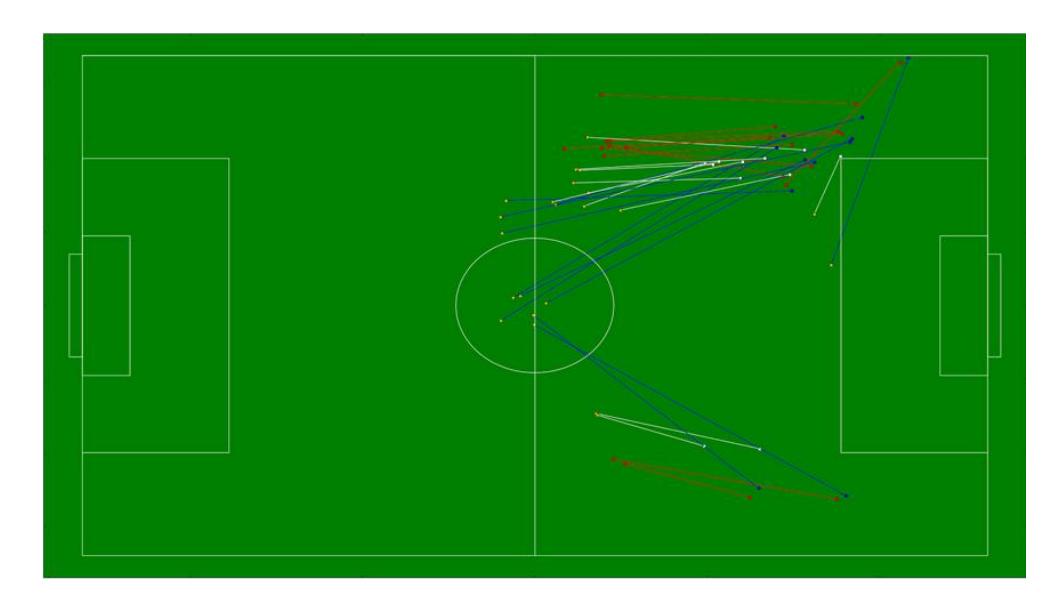
Furthermore, in case of through pass, we set 1 to output, and in case of the others, we set 0 to output. In addition, 5 games were performed for the learning of this Neural network. Through pass in one game are shown in the Fig. 1. with blue lines. Red lines and white lines in Fig. 1. show the movements of the receivers and the movements of the nearest opponent's agent.
2.2 Experimental procedure
In this experiment, the learning of Neural Network was performed with using game logs of HELIOS2015 and agent2d-3.1.1 because they made a lot of through passes. In this article, we decide to call the first Neural Network NN pos and the second Neural Network NN adjust. At first, the approximate position, where the forward players can receive a through pass, is predicted by using NN pos. Secondly, some candidate positions are generated around the predicted approximate-position. After that, the outputs are received based on the candidate position, where the agent receives the ball, by using NN adjust. Finally, we change destination to the point which has the highest value.
2.3 Result
In this experiment, we decided position of agent whose uniform number is 9 and 10 by our method and performed 100 games against four teams. Table 1 shows the number of through passes with using our Neural Network or not using it.
Table 1. experimental results
| vs Team name | Without the Neural Network | With the Neural Network |
|---|---|---|
| HELIOS base | 519 | 936 |
| Toyosu-Galaxy | 426 | 710 |
| HELIOS2015 | 73 | 69 |
| YuShan2015 | 455 | 485 |
We can confirm that the number of through passes increases when we use our method.
3 The system which agents analyze opponent's tactics
(Section container)
3.1 Examining methods
In soccer games, it is important to understand opponent's tactics and change our actions. So, we make the system which every agent analyzes opponent's tactics. In this paper, we classify opponent's type as quick type (main tactics is driblle) or slow type (main tactics is pass). First, we use the agents' feature which moves to chase the ball and opponent's agents. We make every agent remember how to move in the field. We use values of x-coordinate because we only want to classify opponent's attack speed. We add values of x-coordinate with error margins and calcurate the variance. If opponent attacks quickly with dribble, it means the variance becomes big. On the other hand, if opponent attacks slowly with many passes, it means the variance becomes small. Our supervised learning uses the difference of these variances and makes classfications. We make two types of classification method. One is to classify into nearer type from avarage of each training data. Another is to classify with probability and weight. First method is so correct in the close area from avarage range of quick or slow type. However in the middle area of two types, it makes more mistakes. Second method is great in the middle area of two types, but in the close area from avarage range of quick or slow type, it is worse than the first method. So, we decide to use both of then. We culcurate the avarage of all training data. After that, we use the second method in the fixed range near the avarage and the first method in the other range.
3.2 Result
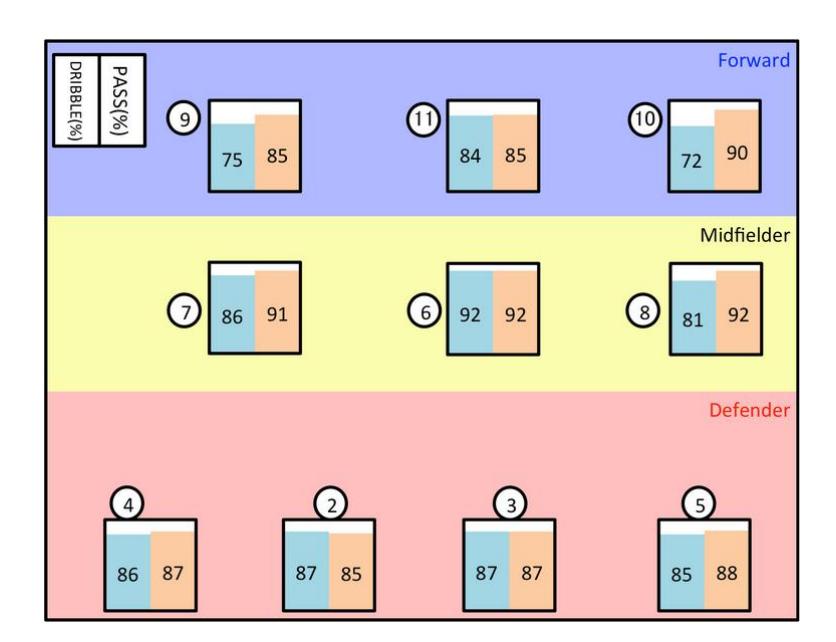
Fig. 2. shows experimental results. This picture shows our formation and probability of succeeding classification for each agent. Right graf is probabillity by using slow type team (main tactics is pass) for test data, and left grafis probabillity by using quick type team (main tactics is driblle).
4 Decision about dribble course by RRT
(Section container)
4.1 Examining methods
Our teams tactics have used many passes so far. However, our agents make too mush passes and cannot get goal efficiently. So in this year, we use RRT(Rapidly-Exploring Random Trees) algorithm to choose the suitable dribble course.
4.2 Experimental procedure
Our method consists of the following four steps.
First, we generate randomly 100 points at the field. At this time, the generated points are confined in the opponent's area to approach the goal. Also, the points are not generated within 3 radius from the opponent's agents.
Secondly, we choose the point which is closer to the opponent's goal and far from opponent's agents. To avoid opponent's agents, we draw a circle round them and a line between our agent and distination, and choose the destination which has no intersections by the circles and the line.
The agent sets a chose point as a target point and calculates the angle. The agent chooses the angle which has small difference between the direction, and dribbles to target point.
After arriving the target point, the agent chose the next target point. While our agents have the ball in the determinate area, the agent repeats the same method.
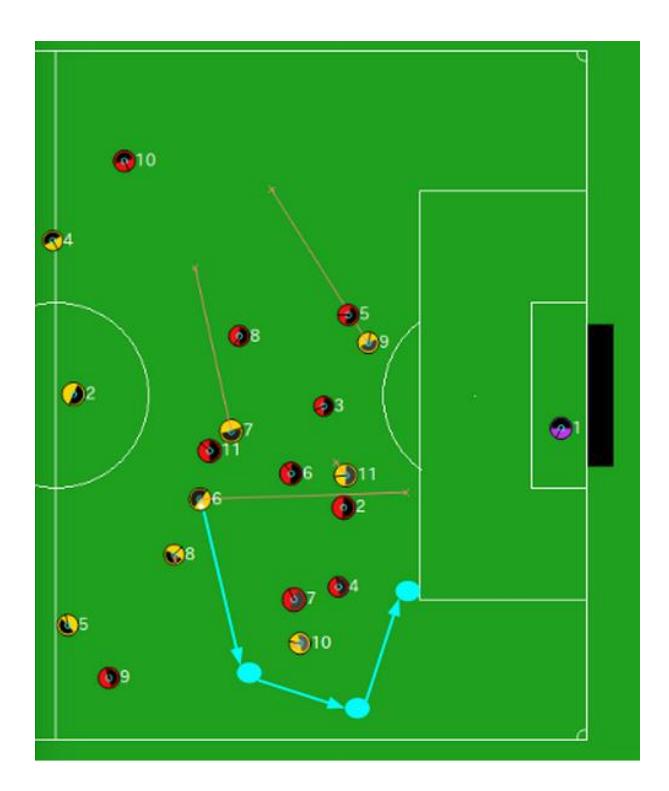
The Fig.3. shows the example of the dribble course chosen by this method.
4.3 Result
By using this method, our agents obviously come to attack opponent's goal with using more dribble and hold the ball in the opponent's side. Accordingly, the subject that our agents make more passes and do not attact efficiently in the opponent's side is solved.
5 Conclusion
Finally, we will write the consideration of this paper for each method. In the result of positioning search for foward with using Neural Network, the number of our through pass is increasing. It means we can make more chance to get scores. In the system which agents analyze opponent's tactics, we succeed to classify opponent's strategy. We will apply this method to defense action. In the program of searching dribble courses by Rapidly-Exploring Random Trees, we succeed to dribble efficiently. However, this present technique does not lead to get scores directly. So we think about conditions more when our agents choose a course in this technique, and adjust it from now on. To improve this method is going to cause our team to get more scores.
References
- Hidehisa Akiyama, Tomoharu Nakashima: HELIOS Base: An Open Source Package for the RoboCup Soccer 2D Simulation, Proc. of 2013 RoboCup Symposium, 8 pages (2014)
- Sakamoto, E., Nagata, C., Aoyagi, S.: Trajectory Generation for Collision Avoidance in Double-Arm Robot Using RRT (2015)
- Yosuke Narimoto, Tomoharu Nakashima: Pass Receiver Prediction using Neural Networks (2010)
- Hazime Mase, Junnichiro Kaji, Tomohiro Yasuda, Tomotsuka Takayama: Prediction of tsunami in Osaka Bay in real time using Neural Networks (2007)