CSU_Yunlu 2D Soccer Simulation Team Description Paper 2017
Jizhou Chen, Kai Yu Fu Jiang, Xiaoyong Zhang, Jun Peng
School of Information Science and Engineering, Central South University, Changsha, Hunan Province, China
Abstract CSU_Yunlu 2D soccer simulation team which has been participating in the RoboCup competition since 2002.In these past 15 years,CSU_Yunlu has got lots of achievements in this field and it was growing rapidly more than our expectations.In recent years, the 2D soccer simulation teams from all over the world have made rapid progress such as Gliders, Helios, Ri-one and so on.In this paper,we briefly describe the scientific focus of CSU_Yunlu,our current research efforts and the recent improvements since the last competition.
1 Introduction
In 2002, CSU_Yunlu was established by School of Information Science and Engineering of Central South University as a simulated soccer team for the RoboCup soccer 2Dsimulator.
The team has participated in many competitions and obtained a lot of exciting achievements since 2002 .In RoboCup China Open 2002,the first competition for the CSU_Yunlu, we ranked the 3rdplace. In the next few years , CSU_Yunlu admitted UVA_base_2003[1, 2] as the base code. Moreover, we used a dynamic role-based cooperation model and a decision algorithm based on the behavior of Multi-Agent System (MAS) in our team to enhance the cooperation.However,in the RoboCup China Open 2010, CSU_Yunlu got the 7thplace of 2D soccer simulation,which was beyond our expectations.Therefore, in the next year, we determined to change the base code from UVA_base_2003 to agent2d-3.1.0 source[2],a well-known base code developed byAkiyamaetal.
Because of our continuous efforts, CSU_Yunlu gained 2ndplace in the RoboCup China Open 2011, which was a big breakthrough for us. Later in the Robocup China Open 2012, we ranked 5thplace.In the next 2 years, CSU_Yunlu improved in many ways and made a series of achievements in the RoboCup China Open. In the RoboCup China Open 2014, our team worked hard and won the 5thplace in fierce competition, in the RoboCup China Open 2015, CSU_Yunlu defeated all the competitors except WrightEagle and ranked the 2nd place. In the RoboCup 2016 Soccer Simulation League, 2D competition we ranked the 4th place.
We sincerely hope that we can participate in the RoboCup 2017 Soccer Simulation League 2D competition in order to test and verify the development we made since the last competition and improve ourselves.
2 Direction of Improvement
(Section with subsections)
2.1 man-marking strategy
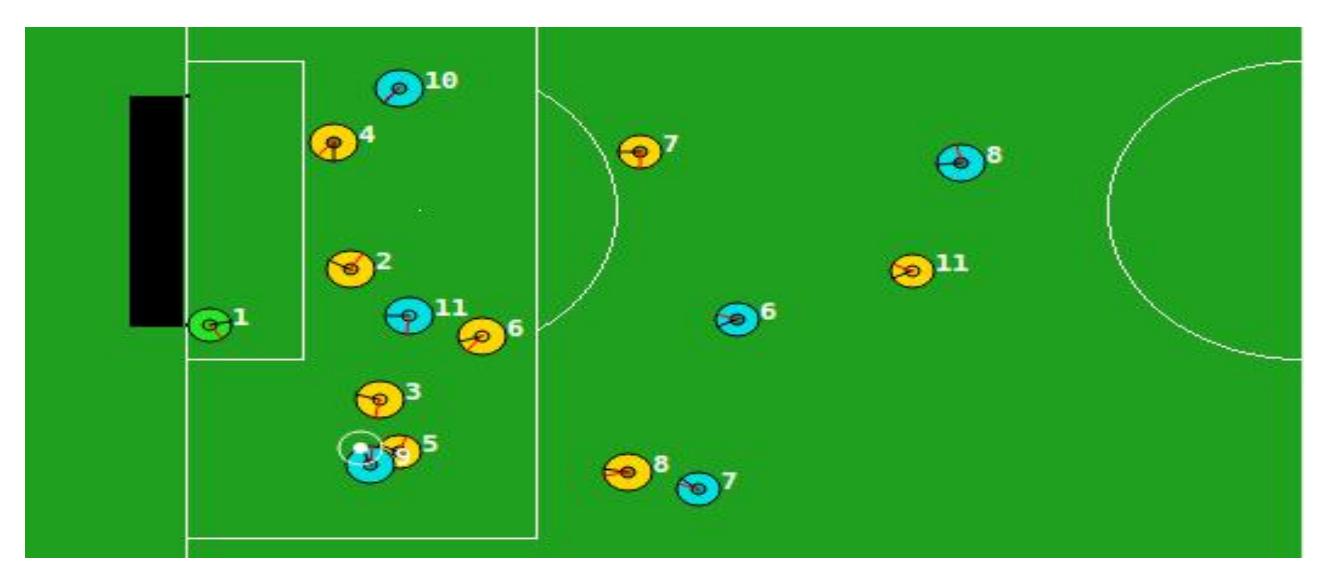
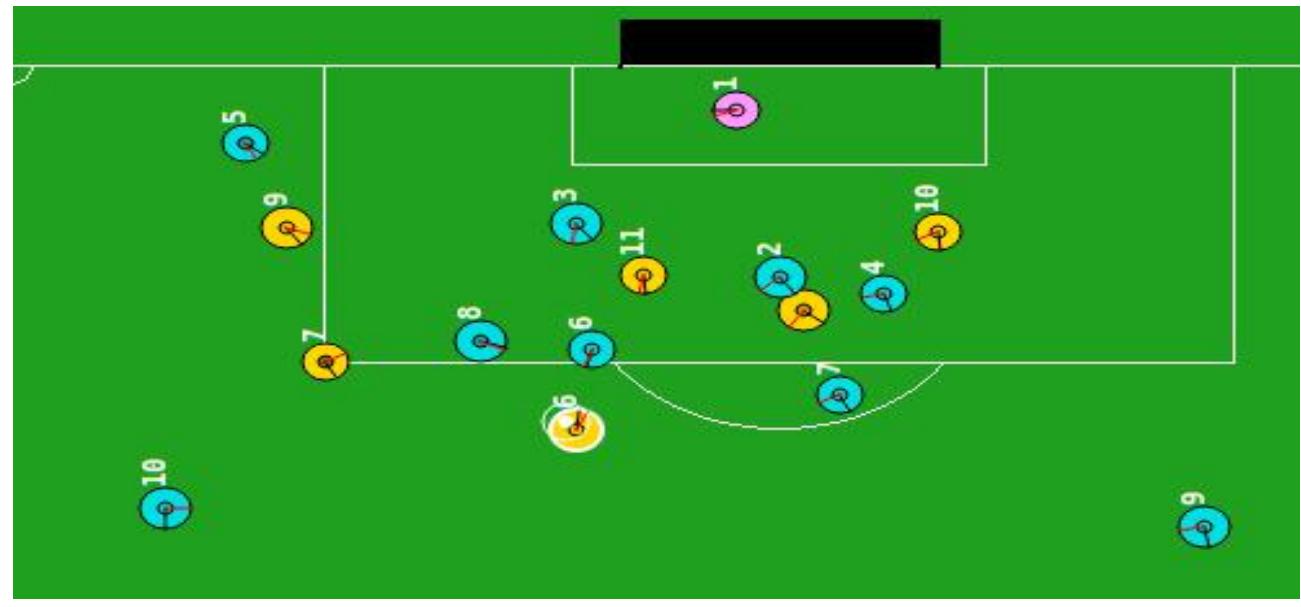
Man-marking is an effective way to strengthen the team's defensive intensity, but it will consume a lot of energy. We applied the man-marking strategy to different defensive situations. On the defensive side, we are the same as the last year, our goal is to control the center forward. When the opponents are trying to make a breakthrough from sidewalk and dribble to crossblock area, our players will follow their center forward closely so that opponents can't make cooperation(Fig 1). If opponents dribble to our restricted area, then all of defensive players will mark an attacker according to distance, and others will try to make a tackle(Fig2).
2.2 Offensive and defensive conversion
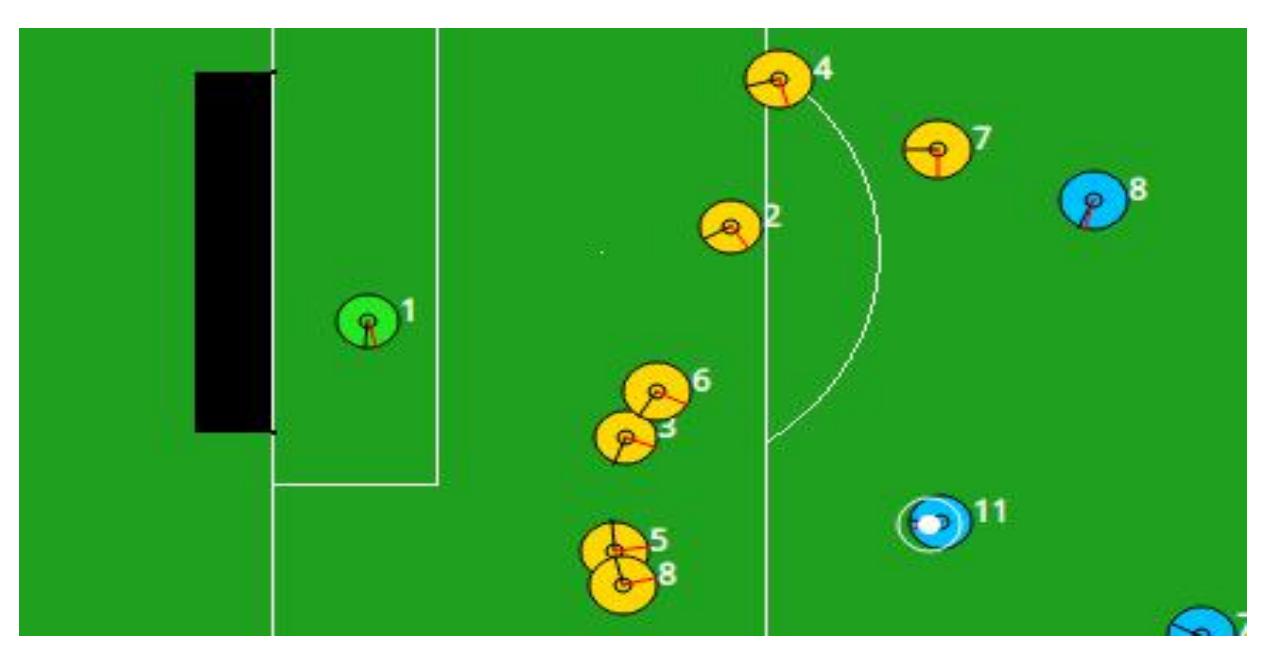
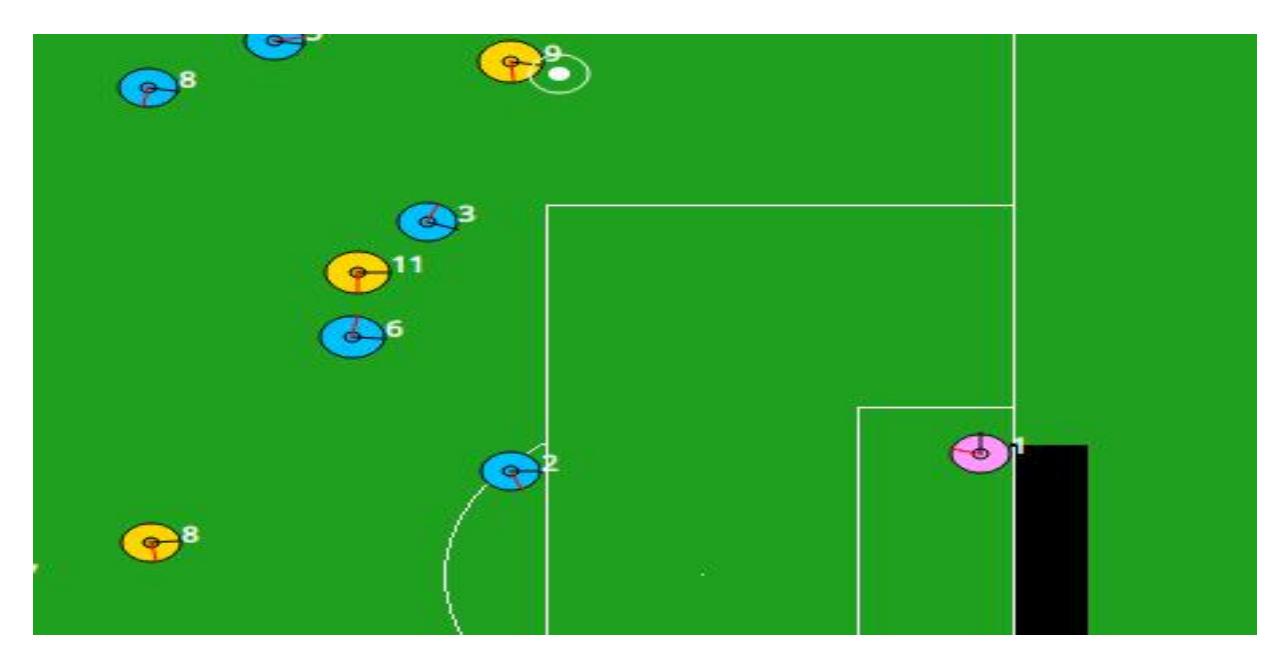
In recent years, we have found that the majority of the team has chosen to slow down the pace of the game, for effective defense. It is surely an effective defensive strategy. In this case it is very difficult to score (Fig3). Because when we attack, the number of our offensive players issignificantly less than the opponents. They can defend us easily. So we aim to break the defense when the defensive formation has not yet formed. And it will happen when the opponent attack failed(Fig4). And then, it's easier to score in this situation.
3 Conclusion and future work
In recent years, all teams have strengthened the defense strategy. We think the player's personal ability has reached a high level, the player's ability between teams is not very different. So, this year, we focus on the improved strategy, especially the offensive strategy, after all the efforts of members of our team, our offensive efficiency has been greatly improved. We hope to show our effort through the RoboCup 2017 Soccer Simulation League 2D competition. Our team ,this year, really want to add running with coordination to the scheme, offence with coordination in particular. It is bound to be the powerful tools for a wonderful score. And, to a certain extent, we have implemented this in the code. Surely, another orientation of focused research is the communication module. It is necessary to accomplish the whole team's tacit cooperation. For example, we should think highly of the problem that how to perform excellently and efficiently in the communication and signal processing between players.
Last year, we ranked the 4th place in the RoboCup 2016 Soccer Simulation League 2D competition. It can prove our team is a strong contingent. In this paper, we have briefly presented our current work to CSU_Yunlu. Although we have made great effort, the team still has plenty of room to develop. In the next period, we will focus on the reinforcement learning method and the intelligent cooperative strategy.
References
- Kok, J.R., Vlassis, N., Groen, F.: UvA Trilearn 2003 team description. In Polani,D., Browning, B., Bonarini, A., Yoshida, K., eds.: Proceedings CD RoboCup 2003, Padua, Italy, Springer-Verlag (July 2003)
- http://www.science.uva.nl/~jellekok/robocup/2003/
- Akiyama, H.: Agent2D Base Code.http://www.rctools.sourceforge.jp.2015
- Peng, J., Wu, M ., Cao, W.: Some Key Techniques in RoboCup Simulation League [J].Computer Engineering, 2004, 30(4): 49-51
- Peng, J., Wu, M .: Multi-agent Cooperation Model Based on Action Prediction [J]. Computer Engineering and Applications, 2005, 41(9): 23-25
- Zhang, X., Peng, J.: Realization of Pass Ball Strategy in RoboCup [J]. Computer Engineering, 2004, 30(23): 123, 149
- Li, S., Chen, J., Sun, Z.: Structural design and implementation of Tsinghua Robot Soccer Team [J]. J Tsinghua Univ (Sci & Tech), 2001, 41(7): 94-98
- Yun,J., Zhang, X., Wei, X., Wang, C.: Key tactics of intercepting the ball, possessing or dribbling the ball and running in RoboCup [J]. Journal of Inner M ongolia University of Science and Technology, 2009, 28(2):136-142
- Peng, J., Ding, C.: Realization of formation strategy in RoboCup. In: The 2006 International Conference on Artificial Intelligence, 2006/6/26.
- Akiyama, H., Shimora, H.: HELIO S2010 Team Description. In: RoboCup 2010: Robot Soccer World Cup XIV. Volume 6556 of Lecture Notes in Computer Science,Springer(2011).
- Huang,T., Yin,J., Jiang, F., Zhang,X., Peng,J.: CSU_Yunlu 2D Soccer Simulation Team Description Paper 2015.