RCMasterZ Team Description Paper RoboCup2017
Mohsen Sadeghipour, MohammadAli Kamkar, Azin Ghasemi, Kamyar Kalajooyeranjbar, Khashayar Kalajooyeranjbar, Mohammad Chaposhloo, Mohsen Firoozbakht
Department of Computer Engineering, Islamic Azad University, South Tehran Branch, Tehran, Iran; Department of Computer Engineering, Islamic Azad University, Science and Research, Tehran, Iran; Shahid Beheshti University, Tehran, Iran
http://en.osdn.jp/projects/rctools/releases/p4887
Abstract RCMasterZ Soccer Simulation 2D team was established in 2017 by merging Ziziphus and RCMasters teams. In our team, Concentric Circle Model (CCM) forms the basis for the modeling the playground around agents in a multi agent systems. Implementation of CCM, with regards to decision making and statistical dispersion in Decision History Table's (DHT) record is rather challenging. To overcome this challenges, we have developed a method in which decision making is integrated into CCM. In this method, each Victory Region represents a victory for one particular skill. We have further enhanced DHT by changing our attitude from the skill-based to mode-based strategy along with the dynamic triangulation based on game-mode. By these improvements, we have overcome hurdles like long execution time and missing values in DHT's record.
1 Introduction
RCMasterZ Soccer Simulation 2D team was established in 2017 by merging RCMasters and Ziziphus teams in Islamic Azad University, Science and Research Branch, Tehran, Iran. Since 2009, Both Ziziphus and RCMasters teams have been participating in several national competitions, namely Kharazmi National Award, IranOpen, Sharif-Cup, RoboLand, and PNUOpen in Iran. Moreover, Ziziphus team participated in two international competitions, RoboCup 2015, China [1] and RoboCup 2016, Germany [2]. This year, however, we have merged these two teams, Ziziphus and RCMasters and established RCMasterZ. The primary goal of our team is to refurbish and improve the Agent2D-3.1.1 [3].
In previous years, for the implementation of Concentric Circle Model (CCM), we have faced several challenges including decision making and statistical dispersion in Decision History Table's (DHT) records. We were considering each skill separately which would needed a decision making algorithm apart from CCM. In this situation, we would had two choices, either to create a CCM for each skill and then choose the best skill to act, or choose a skill and create the corresponding CCM. If the results was not satisfactory, we had to choose another skill. In the former situation, although DHT had a complete data on its records, the execution time was long. In the latter case, however, the execution time was reduced relatively in the expense of having too many missing values on DHT's records. In the current method, we have refurbished our previous method for opponent's gameplay learning in multi agent system through simplifying our former decision making method. Here, we have integrated decision making into CCM. Detailed development of the method is described in section 2.
On the other hand, we were using Agent2D Normal-Formation triangulation for dividing the playground into triangles and investigating CCMs based on the triangle, where an agent was located. We were also dividing the playground into static triangles for every game-mode. This approach resulted in increasing missing values for some gamemodes. We hence enhanced DHT to minimize the missing values by using the dynamic triangulation based on game-mode, which is described in section 3.
2 Integration of Decision Making into CCM
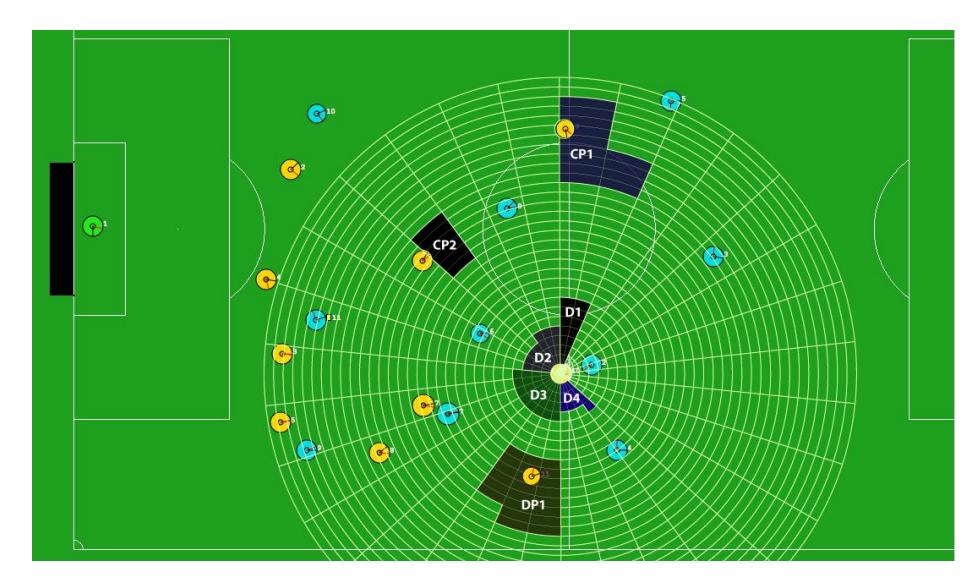
To integrate Decision Making into CCM, we have created CCMs for each game-modes (Offence, Defense, Corner-Kick, Free-Kick) instead of processing CCMs for each skills [2]. In this new method, each Victory Region represents a victory for a specific skill that is processed within the integrated CCM.
To offend, we created an unique CCM and filled its sectors by question: "If I kick the ball can I or my teammates intercept the ball?". If the answer to this question is true, a pointer to the player who can intercept the ball returns, otherwise, a null pointer returns. For defense, the method is the same as offence, except that CCM's sectors are filled by question: "If the opponent kick the ball can I or my teammates intercept the ball?".
Consequently, the new Victory Regions is the summation of the sectors which have the same pointer value and are in the vicinity of each other. Hence, all the victory regions within a CCM do not represent an unique skill anymore, rather each of them corresponds to an unique skill.
This approach reduces the overhead of CCM creation as well as missing values by changing our attitude from skill-based to mode-based strategy.
In the Integrated CCM, we have considered that a height of each level is equal to agent's kickable-margin, therefore we can use level zero to play with ball in the agent's kickable area. As depicted in figure 1, we have modeled the playground around agents using CCM in the specific cycle and located three different Victory Regions ((D1-4), (CP1- 2), and DP1) which each represents a specific skill. D1-4, are the areas where the agent (in this case the agent number 10 located in the center of CCM) can dribble (quick/ordinary dribble), whereas areas marked with DP are suitable for the direct pass and the ones marked with the CPs are desirable for cross pass.
3 Enhanced DHT
DHT is a table to store an agent's experience based on its situation and decision and then use it for future situations. It is used to learn opponent's game-play and to predict its actions. To enhance DHT, we made two changes in its structure as it follows:
- CCM changes to integrated CCM as it is described in section 2.
- Normal formation triangulation replaces with specific and dynamic triangulation as well as the running formation for each game-modes.
The advantage of this approach is to categorize the decision history based on sensitivity of each game-mode. i.e. the triangles can be adjusted when more precision is needed. For instance, in Non-Play-on modes, when we need less precision, triangles are rather larger than Play-on modes.
4 Conclusion and Future Work
In summary, we have improved our last year method in learning opponents behavior by changing our attitude from skill-based to mode-based strategy. This is necessary because the previous method required more time for calculations. Furthermore, the approach has overcome the problem of data mining on DHT's record.
Considering these improvements, we are closer than ever to our goal; developing an ability for the agent to imagine oneself in other agent's situation and plan the decisions with multiple steps.
References
[1] M. Sadeghipour, A. Ghasemi and M. Firoozbakht, "Ziziphus Temp Description Paper," 2015. [2] M. Sadeghipour, A. Ghasemi, M. Chaposhloo and M. Firouzbakht, Ziziphus Temp Description Paper, Leipzig: The 19th annual RoboCup International Symposium, 2016. [3] H. Akiyama, "Agent2D Soccer Simulation 2D Base Source code and Documentation," [Online]. Available: http://en.osdn.jp/projects/rctools/releases/p4887.