Team HillStone2018 in the 2DSimulation League Team Description Paper
Tadashi Sugino, Taiga Ito, Yuki Arimura, Norifumi Watanabe, Takashi Omori
Tamagawa University; Advanced Institute of Industrial Technology
Abstract Team HillStone has taken part in 2D simulation league of RoboCup Japan Open Competition from 2009 in Osaka. We adopted a defensive strategy of allocating player to a ball position, and use ILP algorithm for an effective tactics searching. We discuss a possibility of the strategy and evaluation in our simulation. In the future, we will develop an attack flow from back-pass and keeper.
1 Team History
Team HillStone is consisted of joint effort by two Japanese research groups:
Tamagawa University (TU): a group from the faculty of engineering at TU has joined RoboCup Japan Competitions since 2009. They got the best result (third rank) at RoboCup Japan Competition 2014 in Fukuoka. Members from TU are interested in a compliant human-machine interaction architecture based on human intention estimation by robots. This research is motivated by a desire to minimize the need for classical direct human machine interface and communication. The student members are all undergraduate, and receive professional guidance by Prof. Omori of TU.
We participated in the world convention for the first time in 2016.
2.1.1 Development result in Tamagawa University
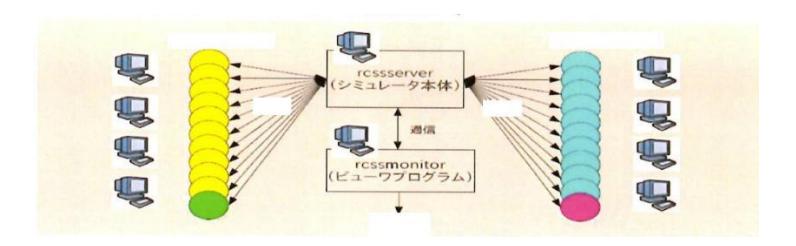
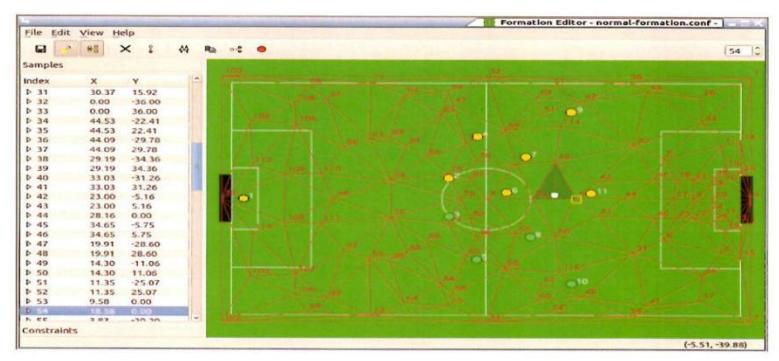
Figure 1 shows a system configuration of soccer simulator. TU students were not familiar with the simulator and its programming, we began to learn about the system. Currently, we are implementing a defensive formation and developing a one-two pass behavior. We are using the fedit version 2-0.0.0 for the defensive formation development, and are creating an allocation of players for the fedit2. A sample of created allocation is shown in Figure.2.
Our strategy of defensive formation is to locate a player at a ball position where an opponent player must be there. By doing so, at least one player can press and defense to the opponent to prevent making effective pass or shoot.
But, the drawback also exists. A large stamina consumption occurs because the defense player has to run quickly toward the ball position when an opponent team player come into the defense zone. The other is a higher risk of foul because the running action is almost same as a tackling action. To avoid these drawbacks, as a future challenge, we must create a chain of cooperative actions program for the defenders before we join RoboCup World Championship. The program works as follows. In a case of opponent player carrying a ball into the defense zone, we plan our defenders come and enclose the ball holder from multiple direction to block all effective pass courses.
2.1.2 Development result in Advanced Institute of Industrial Technology
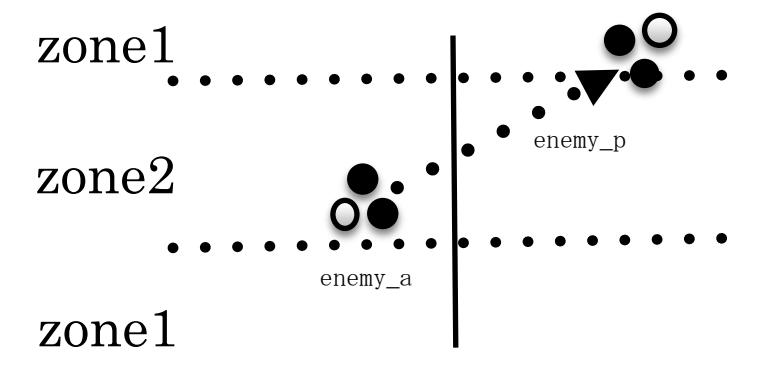
Effective strategic patterns in RoboCup2D simulation are extracted using the inductive logic programming system Aleph. Due to the dynamic changes of the offensive and defensive behaviors, strategic pattern extraction in real soccer is difficult. Therefore, a behavioral model is constructed using J-league soccer player data based on the analysis of behaviors in scenes of mutual intention inference, and implemented the model to the RoboCup2D agents. Then, we extracted effective strategic patterns from log data of the soccer simulation with Aleph and verify the validity of the patterns comparing to the previous studies. Figure 3 shows an extraction result using the Aleph. As a result, a side-pass from the center area could be effective. [2016]
We will make a new definition of the Aleph and try it for future developments.
2.2.1 Attacking Flow from Keeper
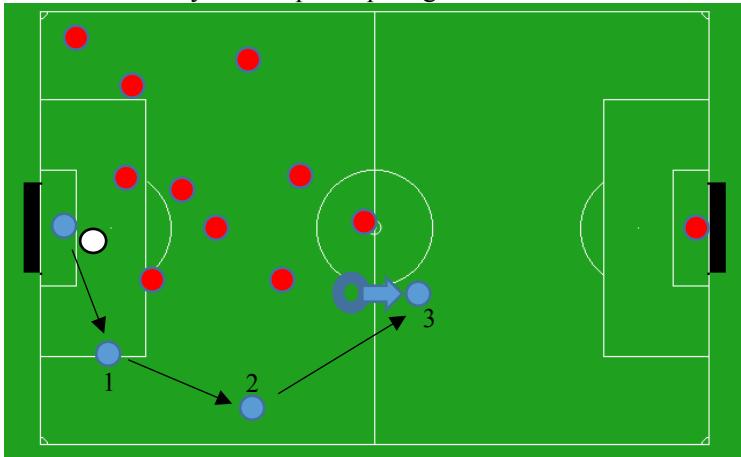
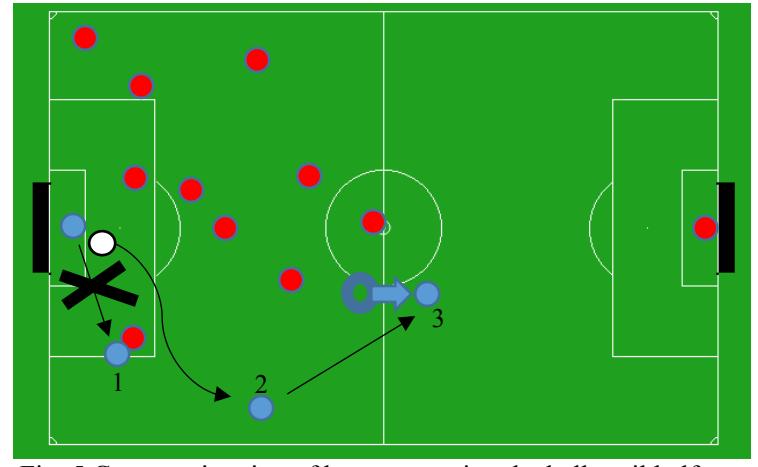
It has the impression that the keeper of agent 2d is positioned just before the goal except when opponent team attacks in. At best, it is about positioning during the game. In a real soccer game, the keeper instructs defense players and keeps the goal and so on. We would like the keeper agent to play even when opponent team is not being attacked. Since we belong to cognitive architecture laboratory in Tamagawa university, we would like to model and build soccer agents from human behavior. Font mismatch (the font style should be changed to default). A keeper agent of agent2D takes the ball from opponent agents and restarts the action. In this time, keeper's restart movement is very slow. The statement is completely wrong. In Figure 1, blue circle is our team player, red circle the opponent player, and white circle the ball. Here, we assume agent2d as the opponent team. Since agent2d has a lot of attacks from the side, if the keeper has a ball, it will make a quick restart from the opposite side and turn the ball mainly with the vertical pass in order of the players 1, 2, 3. And our team attacks the opponent team by these continual attacks.
In addition, many teams consider that they will pass outside as they are selecting paths by looking at the opponent's position. Therefore it is considered that there are many attacks from the side. For example, player 3 crosses the half line when player 2 passes (Fig.4). Their players are shown in Figure 4 only for the players who are the starting points of the keeper and counter. The reason is that other teammates are not shown because they are not participating in the counter.
Also, at the time of restart, if the keeper cannot search pass-receiving players, the keeper carries the ball and passes after the opponent's pressing. This is shown in Figure 5.
2.2.2 Our main focus is development of path on the front line.
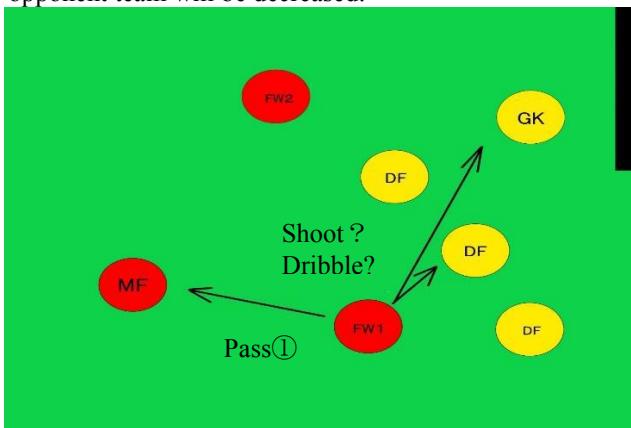
Our team HillStone only performs forwarding pass. In real soccer scene it is important to perform forwarding pass. However, if the passing only be forward, opponent team will cut the ball. When players gather in front of the goal, the players behind gathering players often can move freely. By passing to free players without selecting a pass on a narrow course in front of the goal, the opportunity of ball interception by opponent team will be decreased.
In the case of Fig. 6, opponent DF players are gathering around FW1 player of ball holder. At this time FW1 cannot shoot or dribble because there is no playing course.In that case, FW1 selects pass①to MF who is behind FW1 and not marked by opponent players.The condition that FW1 makes a back pass is the case where it is not possible to shoot surrounded by opponent players and where FW1 position is near team players. FW1 looks for a shoot course from the number of surrounding opponents and the angle with the goal. If team agent judged that there is no shoot course or cannot shoot, the agent will pass other teammate. In that time, FW1 passes a teammate who is near the ball holder and no opponents in the surroundings.
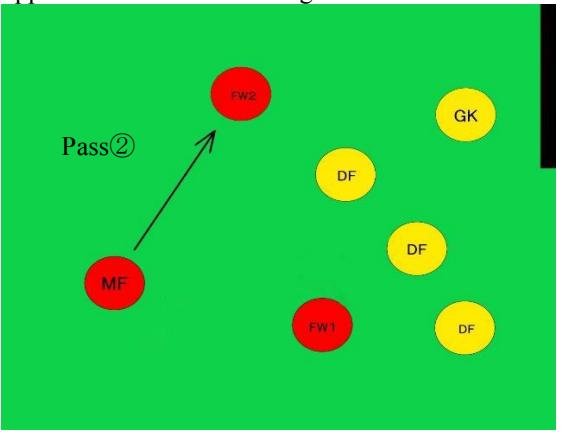
In addition, MF selects pass②to FW2, and FW2 can shoot freely(Fig. 7). MF first receives a pass from FW1. Next, MF selects a path to FW2 where there is no opponents in the surroundings. After receiving a pass, FW2 looks for a shoot course from the angle with the surrounding opponents and goals. In the case of Fig.7, if there is a shoot course, FW2 shoots after receiving a pass from MF. However, if there is no shoot course, FW2 passes teammate in a similar FW1 playing.
References
- Togoro Matsui: A Study on the action learning of the autonomous agent, Nagoya Institute of Technology, doctoral thesis, [2004] http://nous.web.nitech.ac.jp/thesis/thesis03\_Matsui\_Tohgoroh.pdf
- Koichi Furukawa, Tomonobu Ozaki, Ken Ueno: Inductive logic programming, Kyoritsu Shuppan, [2001] (In Japanese)
- Stephen Muggleton : Inverse entailment and progol. New Generation Computing, Vol. 13, No.3-4, pp. 245 286, [1995].
- Hidehisa Akiyama : RoboCup soccer simulation 2D league victory guide. [2006] https://osdn.jp/projects/rctools/
- Hidehisa Akiyama : RoboCup soccer 2D simulation workshops @ fall camp 2011.pdf [2011]
- Hidehisa Akiyama : Online tactical planning by the action chain search.pdf[2012]
- Yuki Hagimoto, Norifumi Watanabe, Chiaki Kubomura, Hiroyuki Kamera: Reasoning of Effective Attack Patterns and Evaluation Using the ILP in RoboCup Soccer Simulation 2D, Machine Learning Summer School 2015 poster presentation. [2015]
- Yuki Arimura, Kota Itoda, Norifumi Watanabe, Takashi Omori : Reasoning of Effective Attack Patterns and Evaluation Using the ILP system Aleph in RoboCup Soccer Simulation 2D, Knowledge Base System Study Group [2016]