YuShan Team Description Paper for RoboCup2019
Zekai Cheng, Ningyu Xie, Feng Zhang, Bolun Guang, Qin Zhang, Chen Sun, Xuecheng Wang, Liting Wang
Department of Computer Science, AnHui University of Technology, MaAnShan, P.R.China
http://www.rctools.sourceforge.jp.2015
Abstract
Introduction
YuShan Soccer 2D Simulation Team was established in 2009, affiliated with AnHui University of Technology in China. Having participated in RoboCup five times since 2012, YuShan team ranked 6 th in the RoboCup2018 in Montreal, Canada and won three consecutive championships in RoboCup China Open Tournaments from 2016 to 2018. The development of YuShan2019 is based on the reconstruction project of Agent2D-Base in version 3.1.0[1]. The server version is 15.3.0.
Team's Overall Framework and Action Chain Optimization
The overall framework of YuShan2019 follows its excellent fine tradition, namely, DoKick or DoMove strategy is largely taken into consideration, which is determined by the holding-ball states of players. Given the comparison in both cases, the DoKick strategy optimizes the action chain model while the DoMove strategy advantages the players' movement model. YuShan2018 utilizes the inference and execution model of action chain in Agent2D while YuShan2019 further subdivides the Dribble action so that it initially realizes the optimization of multi-layer action chain and the chain's evaluation function.
The action chain model adopted by YuShan2018 contains two layers. The first layer is the pass or dribble action, and the second layer is the shoot action. YuShan2019 attempts and manages to implement a more stable multi-layer action chain based on the relevant principles in TDP of HELIOS2012, and to optimize the state-space search by means of the addition of direct pass, short dribble and other actions between the two layers[2]. At the same time, YuShan2019 optimizes the evaluation function to strengthen the ball-control ability of forward strikers and midfielders. Fast advancement of Pass action contrasts with its poorest ability, and stability of Dribble action with its slowness. Therefore, the optimization of the evaluation system and integration of various situations on the field conducted by YuShan2019 finally contribute to reasonable preference for either action.
The Digital Twin Model and its Application
YuShan team has been implementing secondary development and optimization based on the underlying open source. However, the underlying state space of Agent2D is extremely large. Obviously, it is difficult to optimize and develop. YuShan makes use of data mining to find some interesting and valuable models to guide the team's research and development.
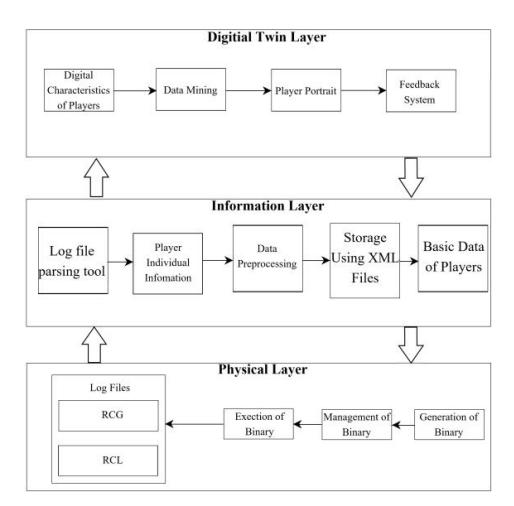
With the rise and development of big data, Digital Twin and other technologies, YuShan2019sums up the related work in recent years and proposes to build a portrait of the player for the simulated 2D team with the Digital Twin model framework, therefore, the Digital Twin model is established to guide the team's research and development by feeding back differences between portraits. The model is divided into three layers: physical layer, information layer and Digital Twin layer, as shown in Fig.1.
Shooting Strategy Analysis and Optimization by Shoot Data
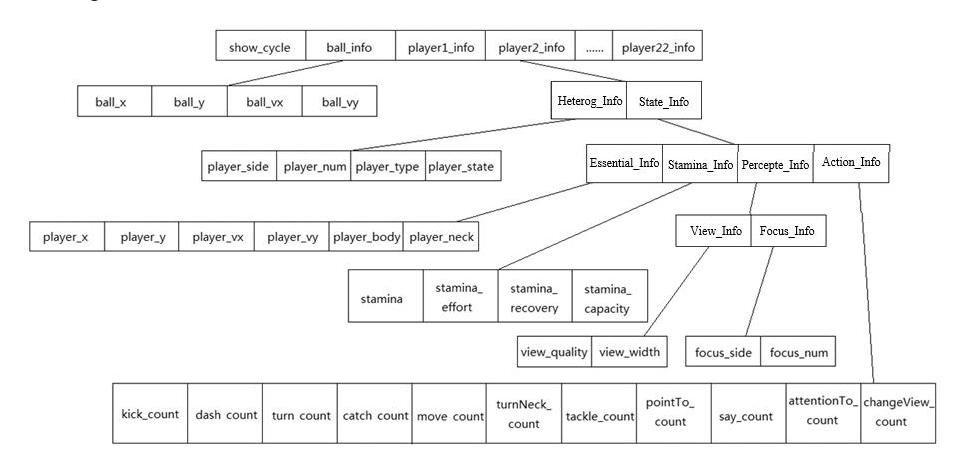
Shooting strategy is one of the key techniques[3]. YuShan extracted there lated shoot data from the log files, mainly including the information of the shooting point coordinates, the shooting speed, the shooting process period, the shooting angle, the shooting error and the goal y-axis coordinate. Based on this, the exploratory analysis is carried out. YuShan2019 builds a portrait of the player and analyzes the player portrait in the Digital Twin framework. Including the following:
This point is the intrinsic connection of various factors of the shoot data. The data of the team's Binary goals in recent years are selected for analysis, as shown in Table 1. As can be seen from the Table 1, the shooting distance is the primary factor.
Analysis of the connection factors of different factors in different teams' shooting. These teams include Cyrus[4], Cyrus2018[5], Gliders2016[6], Helios2017[7], Helios2018[8], MT2018[9] and HfutEngine2017[10].
| Cyrus | Cyrus2018 | Gliders2016 | Helios2017 | Helios2018 | MT2018 | HfutEngine2017 | |
|---|---|---|---|---|---|---|---|
| Dist | 0.988 | 0.965 | 0.952 | 0.943 | 0.952 | 0.868 | 0.951 |
| Cycle | 0.986 | 0.956 | 0.946 | 0.888 | 0.824 | 0.916 | 0.864 |
| Point | 0.491 | 0.745 | 0.829 | 0.337 | 0.541 | 0.515 | 0.673 |
| InitialVel | 0.622 | 0.829 | 0.802 | 0.693 | 0.648 | 0.643 | 0.547 |
| Angle | 0.004 | 0.175 | 0.865 | 0.817 | 0.600 | 0.446 | 0.800 |
YuShan2019 continues to analyze the distribution of the shooting distance of each team according to the region. YuShan2019 uses it as the guiding direction for the optimization of the moving model of the front line players. It shows that the effect is remarkable. According to the cluster center point and frequency, the portrait of the player's forward movement is established, which clearly represents the penetration point of the opposite attack and the loophole of our defense. Furthermore, it is the feedback that acts on the physical layer and directs the underlying Binary optimization.
The Determination of Offensive and Defensive State
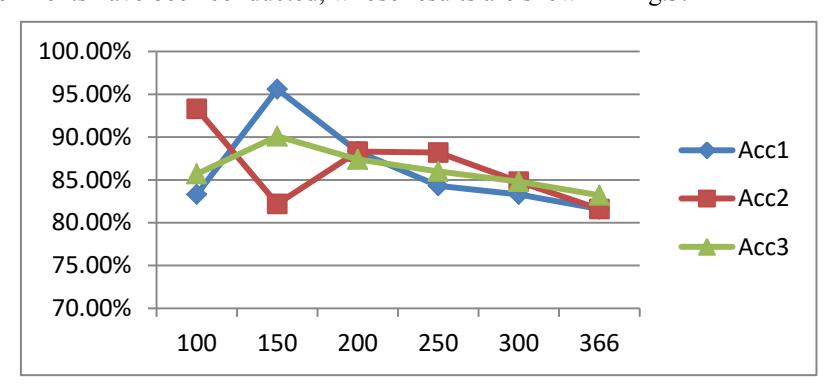
The formation strategy is one of the important research directions. The Agent2D-base however judges the offensive or defensive state only from the interception cycle[11]. The tremendous differentiation between an offensive formation and a defensive one, also among players' standard points frustrates DoMove efficiency, which thus significantly pushes one to accurately judge the offensive and defensive states of a team. In terms of YuShan2019, first of all, portraits of players' offensive and defensive states are drawn[12]. Secondly, some characteristics of the information concerning the interception cycle, ball, offensive and defensive line position, players of both teams in a certain area are selected. Thirdly, relevant data are extracted from the game log files and labeled before pre-processing by discretization. Finally, the discrete Naive Bayes classifier is implemented by Python for predictive analysis. The experimental results take accuracy rate as the evaluation standard, and three groups of experiments have been conducted, whose results are shown in Fig.3.
Conclusion and Prospect
YuShan2019 proposes the digital twin module, and draws different portraits of different players, by which the underlying Binary's optimization is guided and enhanced. This paper analyzes and evaluates the portraits of players such as shooting formations in detail. YuShan will further introduce Big Data analysis technology to enrich the player portraits. Finally, we would like to thank especially Hidehisa Akiyama and Oliver Obst for their selfless dedication to the 2D Alliance over the years. Particularly, we are grateful to Gliders Mikhail Prokopenko who supporting the open source that further promote the development of the RoboCup2D Simulation.
References
- Akiyama, H.: Agent2D Base Code. http://www.rctools.sourceforge.jp.2015
- H.Akiyama, H.Shimora, T.Nakashima, Y.Narimoto, K.Yamashita, HELIOS2012 Team Description Paper, The 16th annual RoboCup International Symposium, Mexico, 2012.
- ZeKai-Cheng,ZhaoLong-Ling,GenShen-Zhang,WenWen-Jin, TanQi-Yu, LiQin-Zhu, TingLi-Wang, YuShan2015 Team Description Paper for RoboCup2015, The 19th annual RoboCup International Symposium, China, 2015.
- R.Khayami, N.Zare, M.Karimi, P.Mahor, A.Afshar, MS.Najafi, M.Asadi, F.Tekrar, E.Asali, A.Keshavarzi, CYRUS 2D simulation team description paper 2014, The 18th annual RoboCup International Symposium, Brazil, 2014.
- N.Zare, M.Sadeghipour, A.Keshavarzi, M.Sarvmaili, A.Nikanjam, R.Aghyari, A.Firouzkoohi, M.Abolnejad, S.Elahimanesh, A.Akhgari, Cyrus 2D Simulation Team Description Paper 2018, The 22th annual RoboCup International Symposium, Canada, 2018.
- M.Prokopenko, P.Wang, O.Obst, V.Jauregui, Gliders2016: Integrating multi-agent approaches to tactical diversity, The 20th annual RoboCup International Symposium, Germany, 2016.
- H.Akiyama, T.Nakashima, S.Tanaka, T.Fukushima, HELIOS2017 Team Description Paper, The 21th annual RoboCup International Symposium, Japan, 2017.
- T.Nakashima, H.Akiyama, Y.Suzuki, A.Ohori, T.Fukushima, HELIOS2018 Team Description Paper, The 22th annual RoboCup International Symposium, Canada, 2018.
- Z.Yang, Z.Liu, X.Wang, N.Dong, X.Hu, JingLi, S.Chen, G.Lv, MT2018: Team Description Paper, The 22th annual RoboCup International Symposium, Canada, 2018.
- S.Wei, J.Ma, K.Zhan, H.Lv, Z.Ling, H.Wang, B.Fang, HfutEngine2017 Simulation2D Team Description Paper, The 21th annual RoboCup International Symposium, Japan, 2017.
- BingChen, et, al. Analysis and optimization of agent 2D underlying action chain mechanism in Robocup2D project [J]. Journal of System Simulation, 2017, 29(11): 2782-2787.
- BingChen, et, al. Mining and Verification of Attack Behavior in Robocup2D Simulation Countermeasure [J]. Journal of System Simulation, 2018, 30(12).