Jyo_sen2021 (Japan) 2D Soccer Simulation League Team Description Paper
Minoru Mochizuki, Takashi Kataoka, Riku Ueda, Ryoya Tatenuma, Ken Sugihara, Masayoshi Nakamura
Akihabara Programming School, Japan
https://ja.wikipedia.org/wiki/%E9%99%A3%E5%BD%A2 · https://github.com/kumitatepazuru/cszp
Abstract This team description paper introduces the resent research theme of the team Jyo_sen2021. The team is now working on the analysis of soccer formations. We investigate which soccer formation is more efficient than the others, by comparing formations used by professional soccer teams and those used at ancient battle fields in Samurai-era. In addition, we develop an automated test program called cszp for efficient analysis.
Keywords: Formation analysis, Automatic test program, cszp: Easy soccer execution program.
1 Introduction
Jyo_sen (Akihabara Programming School Soccer Club) consists of approximately 10 members from junior high school students to adults. Most of the members study deep learning at AI programming courses, but there is a limit to improve the programming skills without applied problem solving challenges such as artificially playing soccer games. Therefore, by starting a soccer club to participate in RoboCup 2D simulation, we are improving programming skills and enjoy communication beyond generations.
Jyo_sen is founded in 2018 and participate in Japan Open 2019 held in Nagaoka for the first time. Our team ranked 5th out of 10 teams. Jyo_sen2019 described in this paper is created based on agent2d (release 3.1.1) made by H. Akiyama [1,2]. Jyo_sen2021, which is scheduled to participate in RoboCup2021, will be created based on Gliders2d [3,4] with reference to the movement of each player in the team HillStone code[5].
The team name "Jyo_sen" comes from the traditional phrase "Jyozai-senjo (常在戦場)" that means "You're always in the battle field". There was a legendary samurai, T. Kawai who was a commander of last army troops of Edo Shogunate. He respects this phrase and is known as the final samurai.
2 Analyzing performances in various formations
We wanted to strengthen our team using the reinforcement learning described in the Future Works section, but we just didn't have the skills to write reinforcement learning programs yet. So, we decided to do something at the level we could do, and decided to investigate the performance impact of changing the formation.
At that time, the soccer formations used by professionals alone were boring, so we found it interesting to include the formation of the Samurai period related to the team name, "Jyozai-senjo (常在戦場)".
We analyzed the performance differences in soccer formations such as win rate and goal difference. We create three types of formations based on actual soccer and one type formation based on battles in the Samurai period.
2.1 Description of the formation
We created the following formations based on actual soccer; "4231.conf" based on the 4-2-3-1 formation, "433.conf" based on the 4-3-3 formation, and "442.conf" based on the 4-4-2. As a defensive formation, we created "df433.conf" based on the 4-3-3 formation [6].
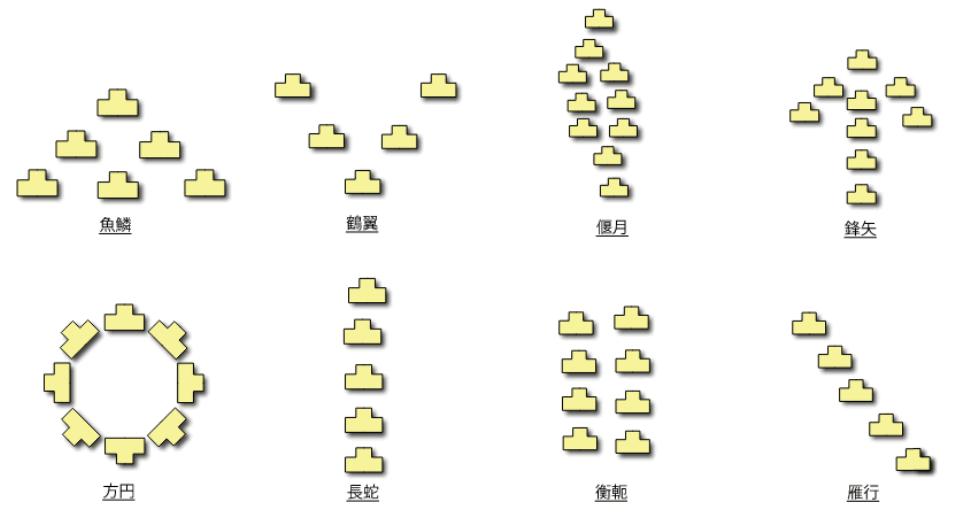
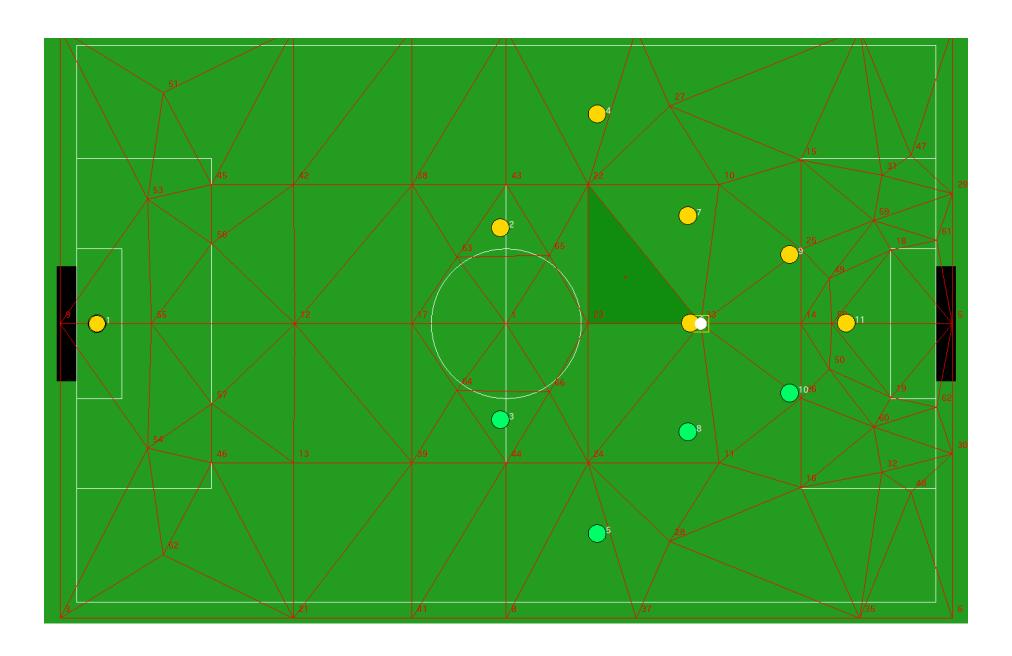
The representative battle formation in Japan is the Takeda Hachijin formation. The formation is composed of eight types, Gyorin (魚鱗), Kakuyoku (鶴翼), Engetu (偃月), Houshi (鋒矢), Houen (方円), Chouda (長蛇), Kouyaku (衡軛) and Gankou (雁行) (Figure 1). This time, we created a Gyorin formation with reference to Gyorin (魚鱗) (Figure 2).
Gyorin, which literally means "fish scales", is a formation in which the center protrudes forward and both wings recede. Gyorin maintains the overall defense performance, while keeping the mobility of each small unit, consisting of a certain number of people. It is said in history that Shingen Takeda used the Gyorin formation to defeat Ieyasu Tokugawa in the battle of Mikatahara. At the Rugby World Cup 2019, the platoon All Blacks took in the pre-game performance resembled a platoon of Gyorin.
2.2 Test method and results
Jyo_sen2019 takes an offense position when an ally team member is closer to the ball than an opponent team member by two or more cycles. Also, it takes a defense position when the opponent team member is closer to the ball than one of its own team members by two or more cycles. When neither of two applies, it takes a normal position.
In the offense positions and normal positions, four types of formations are set: "of4231.conf", "of433.conf", "of442.conf" and "Gyorin.conf". In the defense position, "df433.conf" is commonly used. Jyo_sen2019 and agent2d (release 3.1.1) played 300 matches, and the following results were obtained (Table 1).
Table 1. Performance by formation
| Formation | Won | Lost | Draw | Win rate | Jyo_sen 2019 | Agent2d | Goal Difference |
|---|---|---|---|---|---|---|---|
| 4-2-3-1 | 204 | 45 | 51 | 0.82 | 3.12 | 1.58 | 1.54 |
| 4-3-3 | 200 | 53 | 47 | 0.79 | 3.28 | 1.85 | 1.43 |
| 4-4-2 | 152 | 77 | 71 | 0.66 | 2.16 | 1.60 | 0.56 |
| Gyorin | 176 | 75 | 49 | 0.70 | 2.72 | 1.83 | 0.89 |
The best win rate was observed with 4-2-3-1 formation, followed by 4-3-3, Gyorin, and 4-4-2. It is thought that 4231 and 433 are strong because of the balance between offense and defense. 442 is weakest because it is too defensive and scored poorly. Gyorin was the third despite the fact it was one of the best formations in battle fields. Gyorin formation may not be very efficient in soccer because in a battle field, people and horses move with their feet and approach the opponent's general, whereas in soccer the team approaches the opponent's goal mainly with passes.
3 cszp
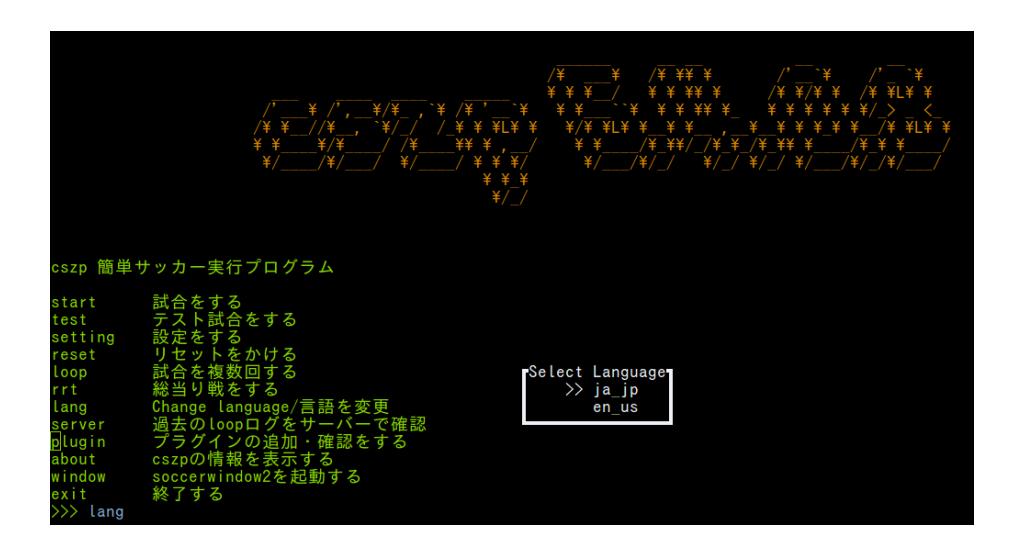
A dedicated program is required to run hundreds of tests. Therefore, we have developed a program called cszp to perform tests easily (Figure 3). cszp was developed by a junior high school member of the team .
The program is CUI based and supports two languages: Japanese and English. When loop mode is selected on the start screen and the number of games and server arguments are input, the test starts, and data such as game time, team name, score, goal loss, and score difference can be output in CSV file. It also supports sync mode [7].
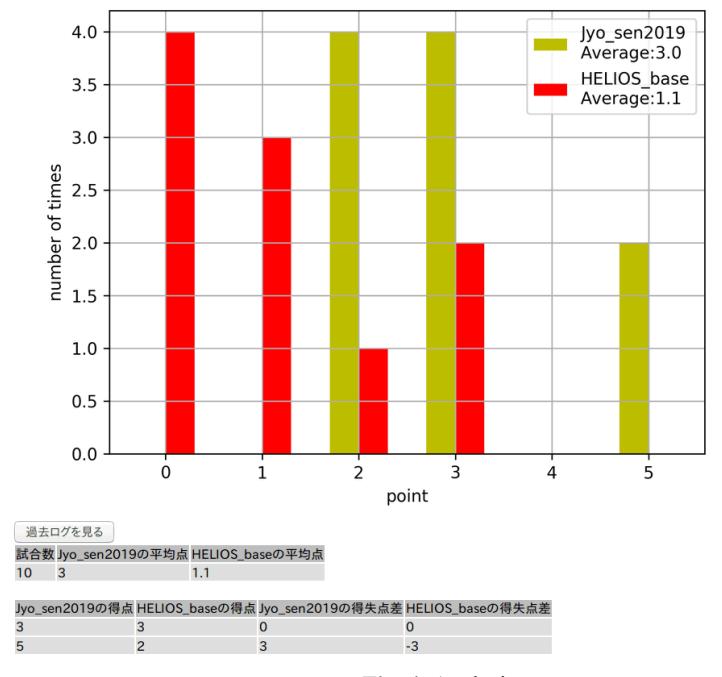
The data in the CSV file can be analyzed using a browser during test execution (Figure 4). You can also view the past log after the test by selecting server mode on the start screen [8]. At the time of writing, cszp was 5.4.0, but we will continue to update it to make it easier to use.
GitHub: https://github.com/kumitatepazuru/cszp
4 Future Works
We plan to learn AI by incorporating the following automation technologies and machine learning [9].
- Construction of automatic parameters tuning system
- Make some agent2d features (Dribble, etc.) a learning base, such as reinforcement learning
References
- Hidehisa Akiyama, Tomoharu Nakashima, "HELIOS Base: An Open Source Package for the Robocup Soccer 2D Simulation", RoboCup 2013: Robot World CupXVII, pp. 528-535, 2014.
- Hidehisa AKIYAMA, "Online Tactics Planning using Action Sequence Search", JSAI Technical Report SIG-Challenge-B101-6, pp. 23-28
- M. Prokopenko, P. Wang, Gliders2d: Source Code Base for RoboCup 2D Soccer Simulation League, RoboCup 2019: Robot World Cup XXIII, to appear;also: arXiv:1812.10202 (2018).
- M. Prokopenko, P. Wang, "Fractals2019: Combinatorial Optimisation with Dynamic Constraint Annealing", RoboCup 2019: Robot World Cup XXIII, (Champion paper), to appear; also: arXiv:1909.01788 (2019).
- Taiga Ito, Junichiro Iseki, Norikazu Sato, Yuki Arimura, Norifumi Watanabe, Takashi Omori, "Team HillStone2019 in the 2DSimulation League Team Description Paper", in Robocup 2019, Sydney, Australia,2019
- super-crack https://super-crack.com/
- Ryota Kuga, Yudai Suzuki, Tomoharu Nakashima, ''Development of a Performance-Evaluation System for RoboCup Soccer Simulation 2D,'' Proc. of 36th JSAI SIG-SAI, 7 pages, 2019 (in Japanese)
- An Ohori, Takuya Fukushima, Tomoharu Nakashima, Hidehisa Akiyama," LogAnalyzer3: Log Analysis Tool for RoboCup Soccer Simulation 2D", 34th Fuzzy System Symposium Lecture Paper Collection, pp. 109-110
- RYO TAGAWA, HARUKAZU IGARASHI, "Reinforcement Learning of State Evaluation Functions in Soccer Agents", the 20th Game Programming Workshop 2015, pp. 78-83