HELIOS2022: Team Description Paper
Hidehisa Akiyama, Tomoharu Nakashima, Kyo Hatakeyama
Okayama University of Science, Okayama, Japan; Osaka Metropolitan University, Osaka, Japan
https://github.com/helios-base · https://github.com/opusymcomp/loganalyzer3
Abstract This team description paper introduces the overview of the previous works and the recent research themes of Team HELIOS2022. The team has been continuously developing the method to dynamically adapt the team strategy according to the opponent. In order to assess the effect of the adaptation, we investigated the influence of the team name on the game result from the game log. The result of the numerical experiments shows there is the significant difference by using Anonymous mode.
1 Introduction
Team HELIOS2022 has participated in the RoboCup competition since 2000, and has won four championships [1]. The team has never failed to be one of the top four teams since the year 2005.
One of our recent research topics is an analysis of soccer games. In the soccer simulation league, it is becoming more important to change the team strategy and players' behaviors according to the opponent. The contribution described in this paper is an analysis of the influence of the team name on the game result from the game log.
2 Previous Works
We have released a part of our team's source codes and their related debugging tools in order to help new teams to participate in the competitions and to start the research of multiagent systems [2]. Currently, the released software packages are available at our project site (https://github.com/helios-base). We have proposed two important methods for developing a (simulated) robotic soccer team, a formation model using triangulation [3] and a framework of action sequence planning [4]. These methods have already been implemented in the released software so that it allows us to develop a working simulated soccer team effortlessly.
Acquiring an effective evaluation function for action sequence planning is still a problem to be solved. We are trying to apply some machine learning methods for this problem [5,7]. As an application of evaluation function research, we also developed an automatic cheering system [11]. The game analysis is also an important topic related to the evaluation function modeling. We have proposed several analysis methods using the information of kicking action distribution in the game [9,10]. In order to realize a quantitative evaluation, we have also developed a team evaluation system [6] and a log analysis tool (https://github.com/opusymcomp/loganalyzer3).
3.1 Changing Team Strategy According to Opponent Team Names
In the RoboCup soccer simulation 2D league, almost all teams have developed their own strategies while there seem to be a few teams that has specialized strategies to some particular teams. Our team has also been trying to adopt the strategy according to the specific opponent strategy [8].
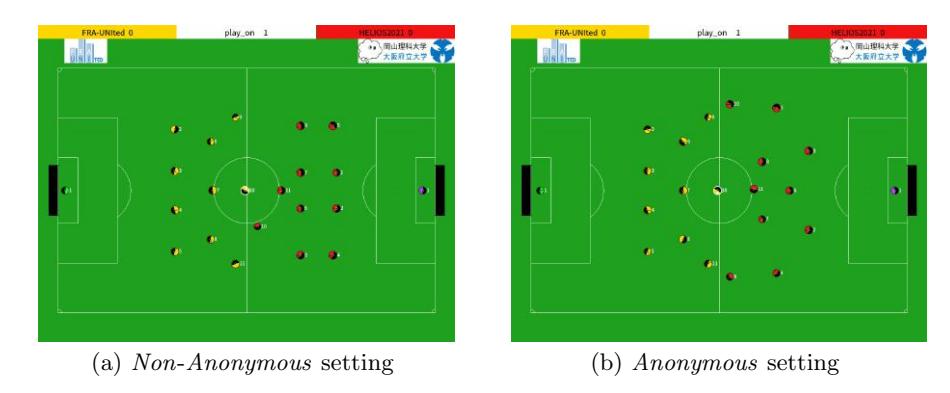
For example, Fig. 1 shows the difference of formations before the start of the game in the same matchup. Our team is the right side one. In the left of the figure (Fig. 3.1(a)), both teams know their opponent teams. That is, the information of the opponent's team name is known before the game starts. On the other hand, the right figure (Fig. 3.1(b)) shows the kickoff formation when the information on their opponent team (i.e., team names of each other's opponent) was not allowed to be sent to both teams. As shown in the figures, our team obviously changes the formation only by the name of the opponent team. This indicates that our team has a specialized strategy to a particular team. Because the specialized team strategies indicate that the phase of team development is shifting to the second way, investigation into this will give us some information on the progress in this league in terms of team development.
3.2 Numerical Experiments
In order to assess the effect of team names on the team strategy, we conducted numerical experiments described below. At first, we investigate the difference in team performance between Anonymous and Non-Anonymous settings. Then, the team strategies are analyzed in more details to discuss the difference in the players' behaviour between the two modes.
We have collected the binaries of the top 13 teams in RoboCup 2021. The teams played round-robin games 1000 times. This process was applied to in both cases of Anonymous mode and Non-Anonymous mode.
Difference in Winning Rate
In the first experiment, we investigated if there is any difference for a team in winning rates between Anonymous and Non-Anonymous modes. In order to see whether teams change strategy according to opponent team name or not, the difference in winning rates between Anonymous and Non-Anonymous modes are calculated for each team. Tab. 1 shows the total average point and the rank of the team in this experiment. The points of some teams have increased or decreased by 1.0 or more. Although the fluctuation of the ranking is small, it is considered that there is a difference in terms of points.
Table 1. Total average point (rank) in 1000 games.
| Team | Non-Anonymous | Anonymous |
|---|---|---|
| CYRUS | 26.047 (3) | 26.219 (3) |
| HELIOS2021 | 32.188 (1) | 32.281 (1) |
| YuShan2021 | 27.812 (2) | 26.781 (2) |
| HfutEngine2021 | 16.656 (7) | 16.281 (7) |
| Alice2021 | 24.391 (4) | 25.500 (4) |
| Oxsy | 21.688 (5) | 18.656 (6) |
| RoboCIn | 12.938 (9) | 12.977 (9) |
| FRA-UNIted | 17.375 (6) | 19.219 (5) |
| Jyo sen2021 | 9.102 (10) | 9.039 (10) |
| MT2021 | 14.023 (8) | 14.117 (8) |
| ITAndroids | 4.820 (13) | 5.207 (13) |
| Persepolis | 7.453 (11) | 7.695 (11) |
| ARAS | 6.227 (12) | 6.188 (12) |
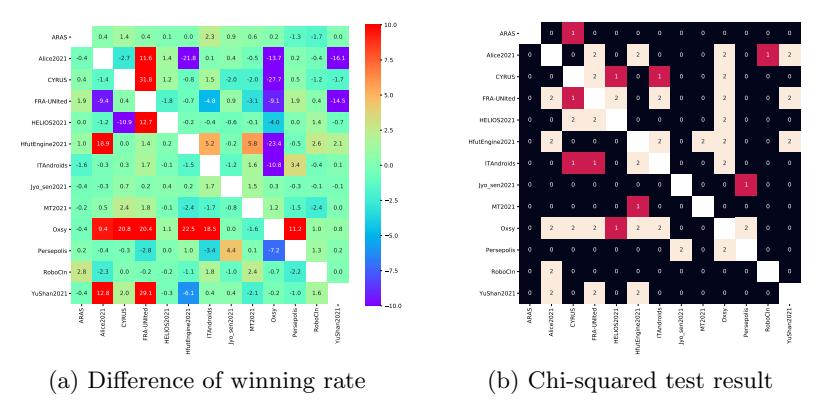
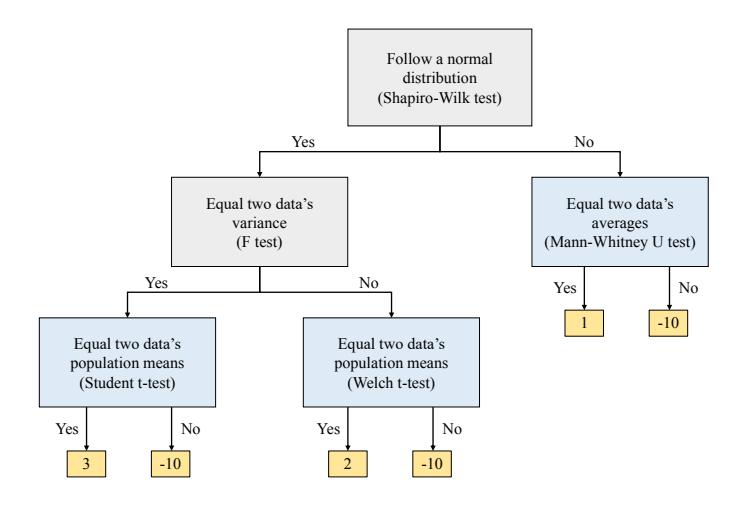
The significance of the differences in the team strategies was checked by using Chi-squared test. The test was conducted in two rounds. In the first round of the test, we used two indices that the number of winning and the others. Second, we used three indices: The number of wins, draws, and losses. If both tests proved that the difference is significant, Point 1 is given to the team. If the significant difference is proved only from one of the two tests, the point 0.5 is given. If neither of the two tests recognize any significant difference, no point is given (i.e., the point is zero).
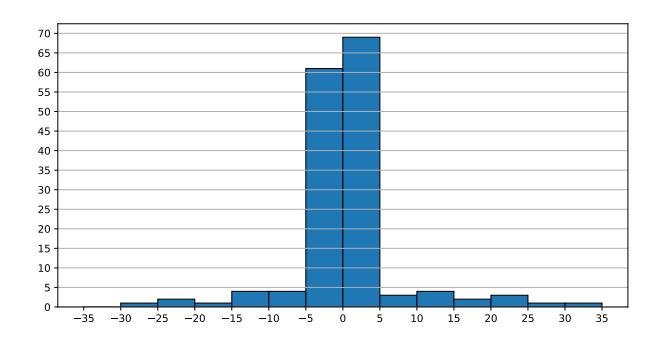
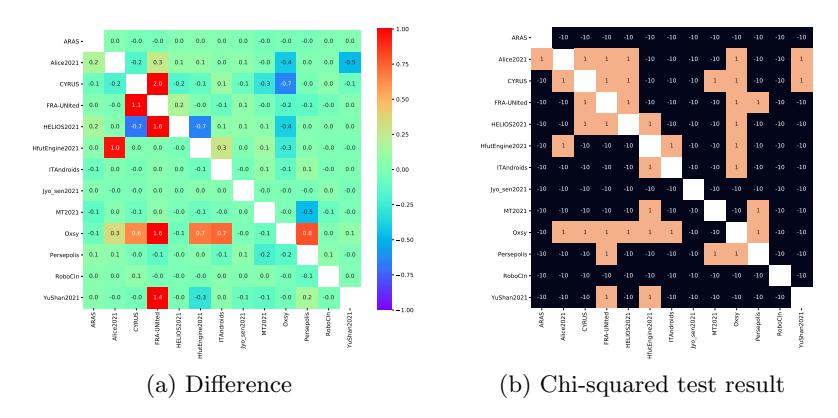
Fig. 2 shows the difference in the winning rates. Most of the differences in the winning rates are less than 5%. However, there are some matches where the difference was tested significant.
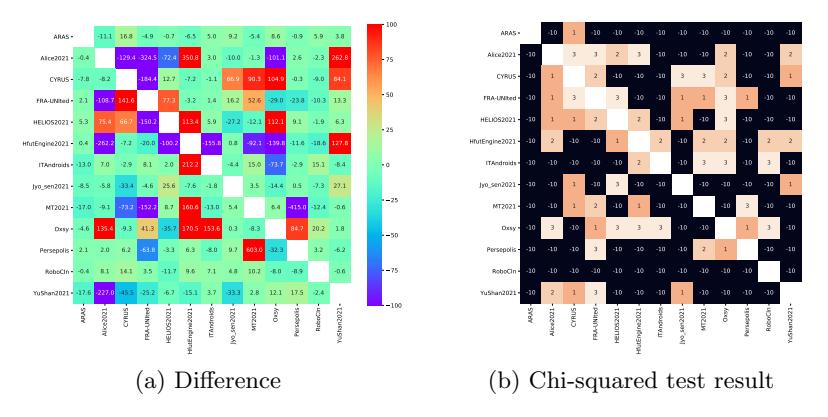
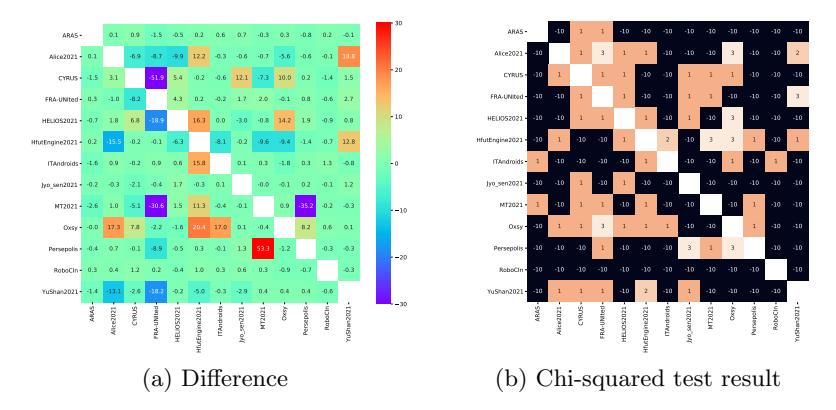
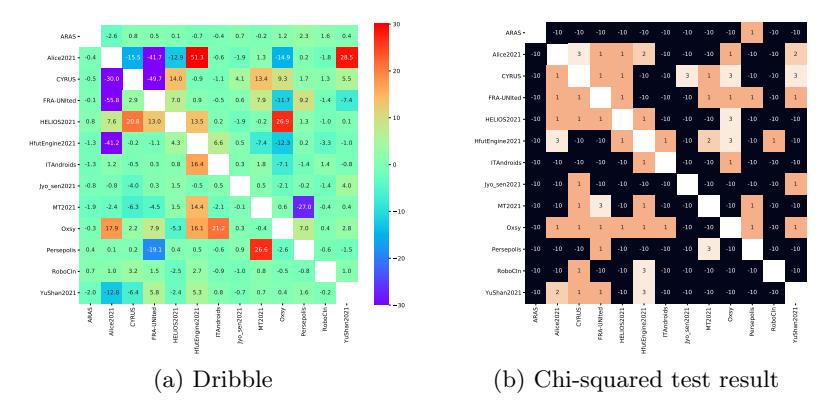
Fig. 3 shows heat maps of winning rate and the result of Chi-squared test. The value represents the winning rates of the teams in a row against the teams in a column. This means that if the larger the positive value is, the stronger the corresponding team is, and if the smaller the negative value is, the weaker the corresponding team is in the Non-Anonymous mode. On the other hands, if the value near 0, there is not much difference between Anonymous and Non-Anonymous . Regarding same matchups whose difference of winning rate is more several percent: We found that Chi-squared test decided that there is a difference in such frequency of result.
3.3 Experiment Conclusion
Our numerical experiments focused on the effect of team name on the team strategies. It seems that some teams take more advantageous strategy according to their opponent teams. However, we could not find how such strategy change was realized. Thus, we hope we get more detail on those parameters that are related to the weakness of the opponent teams.
In this paper, the Anonymous mode was employed where both teams do not know their opponent team name. However, in this setting, it is difficult to confirm if only one team changed its strategy or both teams changed their ones. It is necessary to conduct this anonymous aspect only for one side of the team while the other side of the team knows its opponent team name.
4 Conclusion
This paper described the previous efforts and the current research topics of team HELIOS2022. We examined that the winning rate changed between Anonymous and Non-Anonymous in the simulated soccer games. Furthermore, we examined the difference of several characteristics using the Chi-squared test. The result showed that there are significant differences in some characteristics if there is a difference in the winning rate.
References
- Hidehisa Akiyama, Tomoharu Nakashima, "HELIOS2018: RoboCup 2018 Soccer Simulation 2D League Champion", RoboCup 2018: Robot Soccer World Cup XVII, pp. 18–22, 2018.
- Hidehisa Akiyama, Tomoharu Nakashima, "HELIOS Base: An Open Source Package for the Robocup Soccer 2D Simulation", RoboCup 2013: Robot World Cup XVII., pp. 528–535, 2014.
- Hidehisa Akiyama, Itsuki Noda, "Multi-Agent Positioning Mechanism in the Dynamic Environment", RoboCup 2007: Robot Soccer World Cup XI, pp. 377–384, 2008.
- Hidehisa Akiyama, Shigeto Aramaki, Tomoharu Nakashima, "Online Cooperative Behavior Planning using a Tree Search Method in the RoboCup Soccer Simulation", Proc. of 4th IEEE international Conference on Intelligent Networking and Collaborative Systems (INCoS), pp. 170-177, 2012.
- Hidehisa Akiyama, Masashi Fukuyado, Toshihiro Gochou, Shigeto Aramaki, "Learning Evaluation Function for RoboCup Soccer Simulation using Humans' Choice", Proceedings of SCIS & ISIS 2018, 2018.
- Ryota Kuga, Yudai Suzuki, Tomoharu Nakashima, ""n Automatic Team Evaluation System for RoboCup Soccer Simulation 2D", 2020 Joint 11th International Conference on Soft Computing and Intelligent Systems and 21st International Symposium on Advanced Intelligent Systems (SCIS-ISIS), pp. 1–4, 2020.
- Takuya Fukushima, Tomoharu Nakashima, Hidehisa Akiyama, "Evaluation-function modeling with multi-layered perceptron for RoboCup soccer 2D simulation", Artificial Life and Robotics, Vol. 25, issue 3, pp.440–445, 2020.
- Takuya Fukushima, Tomoharu Nakashima, Hidehisa Akiyama, "Online Opponent Formation Identification Based on Position Information", RoboCup 2017: Robot World Cup XXI., pp. 241–251, 2018.
- Jiarun Zhong, Tomoharu Nakashima, Hidehisa Akiyama, "A Study on the Analysis of Soccer Games Using Distributed Representation of Actions and Players", ICIC Express Letters, Vol. 13, No. 4, pp. 303–310, 2019.
- Takuya Fukushima, Tomoharu Nakashima, Hidehisa Akiyama, "Similarity Analysis of Action Trajectories Based on Kick Distributions", RoboCup 2019: Robot World Cup XXIII, pp. 58–70, 2019.
- Yudai Suzuki, Takuya Fukushima, Lea Thibout, Tomoharu Nakashima, Hidehisa Akiyama, "Game-Watching Should be More Entertaining: Real-Time Application of Field-Situation Prediction to a Soccer Monitor", RoboCup 2019: Robot World Cup XXIII, pp 439–447, 2019.