Hades2D soccer2D simulation Team Description paper
Sana Esmaelifar, Seyedeh Raha Rokni, Sama Esmaelifar, Fatemeh Akhondi, Adrina Rajabi, Rozhina Pourmoghaddam
Farzanegan 7 High School, Tehran Province, Tehran, South Golafshan, Iran; Farzanegan 1 High School, Tehran Province, Tehran, Sarparast St, No. 56, Iran; University of Tehran, Iran
Abstract This paper includes the description of implemented algorithms by Hades2D team members. We tried to improve individual player offensive skills and team offensive strategies by improving the agent's main actions; pass, dribble and shoot. Also, we worked on the players to become cohesive in the targeted defense areas. In addition, This year we came up with solutions to team deficiencies' challenges we had in previous years. Finally, we look over the results of these developments. Our team has made changes that is include improvements such as our average number of goals against the base of 9 goals per game.
1 Introduction
RoboCup is an international scientific initiative to advance the state of the art of intelligent robots. When established in 1997, the original mission was to field a team of robots capable of winning against the human soccer World Cup champions by 2050. The soccer2D simulation league is one of the first robotics leagues.
Hades2D soccer simulation team members have been working on improving Base Agent algorithms for three years (previously under the name of Andromeda). We started coding on staterAgent [1]. The starterAgent base of Agent2D [2] or HeliosBase base had been simplified for students to use.Hades2D team participated in the IranOpen2020, JapanOpen2020, and RoboCup2021. We won 2nd place in international competitions of the IranOpen2021 and JuniorCup2021. In this article, first, we'll describe our strategies. Then in the Conclusion section, we'll analyze the team's improvements with these changes, and in the end, in the future ideas, we'll talk about some of the challenges we faced.
2 Related work
Here is a brief description of the articles published by other 2D teams that helped us develop new ideas.
YuShan2021 [3] decrease the gap between themself and the other strong teams in shooting, passing, formation, and physical strength by adjusting the tactical strategy of the team in time and improving the performance of the team's attack, defense, and stability in passing and receiving the ball. Perspolis [4]used a new method for determining the execution point based on the scoring method. HfutEngine [5]also simulated a different attacking environment by setting agents at non-identical points on the field. HELIOS2021 [6]proposed two methods for developing a (simulated) robotic soccer team, a formation model using triangulation and a framework of action sequence planning. Cyrus [7] [8] [9], champion of 2021, used a table generator to take action from the chain action module. They also predicted the behavior of agents with ball possession in 2018. Furthermore, in 2019, they utilized Defensive Decision Making by using Deep Reinforcement Learning. Cyrus also predicted a pass by using Deep Neural Network since 2021.
3 Defense
(See subsections below)
3.1 Mark
For defensive, we assign a role to each player. In critical situations, we cover vulnerable areas with two extra players. Each player target an opponent player to defend. Then we analyze the distance of opponents from our goal and the density of teammates around them to see how critical the situation is. Considering the opponent's risk, we place some players between the opponents and the goal to decrease the chance of losing score.
3.2 Position
The position of players during the game has a considerable impact on strategies efficiency. To solve this challenge, we examined several cases and various positionings. Finally, we chose two different methods. We move between them based on whether we are the loser team or the winner team.
The idea for our first algorithm comes from one of the ThunderLeague team strategies described in their last year's TDP [10].
The first method, which is used when we are in the winning or equal situation, is using dynamic formations based on the Delaunay triangle. In case of starting a counter-attack, as there is no need to defend heavily, our defender players choose offensive positions considering the distance from the opponent's goal. As they are no longer in charge of defense, players can save more stamina and use it to reach their offensive positions faster.
The second method, which is used when we are in alosing situation, is concentrating on areas where the opponent's attackers are most likely to show up. Last year, the Yushan team shared some analyzes about risky offensive areas in their TDP [3]. Based on these analyzes, we assign players to each area in the field.
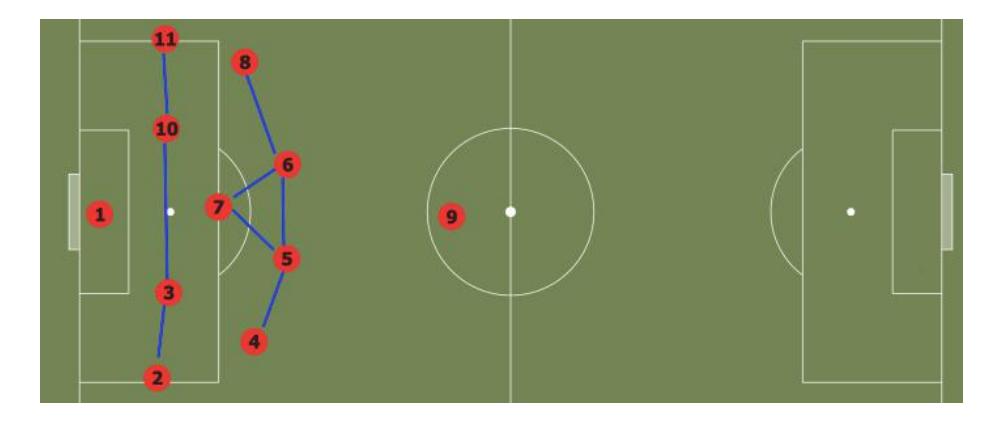
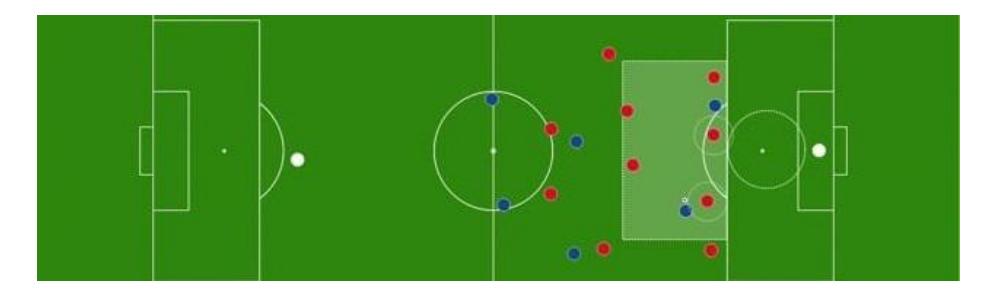
In this case, our team's possession of the ball will be decreased, but because the players have become cohesive in the targeted defensive areas, they'll be able to resist the attacks better. We defined the layout of our team as low block 4-1-4-1 (Shown in Fig.1). The player chooses one of the three tasks defined for it (Defending the ball owner, defending the risky players, being wingers), based on some parameters. These parameters include the position of the player who owns the ball, the position of our players and the opponent players, the position of the goal and the goalie, the amount of energy left by the players, etc. This method increase defense density in zone14 (Shown in Fig.2), which decreases the number of lost scores.
This strategy is not finalized yet as we have some difficulties recognizing the game mode.
4 offense
Our team mainly focused on desicion making, leaving the shooting and passing methods similar to the last year. The changes we made in the shooting, dribbling and passing over the past two years, have led to significant improvements in the number of goals and the total win count against the baseAgent code, as mentioned in our last year's TDP [11].
4.1 Dribble
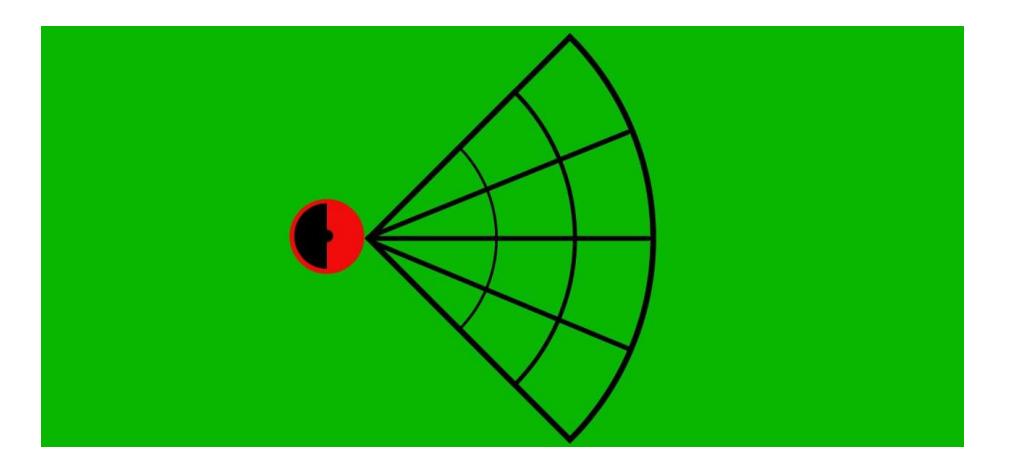
To improve our last year's algorithms, we changed the dribbling strategy. In our new dribble, the player aims to find the best region in the field for generating potential dribble points. To detect this region, the player considers different sectors (These sectors are based on dividing the viewing angle into six parts and removing the two side parts as you can see in the Fig.3), then splits each sector into three areas based on distance from the player. The areas then are rated based on opponents' count in them and the chance of finding a suitable partner to receive the following cycles' pass. Finally, the player chooses the area with the best score.
5 Conclusion
This paper described the previous efforts and the current research topics of the Hades2D team. We implemented a series of computational experiments to show the effectiveness of the positioning changes. In addition, we presented a system to evaluate the team's performance about the pass. In the end, defense algorithms made it possible for us to choose the proper positioning against the attack of the opponent players. You can see all these changes results in 100 games of our team with the base.
Table 1. In this table, you can observe the improvements, analyzed by Autotestt [12] in 100 games
| Name | Hades2D base code | |
|---|---|---|
| Goals | 912 | 17 |
| Points | 300 | 0 |
| Avg Goals 9.12 | 0.17 | |
| Avg Points 3.00 | 0.00 |
6 Future ideas
Our team is currently working on several algorithms. Some of these algorithms are as follows
- Find a way to eliminate player confusion while choosing the most appropriate position.
- Improving goalie's decision-making when the ball has been caught.
- Analyzing the general behavior of the goalie and locating it
References
- N. Zare, "StarterAgent2D," [Online]. Available:https://github.com/naderzare/StarterAgent2D.
- Hidehisa Akiyama, and Tomoharu Nakashima, "HELIOS2012: RoboCup 2012 Soccer Simulation2D League Champion," In Robot Soccer World Cup 2013 Jun 24 (pp. 528-535). Berlin, Heidelberg. 2013.
- Zekai Cheng, Jinbo Guo, Feng Zhang, Bolun Guan, Chenjun Pin, and Liting Wang, "YuShan2021 Team Description Paper for RoboCup2021,"In RoboCup 2021 Symposium and Competitions, Worldwide. 2021.
- Morteza Noohpisheh, Maryam Shekarriz, Fatemeh Zaremehrjardi, Farnaz Khademi Ardekani, and Seyedeh Afsoon Khorsand, "Persepolis Soccer 2D Simulation Team Description Paper 2021," In RoboCup 2021 Symposium and Competitions, Worldwide. 2021.
- Wang junyang, Cao Mingkuan, Wang Hao and Fang Baof, "HfutEngine2021Team Description Paper," In RoboCup 2021 Symposium and Competitions, Worldwide. 2021.
- Masaki Yamaguchi, Ryota Kuga, Hiroki Omori, Takuya Fukushima, Tomoharu Nakashima, and Hidehisa Akiyama, "HELIOS2021: Team Description Paper," In RoboCup 2021 Symposium and Competitions, Worldwide. 2021.
- Nader Zare, Aref Sayareh, Mahtab Sarvmaili, Omid Amini, Amılcar Soares, and Stan Matwin, "CYRUS Soccer Simulation 2D Team Description Paper 2021,"In RoboCup 2021 Symposium and Competitions, Worldwide. 2021.
- Nader Zare, Mohsen Sadeghipour, Ashkan Keshavarzi, Mahtab Sarvmaili, Amin Nikanjam, Reza Aghayari, Arad Firouzkoohi, Mohammad Abolnejad, Sina Elahimanesh, and Amin AkhgariZare,"Cyrus 2D Simulation Team Description Paper2018," In RoboCup 2018, Montreal, Canada.2018.
- Nader Zare, Aref Sayareh, Mahtab Sarvmaili, Omid Amini, Amılcar Soares, and Stan Matwin, "Engineering Features to Improve Pass Prediction in 2D Soccer Simulation Games," In RoboCup 2021 Robot World Cup XXIV.2021.
- Caio de Souza Barbosa Costa, Giovanni Cabral Morales, Antonio Lago Ara´ujo Seixas, Gabriel Cosme, Lucas Pavan, Maria Fernanda Fernandes Rezende, and Ricardo Tamay Honda,"ThunderLeague: Team Description Paper 2021,"In RoboCup 2021 Symposium and Competitions, Worldwide. 2021.
- Fatemeh Akhondi, Sama Esmaelifar, Sana Esmaelifar, Seyedeh Raha Rokni, Adrina Rajabi1, and Ghazal Hasanpour,"Hades2D soccer2D simulation Team Description paper,"In RoboCup 2021 Symposium and Competitions, Worldwide. 2021.
- wrighteagle2d, "autotest2d," [Online]. Available:https://github.com/wrighteagle2d/autotest2d.