Aria 2005 3D Soccer Simulation Team Description
Hesam Montazeri, Ahmad Nickabadi, Sayyed Ali Rokni Dezfouli, Mojtaba Solgi, Hamid Reza Baghi, Omid Mola, Sajjad Moradi
Amirkabir University of Technology P.O. Box 15875-4413, Tehran, Iran
Abstract This paper shortly describes the main strategies and methods that was used in Aria3d 2004 Soccer Simulation team. It also addresses important features and improvements that are going to be in Aria3d 2005. First, we describe the agent's localization methods implemented in the team and those are under implementation. Next, we focus on the method that is used in Aria3d 2004 for developing an environmental model and prediction of the results of agent's actions. The applications of this method that will be used for developing world model of the Aria3d 2005 team are then mentioned.
1 Introduction
Aria3d Soccer Simulation team developed by a group of B.S. students of Amirkabir University of Technology. The team participated in Robocup 2004 and won the first place in the first year of 3D competition. Previously our 2D team placed 7th in Robocup 2003 in Padova. Aria 2005 Soccer Simulation 3D team is heavily based on the architecture of Aria 2004 3D team. We developed a layered architecture. This architecture is organized such that in each release of server we can apply the changes to this architecture, easily[1].
We used an observational method to capture environmental parameters (e.g. field friction and air drag) and model the effect of agents actions. World model uses these parameters and messages received from server to predict agent and ball's movement. Currently, we are working on applying reinforcement learning to improve the low-level skills. We also are working to apply a more improved method (Particle filtering [2]) for localization instead of current one.
2 Localization
The localization of our agents is based only on the vision perceptions about the flags that the agent receives from the server in each cycle. Because the agent has a 360 degrees view of the field and no direction, the agent's location can be computed using relative position of only one flag. However, because the agent percepts each flag with different amount of noise in each cycle (server generates noise for each flag independently), we used all 8 flags information to minimize the noise of localization. Using this method, the average error decreased to 3cm in x-axis and 4cm in y-axis.
We used this simple method of localizing in the first year. In Aria3D 2005 we're implementing Particle filtering, one of the more improved methods on localization, to decrease the amount of localization error. This method previously used successfully in [2] and [3] in 2D Soccer Simulation. It considers both current vision percept of agent and its previous states and actions. The method needs the world model to predict the effect of actions, which is described in the following section.
3 Environment Modeling
Knowing the result of its actions in the environment, in which it lives, is a basic requirement for an agent to be rational. We used an observational method for collecting information about the environment and effects of an agent's actions. Here, we describe our method used for finding the effects of drive action on the environment and the agent itself.
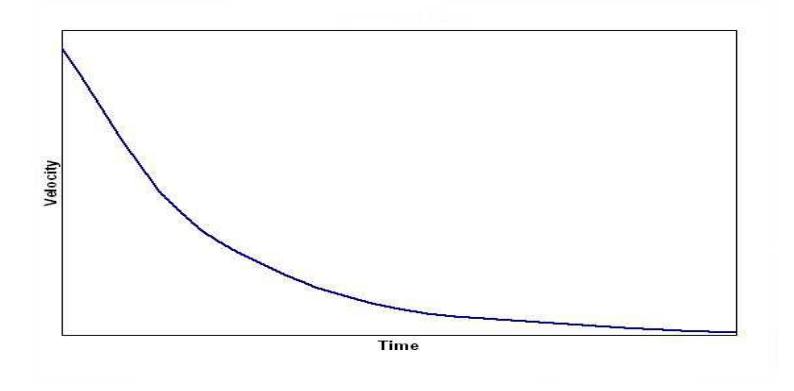
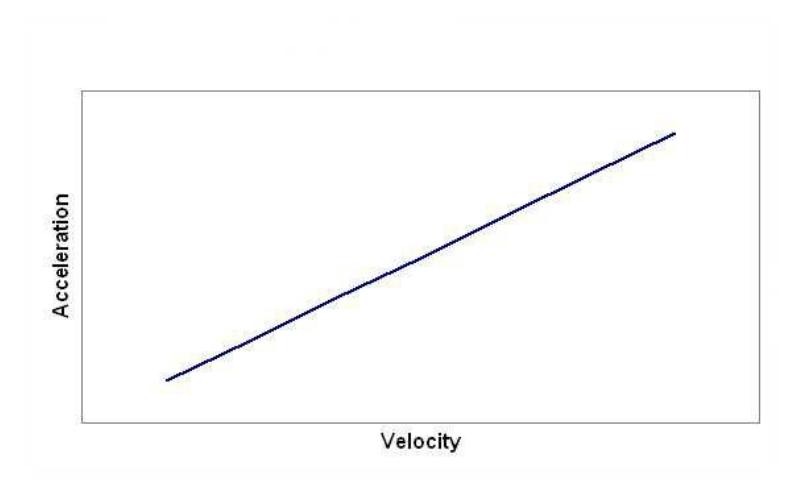
Two factors affect the agents movement in the field, drive as a positive factor for movement and friction (including field friction and air drag) as a negative one. First, to capture the effects of the friction on the movement we drove the agent with power 100 (maximum power) in a constant direction, until we assured that the agent reached the maximum possible velocity ¹. Then we removed the drive by sending drive(0,0,0) to the server. Observing the movement of the agent, we obtained the graphs in Fig. 1 and Fig. 2 for the effect of friction on the agent's velocity and acceleration.
Using math tools and graphs, we approximated agent acceleration as a function of velocity (when friction is the only force applied to the agent) and we discovered that this function is linear.
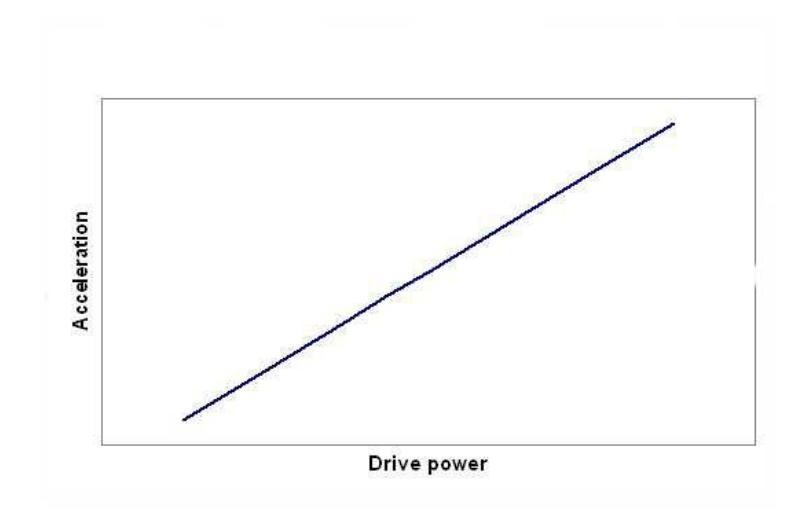
After that, to observe the effect of drive action we drove the agent with different constant powers and logged the accurate velocity of the agent in specific time fractions. You can see the results in Fig. 3.
As it can be seen in Fig. 3 the effect of drive power to agent acceleration is also linear. To sum up, we drew the conclusion that an agent's acceleration is a function of power of the drive by which the agent is moving and the agent's speed (length of the velocity vector). There are also some constant numbers in the acceleration equation. Knowing power of the drive and its current velocity, we can simply predict agent's position and velocity in next simulation cycles, just by some kinematics computations.
In Aria 2005 3D team, we are using these predictions to minimize the effect of sense and action latency of server.
¹ For testing purposes we changed some parts of the soccer server. we set action latency and sense latency [4] to zero and removed the noise of the sense messages such that our test agent always get accurate visions and it's actions is applied by server without any delay.
4 Conclusion
In this paper, we described a few aspects of our current team. We addressed the way we implemented the world model and prediction functions. In addition, the method used for localization is described. We think the 3D soccer simulation league is a good opportunity to port the ideas in Soccer 2D to a more complex environment and present new ideas.
References
- Sayyed Ali Rokni Dezfouli, Hamid Reza Baghi, Amir Ghaderi, Omid Mola, Vahid Kazempour, Mojtaba Solgi, Saeed Akhondian, Hesam Montazeri, Ahmad Nickabadi, Sajjad Moradi. Aria 2004 3D Soccer Simulation Team Description. Proceeding of Robocup 2004 ,2004
- M. Reidmiller, A. Merke, M. Nickschas, W. Nowak,and D. Withopf. Brainstormers 2003 2D Soccer Simulation Team Description. Proceeding of Robocup 2003
- Remco de Boer and Jelle R. Kok. The Incremental Development of a Synthetic Multi-Agent System: The UvA Trilearn 2001 Robotic Soccer Simulation Team. Master's thesis, University of Amsterdam, The Netherlands, February 2002.
- Patrick Riley. SPADES System for Parallel Agent Discrete Event Simulation User's Guide and Refrence Manual. 2003