Borregos Team Description 2005 – 3D
Leonardo Garrido, Carlos Bustamante, Víctor Álvarez
Center for Intelligent Systems Monterrey Institute of Technology and Higher Education
Abstract This paper describes the agent skills developed by Borregos Team, especially player motion, pass control, etc. It also shows the structure of the agents and the strategy of the team. The strategy used is focused on the position of players in the field and the team formation.
1 Introduction
Real-time soccer is a complex game, involving a great deal of coordination between team members and the development of strategies leading to scoring as many goals as possible and receiving as few goals as possible.
Robocup simulated soccer represents that complexity to an acceptable degree of fidelity, meaning that many of the real soccer complexities are present in the simulated soccer as provided by the soccerserver system 3D. Thus, simulated soccer is a challenging problem from the standpoint of coordination, communication with uncertainty, learning, planning, and so on.
Borregos is a new team, which started its activity based on the experience of Borregos-2D in the soccer simulation league at Center for Intelligent Systems, Monterrey Institute of Technology and Higher Education. Borregos-3D is the main topic of our thesis for Master degree. Our goal is to have a research project in Multi-Agent Systems (MAS) and their implementation in simulated environments.
In MAS, the agents are defined in a world model and act autonomously based on the teammates designed goal. Robocup is a great application for this purpose. RoboCup Soccer Simulation is based on SPADES[1]. SPADES is an event based-system, which can be distributed among several machines.
The structure of this paper is to be as follow: Section 2 describes agents' skills, which are now the most fundamental problems in rcssserver3D. Most of the effort has been spent in improving basic skills, especially for the localization of the player, localization of the ball, player motion acceleration control and localization of other objects. Section 3 describes the strategies of the team, the formations of the team, player types and player positioning. Finally, the last section describes future work.
2 Agent Skills
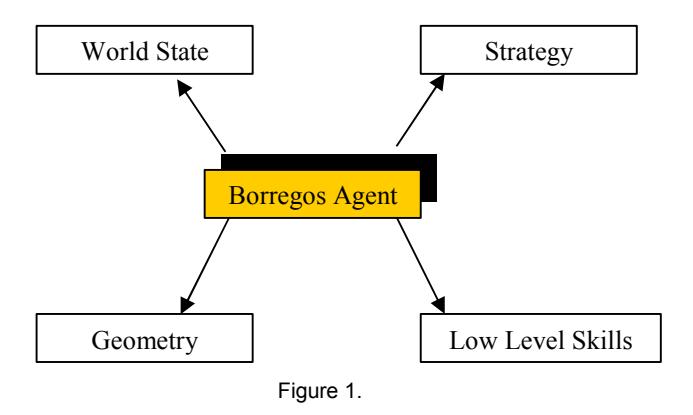
In simulated environments like Robocup, the agents are entities that can sense and act. The skills are an abstraction to low level server commands and should provide the decision layer with high level commands, like drive the player to a certain position. The actual structure of our agents includes 4 modules:
World State Module: is used to keep the agent's world state representation up to date. Information like the position of the ball, the position of the teammates, distances between objects, etc.
Geometry: is used to make the calculations easier during the game, like data concerned with vectors.
Low level Skills: is used to allow the agent to perform basic movements. The basic movements actually implanted are: kick the ball to some point, run player to some place, pass the ball, and try ball intercepting.
Strategy: (See 3)
3 Strategy
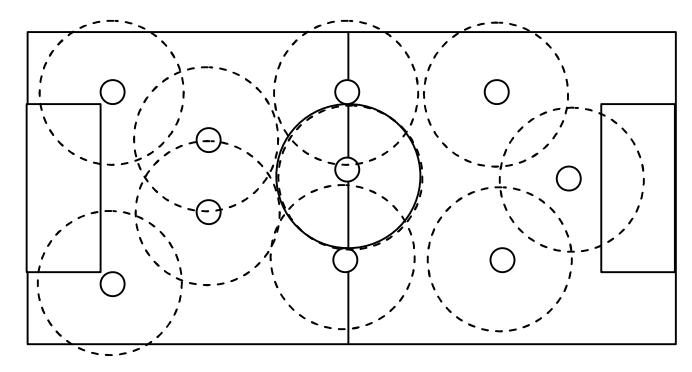
The team needs a general strategy to guide the agents to play better. Our strategy is based in the position of the player and the formation of the team. The strategy of the team is as follow:
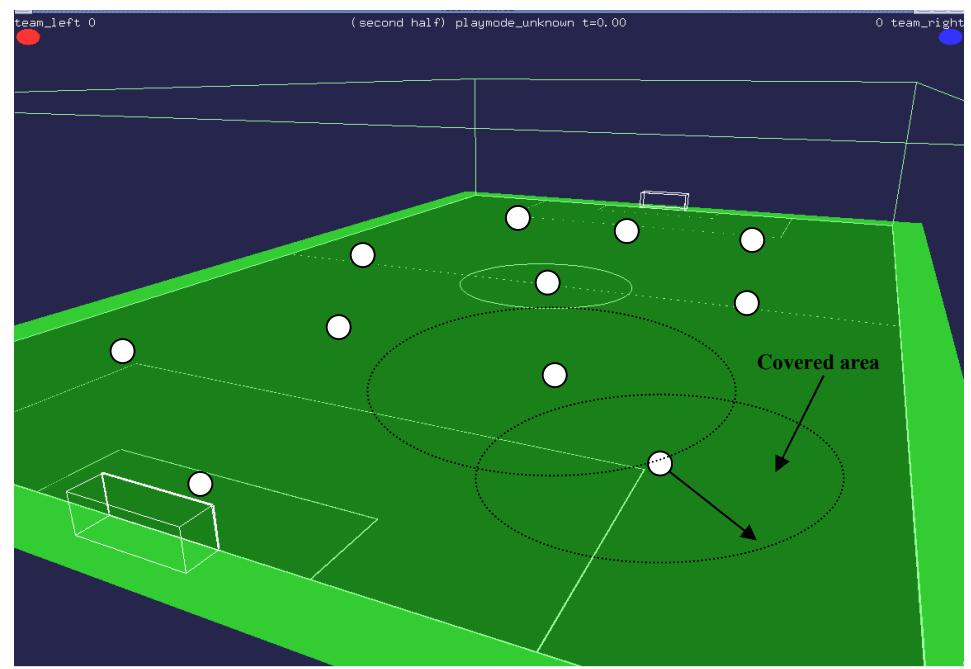
Every agent will be covering a specific area in the field, like show the Figure 2. The objective is that, with certain distribution, every place in the field will be covered by the agents. The player types we are implementing are goalkeeper, defender, midfielder and forwarder.
4 Future work
Improve the agents' skills is one of the most important objective in our project. The second objective is to implement a good decision algorithm and planning too. Other idea that we have is to write an intermediate layer between the Borregos-2D code and the Borregos-3D code.
5 References
References
- Patrick Riley. SPADES system for Parallel Agent Discrete Event Simulation User´s Guide and Reference Manual. 2003. (http://spades-sim.sourceforge.net)